Showing posts with label Athens. Show all posts

WDEC 2026 in Athens

Third Cemetery of Athens. Remembrance Route 1940-1944.
As part of the Week of Discovering European Cemeteries 2026, the Municipality of Athens invites visitors to participate in free guided tours at the First and Third Cemetery of Athens.

Programme

➤ 25 May 2026 | 16:00 – 17:30 | First Cemetery of Athens

Guided walk “The Poets’ Graves — The Greek Language Engraved in Memory”

A special guided walk through the graves of poets and writers at the First Cemetery of Athens, where literature encounters public memory and funerary inscriptions become precious traces of the Greek language through time.

The tour approaches the cemetery as an open cultural landscape and as a unique “anthology” of inscriptions: from archaic expressions and learned epitaphs to deeply moving dedications, personal testimonies, and even unexpected moments of subtle humour. Through monuments, words, and the stories attached to them, participants will explore the many forms of the Greek language, as well as the different ways society remembers its men and women of letters.

The route presents the graves of important poets and literary figures, the forms and symbolism of their funerary monuments, as well as the stories and “afterlives” associated with their memory and posthumous reputation.

The activity is addressed to secondary education teachers, within the framework of the blended-learning training programme “Teaching Greek Language and Literature in Lower and Upper Secondary Education.”


➤ 24 May 2026 | 17:00 – 18:30 | Third Cemetery of Athens

Guided tour “Remembrance Route 1940–1944”

A guided tour dedicated to the memory of the victims of the Occupation, famine, executions, and war, presented within the framework of the This is Athens City Festival.

The tour explores the historical landscape of the Third Cemetery of Athens and the traces of World War II preserved within it, highlighting the cemetery’s role as a place of collective memory and historical testimony.

More information is available here: This is Athens City Festival – A Remembrance Route for Those Who Didn’t Make It (1940–1944)

Third Cemetery of Athens (Greece)

Third Cemetery of Athens (Greece)
Third Cemetery of Athens, the largest in the Balkans, holds exceptional historical significance as a living testament to the city’s experiences during the turbulent twentieth century.

Cemetery History

The Third Cemetery of Athens was established in 1936 in response to the rapid growth of the Greek capital and the increasing population of western Athens. The surrounding district of Nikaia developed significantly after the Asia Minor Catastrophe, accommodating large numbers of refugees who reshaped the social fabric of the area.

During the Second World War, the cemetery acquired a profound historical role. Beyond functioning as a burial ground, it became a site associated with executions, famine victims, and wartime relief efforts, including children’s soup kitchens. Small mass graves commemorate civilians who died during the famine of 1941–1942 under Nazi Occupation, while other sections contain graves of Allied soldiers as well as Italian and German occupation forces.

In the post-war decades, the cemetery continued to expand as the main burial place for residents of Athens from all social backgrounds. It also became the resting place of important political, cultural, and civic figures, while a dedicated Jewish section — including Holocaust victims — reflects the city’s religious and cultural diversity.

Today, the cemetery remains an active burial site while simultaneously serving as a historical and educational landmark where the past continues to shape collective memory.

Architecture and Landscape

Unlike many historic European cemeteries known for monumental architecture, the Third Cemetery of Athens is defined by simplicity, functionality, and spatial organization. The cemetery is arranged through a clear system of sectors and straight circulation axes that create a coherent network of paths. Different sections correspond to various types of graves and religious communities, reflecting the demographic diversity of Athens.

Funerary monuments are generally modest and focused on family remembrance rather than artistic grandeur. At the same time, memorials of collective historical importance are integrated throughout the cemetery. The central square contains the city’s only National Resistance Monument, erected in the mid-1980s, reinforcing the cemetery’s role as a place of reflection and civic memory. Religious and support buildings, including the Orthodox Churches of the Archangels and the Resurrection, together with the interwar ossuary, are organically integrated into the cemetery’s structure, contributing to spatial coherence.

One of its defining characteristics is its rich natural environment. Mature pine and cypress trees line the avenues and open spaces, creating contemplative areas that form a transition between the dense urban fabric of Athens and the quieter space of remembrance. Despite later expansions, the cemetery’s original spatial organization remains largely intact, allowing visitors to understand its historical evolution through its landscape and layout.

Cemetery Significance

The Third Cemetery of Athens functions as an open-air archive of the city’s twentieth-century history. Its significance lies in the way it preserves the memory of civilian suffering during the Nazi Occupation, the resistance movement, and broader social transformations in modern Greece.

Through mass graves and memorials, the cemetery commemorates famine victims, executed resistance fighters, and ordinary citizens affected by war and repression. Major monuments, such as the Mausoleum of Executed Resistance Fighters connected to Kokkinia and Kaisariani, honor those who defended freedom during one of the darkest periods of Greek history.

At the same time, the cemetery links personal stories to national and European historical memory. Its inclusion in wider European remembrance networks further underlines its cultural importance beyond Greece, positioning it within a broader framework of shared historical consciousness.

Important Personalities and Memorials

The Third Cemetery of Athens hosts graves that embody profound historical, cultural, and civic significance, reflecting the city’s turbulent twentieth-century history. Among these, five stand out for their importance within national and European memory.

  1. Mass Grave of Occupation Victims (1941–1944): A small, modest mass grave commemorating anonymous civilians who died during the famine of 1941–1942 and victims of reprisals linked to local resistance during the Nazi Occupation.
  2. Nikos Belogiannis (1915–1952) and Elli Pappa (1920–2009): Nikos was a prominent member of the Greek Communist Party, internationally known as “the man with the carnation” after holding a red carnation during his political trial and execution in 1952. His partner, Elli, was a writer, journalist, and political activist who played an important role in Greek intellectual and political life. Their tomb reflects themes of political commitment, human rights, and European solidarity.
  3. Iro Konstantopoulou (1927–1944): Iro was a teenage resistance fighter and member of EPON (the United Panhellenic Organization of Youth) who was executed at the age of 17, becoming a symbol of youth resistance during World War II.
  4. Nikolaos Skalkottas (1904–1949): Nikolaos was a pioneering Greek composer who combined Greek folk musical traditions with European modernism and twelve-tone composition techniques, placing Greek music within the European avant-garde.
  5. Jerzy Ivanof-Sainovits (1911–1943): Jerzy was a Polish-Greek athlete and member of the Greek Resistance who carried out sabotage operations against Axis forces during World War II and is remembered for his bravery in both Greece and Poland.

These graves highlight the Third Cemetery as a place where civic memory, cultural heritage, and European historical consciousness meet, offering visitors an intimate encounter with stories of heroism, creativity, and sacrifice.

A Place of Memory and Education

Today, the Third Cemetery of Athens serves as an active space of remembrance, education, and public engagement. Visitors can follow the Remembrance Route 1940–1944, which connects key memorials, graves, and historical sites related to the Occupation and the Resistance.

The cemetery is also regularly used for commemorative ceremonies, wreath-laying events, and educational activities focused on the Second World War and civic memory. Its proximity to other important historical sites, such as the Mantra of Kokkinia and the municipality of Aigaleo, allows it to be integrated into broader historical and educational itineraries across Athens.

By bringing together anonymous victims and nationally significant figures, the cemetery creates a space where personal, urban, and national histories intersect.

Cemetery address

Thivon & Kotyoron,
18454 Nikaia, Athens,
Greece

Basic data

Date of first burial: 1 June 1937
Cemetery area: 28 ha
Approximate number of graves: 27.000
Approximate number of yearly burials: 500

Successful conclusion of the International Conference on Cemetery Studies in Athens

Conference on Cemetery Studies in Athens 2024
From 18 to 20 April, 2024, the International Conference on Cemetery Studies took place at the Harokopio University in Athens, Greece.

The International Conference on Cemetery Studies, organized by the Harokopio University in collaboration with the University of York, both members of ASCE, reached a successful conclusion.

Taking place at Harokopio University from April 18 to 20, 2024, the conference showcased a diverse range of presentations that explored the latest research on cemeteries spanning from the late 18th century to the present day. Scholars from diverse disciplines presented their insights and findings on history, art, culture, anthropology, geography, social studies, and cemetery tourism.

The conference facilitated lively discussions and fostered new collaborations, contributing significantly to the field of cemetery studies.

You can find the event program HERE.

International Conference in Athens 2024: Program

Athens, Greece
The Harokopio University presents you the program of the International Conference on Cemetery Studies, taking place from 18 to 20 April 2024 in Athens, Greece.

About the conference

The International Conference on Cemetery Studies, organized by the Harokopio University in collaboration with the University of York, both members of ASCE, will take place from 18 to 20 April 2024 at the Harokopio University in Athens, Greece.

The event will bring together a wide spread of academics, presenting their latest research findings concerning various aspects of cemeteries (end of 18th century onwards), including history, art and culture, anthropology, geography, social studies, and cemetery tourism.

The guest of honor at the event will be the ASCE president, Mrs Lidija Pliberšek.

Participation at the conference

The conference fee is 30 euros (15 euros for doctoral students). The fee includes a light lunch, refreshments, and a guided tour in the historical cemetery of Athens. 

Conference language: English.

Conference program

You can find the detailed program of the event at this LINK.

International Conference in Athens 2024: Call for paper

First cemetery of Athens
The Harokopio University invites you to participate in the International Conference on Cemetery Studies, taking place from 18 to 20 April 2024 in Athens, Greece.

About the conference

From 18 to 20 April 2024, the International Conference on Cemetery Studies will take place at Harokopio University in Athens, organized by Harokopio University in collaboration with the University of York, both members of ASCE.

The event intends to bring together a wide spread of academics, presenting their latest research findings concerning various aspects of cemeteries (end of 18th century onwards), including history, art and culture, anthropology, geography, social studies and cemetery tourism. Postgraduates and doctoral students are especially welcome.

The guest of honor at the event will be the ASCE president, Mrs Lidija Pliberšek.

The conference fee is 30 euros (15 euros for doctoral students), including light lunch, refreshments and a guided tour in a historical cemetery of Athens. 

IMPORTANT: For all ASCE members who wish to attend the conference (without presentation) there won't be registration fees. The number of places is limited, so please confirm your participation at ioannaparaskevopoulou@yahoo.gr by the end of February.

Conference language: English.

Call for papers

Abstracts of no more than 300 words and a short, 100-word CV (both in word format and in English) should be sent to ioannaparaskevopoulou@yahoo.gr no later than 31 January 2024.

An edited selection of papers from the conference will be published in electronic form (with ISBN).

You can find the entire call for papers HERE.

WDEC 2023 at the First Cemetery of Athens

The First Cemetery of Athens (Athens, Greece)
Take a guided tour or observe the maintenance process of two bronze statues at the First Cemetery of Athens during the WDEC 2023.

28 May 2023: Spend time, walk, observe, feel, and share knowledge

Following the rhythm of the famous Athens City Festival in May, the City of Athens would like to invite you to a guided tour of the First Cemetery of Athens on 28 May 2023, at 17.30, on which we will explore the history and monuments of the most important Athenian open-air museum.

Located in the heart of Athens, just a 15-minute stroll from the Acropolis, the First Cemetery is open to anyone who wants to walk in a beautiful place full of cypresses and towering pines, majestic romantic and neoclassical sculptures. During a tour we can share knowledge, memories, and stories, and therefore, connect.

You can find more details at https://cityfestival.thisisathens.org/en/outdoor-28-en/.

1 – 4 June 2023: Preserving two female statues, representing great Greek figures of Arts and Letters

Starting from last year, the City of Athens established an annual collaboration with the University of West Attica, performing surface cleaning and maintenance on bronze sculptures during the WDEC. 

Thinking about the theme of WDEC 2023 (mental and physical health and well-being in the cemeteries), we prepared a conservation action for two bronze female sculptures in the central square of the cemetery: that of the actress Marika Kotopouli Tomb and the bust of the scholar Kalliroi Parren.

By talking about their biography and how these personalities are represented in the cemetery, we connect to the arts and letters, theater and witting that keep our memory, minds, and bodies active and contribute to our well-being. 

 The action will take place from 1 to 4 of June. Visitors as well as students will have the opportunity to observe, learn and connect.

Cemetery video

Discover the First Cemetery of Athens also through this promotional video made by the City of Athens / Department of Cultural Heritage.

Contact information:

City of Athens / Department of Cultural Heritage
T: +302103721596, 2103721555
E-mail: t.pol.klironomias@athens.gr

WDEC 2022 in Athens

The First Cemetery of Athens
Students of the University of West Attica will introduce you to the conservation profession and its contribution to the protection of cultural heritage.

Involving the youth

The First Cemetery of Athens has become a classroom, an amphitheater, a laboratory. Visits from Universities took place throughout the academic year 2021-2022. In this context, the First Cemetery of Athens became a place of teaching and practical training for students of the Department of Preservation of Antiquities and Works of Art of the University of West Attica. Their study concerns the documentation of the most important types of surface damage, causes and effects, as well as the establishment of a preservation management system.

From theory to practice (in situ)

“Mother of the Occupation period” statueFrom 3 to 5 June 2022, during the Week of Discovering European Cemeteries (WDEC), students of the University of West Attica will carry out surface cleaning and conservation of the sculpture "Mother of the Occupation period” in the central square of the First Cemetery. Visitors can watch live and get acquainted with the profession of conservator and his contribution to the protection of cultural heritage.

This initiative and collaboration not only benefits the monuments. It mainly promotes the systematic contact and interaction of young people with cultural heritage, as well as the development of skills and critical thinking for the sustainability of the cemetery landscape.

About the “Mother of the Occupation period” statue

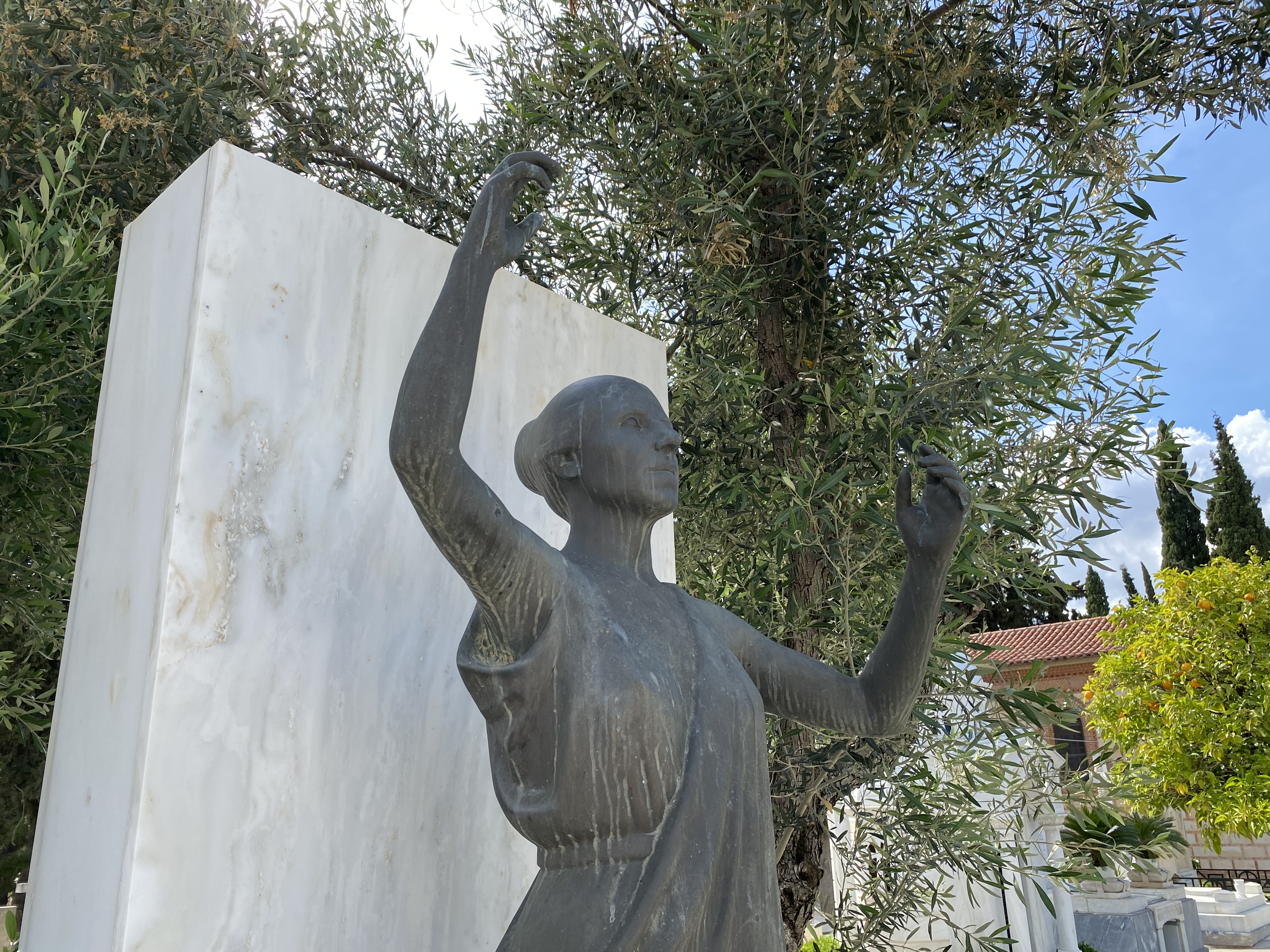
“Mother of the Occupation period” statueThe “Mother of the Occupation period”, made by Costas Valsamis (1908-2003), is a bronze sculpture that refers to the death from starvation during the years of the Occupation in Athens (1941-1944). The image of the dead mother lying on her back, skeletal, with her baby on her chest, was a real scene that the sculptor experienced in the winter of 1941. 

The mention of this tragic moment in an expressionist style in the cemetery is a monument of the sufferings of that period, but also of Motherhood. It was installed in 1979.


Contacts:

City of Athens / Department of Cultural Heritage
T: +30 2103721596, 2103721555
E-mail: t.pol.klironomias@athens.gr

Athens: lecture by Dr. Julie Rugg about Cemeteries in Western culture

ASCE is helping grow the international scientific cooperation in Europe.

Celebrating at the Cemetery of Kifissia: A Photo Exhibition of Greece’s Historic Graveyards

A celebration in honour of Saint Tryfon, the patron saint of the Kifissia Municipal Cemetery, was successfully held on February 1st.Following a Church Service, which welcomed a big crowd, a photographic exhibition of Greece’s historic graveyards was organised in the cemetery’s courtyard.

AGM 2017 report

AGM 2017 report
On October 5th, the Annual General Meeting took place at Harokopio University, Athens.

With over 110 participants from 19 countries at the meeting and conference, event was a great success in terms of knowledge and ideas exchanged.

In 3 days we held AGM and conference and experienced the wisdom and art of ancient and modern Greek.

Thanks to presidency, steering committee and exceptional organizational efforts of our host, the Harokopio University, all the participants could have developed new ideas.

AGM was preceeded by Mrs Lidija Pliberšek, president of ASCE and all steering committee members were present or gave proxy to other members. During the AGM several things were outlined and discussed:

1. Steering Committee work

Steering Committee work was presented by Mrs Beatrix Czipetits. Members remarks were taken into account and decisions from steering committee meeting in March were presented.

2. Financial report for 2016

A well balanced finances statement provides secure future for general work of ASCE. Mrs Lidija Pliberšek presented the agreed future presentations of financial statements in form of cash flow statements.

3. New charter registration

Secretary of ASCE, Mrs Metka Debevc, presented the procedure of registration of modified charter which ended in February 2017.

4. Promotion materials and communications

ASCE promotion materials and communications were presented by Mrs Carol Diaz Ortega. Marketing materials which are available to all members on the website were outlined with explanation on best usage practice. A proposal for smaller postcards was presented and in 2018 SC will prepare a smaller version of the postcard.

5. Cooperation of ASCE with other institutions

Mrs Wenche Madsen Eriksson and Mrs Melissa La Maida presented the cooperation of ASCE with other institutions like European institute of Cultural routes, SEFIT or other initiatives that are undergoing in our Association.

6. Global promotion of ASCE

Mr Thodoris Tzoumas presented the presentation letter of ASCE to the ministries of culture in Europe, cemetery day proposal project, and presentation article about ASCE for newspapers and magazines around the world. The article will be available for all members at ASCE webpage.

7. New members and significant cemeteries

New members of ASCE, European Cemeteries route and new significant cemeteries were presented by president Mrs Lidija Pliberšek.

8. Memorandum of understanding

A special Signing ceremony of Memorandum of Understanding between ASCE/UTILITALIA-SEFIT was performed in order to emphasise the importance of cooperation between ASCE and other organisations. Mrs. Lidija Pliberšek, president of ASCE and Mr. Michele Gaeta, representative of UTILITALIA-SEFIT signed the Memorandum.

9. Projects and logos usage

Projects and logos usage rules were presented by ASCE administrator Dušan Vrban with outlining of the appropriate use.

10. European Cemeteries Route developmnet

European Cemeteries route progress was presented by ASCE administrator Dušan Vrban. In 2017 the route has grown to over 900 points (monuments descriptions) created in the cemeteries. Many of these points are translations but overall we are noticing a significant growth of itinerary available to the visitors.

The reevaluation report required for certification by the European institute of cultural routes was prepared by the presidency.

Symposium in Ljubljana gained much attention in 2017 and many members proposed such workshops to be continued in future years.

A first European Cemeteries route info point was presented that will be positioned in Maribor in October 2017. The point will allow visitors of Maribor cemeteries to explore European cemeteries route and its members on a touch screen with other information available.

11. Symbols project

Symbols project final results were presented by ASCE administrator Dušan Vrban with emphasis on availability of results for the European Cemeteries route members.

12. Week of Discovering European Cemeteries

Mr Olaf Ihlefeldt presented the Week of Discovering European Cemeteries (WDEC) activities in 2017 as well as theme and possible activities for 2018. In 2018 activities should support the Year of European Cultural heritage and should take place between May 18 and June 3.

13. Cemeteries entries project

Project Cemeteries entries is developing and Mr Thodoris Tzoumas presented the current situation while encouraging the members who did not do it yet to proceed with installation of the insignia in their cemeteries.


14. Scientific Representative report

Scientific Representative report was presented by Andreea Pop. Prof. J. S. Curl was confirmed by Steering Committee and Scientific committee/board as a non elected advisory to our scientific committee.

Activities for forthcoming 2018 European Year for Cultural Heritage were outlined and a proposal to join the European Heritage Alliance 3.3 - an informal European sectoral platform composed of more than 40 European or international networks and organisations active in the wider field of cultural heritage.

15. Call for AGM hosting

Mr Martin Ernerth presented the Guidelines and benefits for AGM hosting and a call for AGM hosting in 2020 and 2021.

AGM ended with an invitation to AGM 2018 in Innsbruck by Mr Alexander Legnitti.

16. Conclusions

AGM 2017 provided insight into many developments within ASCE in recent years. Projects and our daily work are bringing together many resources on our common quest of preserving and promoting cultural heritage in cemeteries.

An extended and full program of the conference and side events organised by Harokopio University provided many additional insights into history and future of cemeteries and thus helped participants understand a broader picture on possible new strategies.

17. Photo gallery

Photos from the event will be gathered in this album in following days.

AGM 2017: Bus for participants

AGM 2017: Bus for participants
Bus transport will be organised from hotels to the University for all ASCE participants.

Our host for the AGM 2017, Harokopio University, organised a simple way to get to this year's venue.

A bus for 50 people will transport participants from the locations at following schedule.

Thursday 5th and Friday 6th

07:50 President hotel

08:00 Best Western Ilisia (The residents at  Divani Caravel are welcome to join the bus at  Best Western Ilisia)

08:10 Royal Olympic hotel  (very close to Metro Station Acropolis;  participants who stay elsewhere may join the bus there)

08:15 The Acropolis Kallirhoe

08:30 Harokopio University

The approximate route of the bus can be seen at this link.

Please note that bus will depart at the scheduled times so do not be late if you want arrive to the venue with this bus.

Saturday 7 Oct

A bus offered by the Municipality of Athens will transport participants to the First Cemetery of Athens (Arrival at 9:50 - 10 a.m.).

The bus will follow this schedule:

09:00 Best Western Ilisia (The residents at  Divani Caravel are welcome to join the bus at  Best Western Ilisia)

09:20 Royal Olympic hotel  (very close to Metro Station Acropolis;  participants who stay elsewhere may join the bus there)

9:30 The Acropolis Kallirhoe


The approximate route of the bus can be seen at this link.

After the guided visit the bus is going to transport us at 11:00 to the Acropolis Museum.

AGM 2017: Programme

AGM 2017: Programme
Programme of the Annual General Meeting and Conference 2017, taking place in Athens, Greece.

Title of the conference: Ancient Greek Art and European Funerary Art.

AGM and Conference will take place on the 5th, 6th and 7th of October at Harokopio University in Athens. Instructions on how to reach Harokopio University are available here.

Full program is available here.


You can click on this link (iCal) to add the programme to your personal calendar.

print
Expand program view
Calendar view
    Close

    AGM 2017: Getting to Harokopio University

    AGM 2017: Getting to Harokopio University
    Some helpful information to help you get to the AGM 2017 venue.

    In order to help you reach the AGM 2017 venue we are providing some further instructions.

    You may reach directly Harokopio University (70, El. Venizelou St., Kallithea) by taxi or by public transportation:

    • METRO: Station TAVROS- EL. VENIZELOS 
    • Line 1.TROLLEY BUSES: Line 1  & Line 5 (Both pass from Syntagma Square). Get off: Karagiannis Stop or Harokopou Stop
    • BUS: Number  040 [Athens/ (Departure from Syntagma Square/ Phillelinon St). – Piraeus]. Get off: Harokopou Stop. Note: You may get on Bus 040 also in front of Metro Station “Syngrou/ Fix’’. (see more at: Harokopio University website)

    Departure by bus on 5 and 6 October morning for the Harokopio University and on 7 October for the First Cemetery of Athens  from selected hotels (President, Best Western Ilisia, Royal Olympic, Athens Kallirhoe; even if you don’ t stay there, you may easily reach  Royal Olympic by metro station ‘Acropolis’ Line 2)'


    AGM 2017: Accommodation

    AGM 2017: Accommodation
    Accommodation options for the AGM and Conference, taking place in Athens, Greece from 5 to 7 October 2017.


    On this link you can choose between different accommodation options for the time staying in Athens attending Conference and AGM 2017.

    First Cemetery of Athens (Greece)

    The First Cemetery of Athens (Athens, Greece)
    The First Cemetery of Athens (A Koimitirio Athinon) was founded around 1837, when Athens was also established as the capital city of the modern Greek state.

    About the cemetery

    The First Cemetery of Athens spreads on the slope of the Ardittos hill, close to the Panathinaiko Stadium. Major Greek figures are buried in the First Cemetery, such as heroes of the Greek Revolution, politicians, poets, artists, etc. 

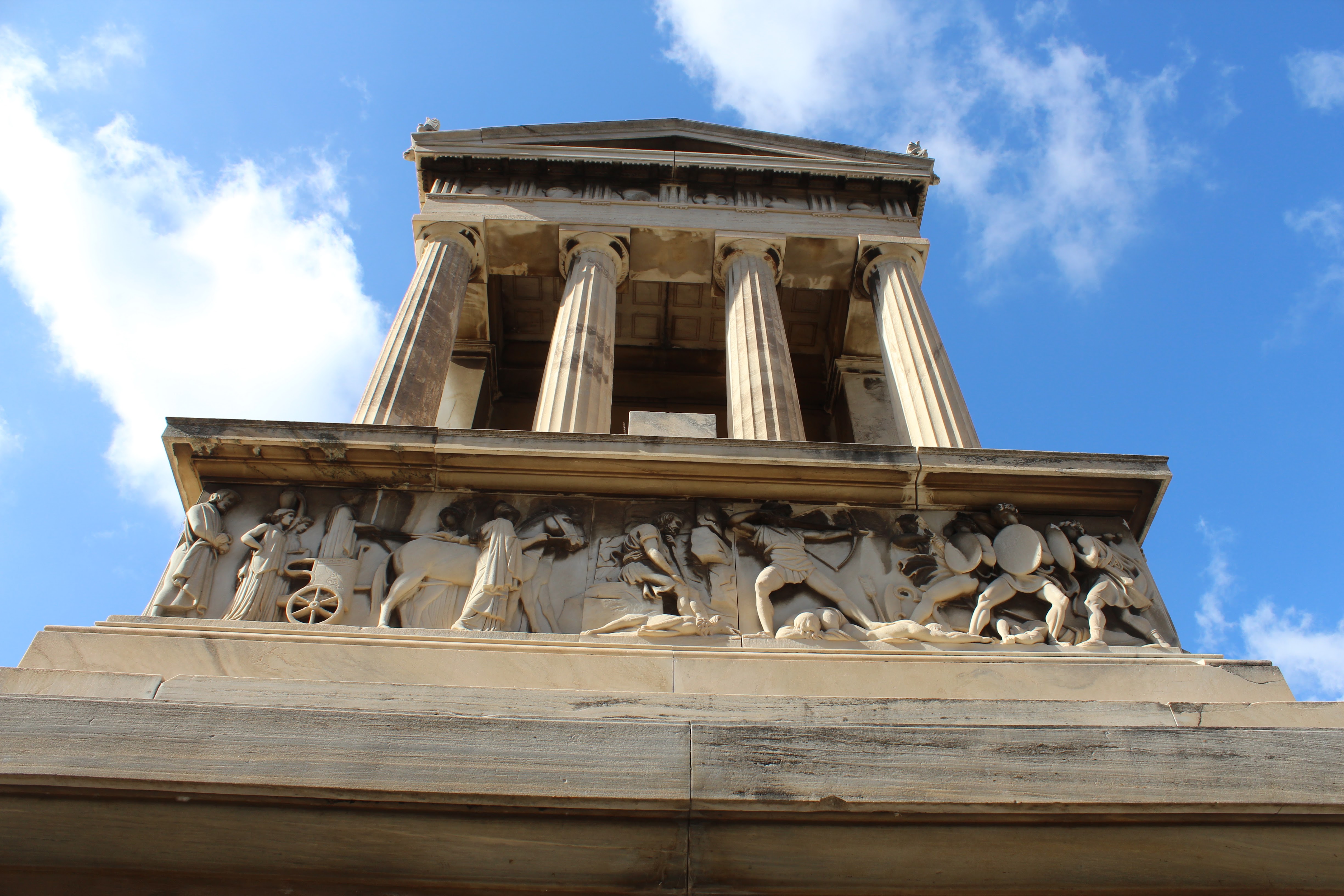
    The style of the cemetery can be traced to the Romantic period. The collection of sculptures hosted in the cemetery can be considered as a most significant and genuine example of the quality attained in marble carving in Greece between 1850 and 1920. Memorial art flourished during the 19th century and marked the rebirth of the new Greek state. All kinds of monuments and ornamental patterns appeared which conveyed the influence of ancient times (stelae, columns, reliefs, sarcophagi, small neoclassical temples). Apart from funerary artworks based on ancient models, some samples can be found of Byzantine and Egyptian patterns, as well as a remarkable number of copper masterpieces.

    Address

    First Cemetery of Athens
    Logginou 3,
    Athina 116 36,
    Greece

    Contacts

    Phone: +30 21 0922 1621