

Showing posts with label Firenze. Show all posts
Showing posts with label Firenze. Show all posts


Cemetery of San Miniato al Monte (Florence, Italy)
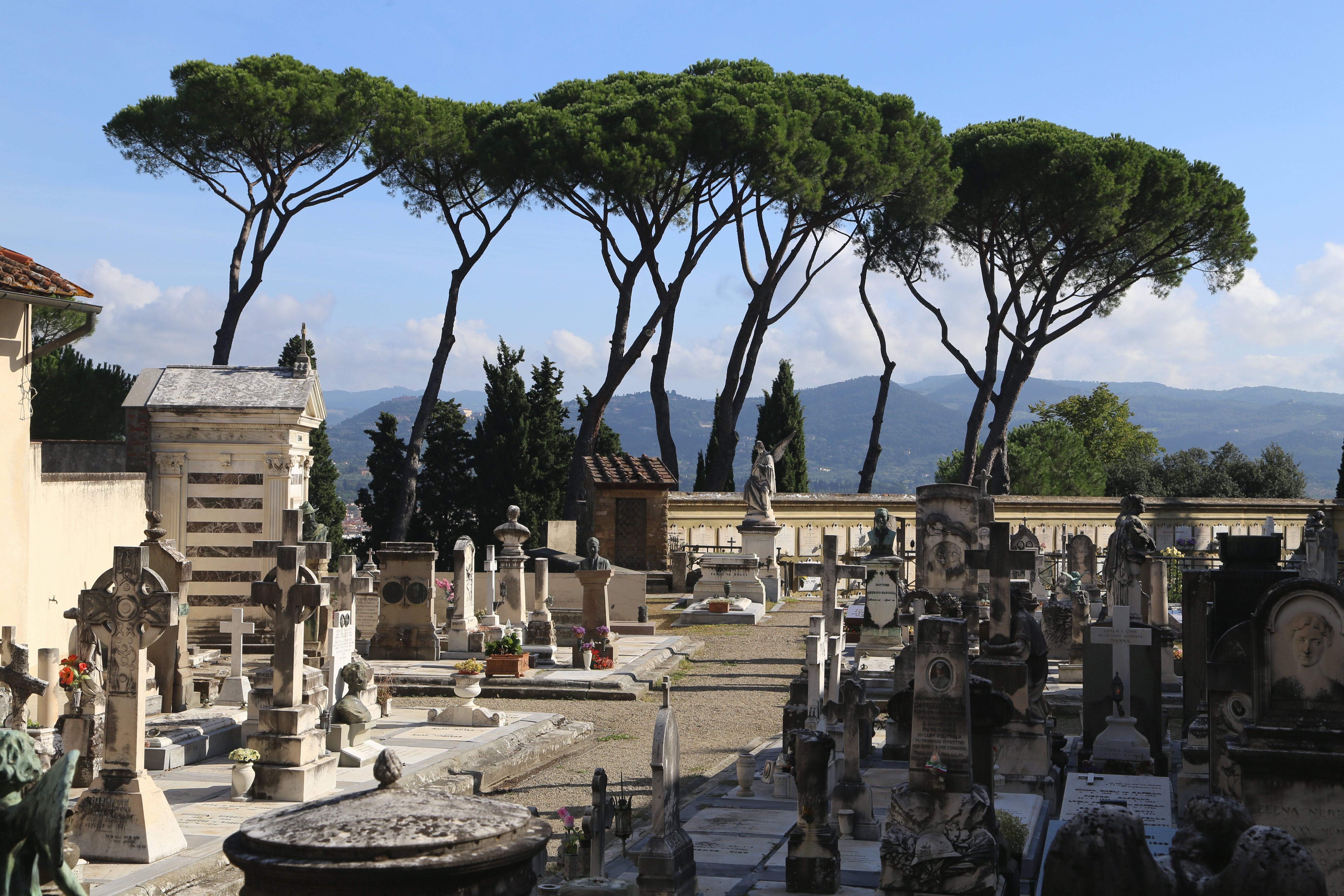
Cemetery of San Miniato al Monte, also known as the Cemetery of Porte Sante, is a monumental cemetery located within the fortified bastion of the Basilica of San Miniato al Monte.
The creation of the cemetery
The initial preliminary project that used the entire area of the Fortress of San Miniato as a cemetery (Michelangelo's work commissioned by Cosimo I de' Medici), was drawn up as early as in 1844 by the architect Matas.
Originally the cemetery, adjacent to the Romanesque Basilica, was destined to the burial of the members of the "Opera Pia dei Padri Spirituali".
In 1854 the cemetery was officially established to guarantee burials during the cholera epidemic. The place was ideal because it was far (but not too far) from the city and located in a quite airy place.
The final project was designed in 1864 by the architect Mariano Falcini.
Cemetery features
The land inside the fort was divided into squares used for individual burials and noble chapels were also built and placed in the enclosure to the southeast of the cemetery. The area was affected by the overall expansion and redevelopment projects of the city of Florence around 1865, which led the ancient basilica and the cemetery to have access from Viale dei Colli a few hundred meters from Piazzale Michelangelo.
Gradually the cemetery was transformed into an elite and monumental cemetery with the construction of numerous chapels and funeral monuments by illustrious Florentine architects including Tito Bellini and Enrico Dante Fantappiè. From the earliest years the most important and rich people in the city were buried there.
Ground burials were permanent and covered with white marble slabs. In this way the squares for the burials became similar to the floors of the medieval churches.
In 1911 "Opera Pia dei Padri Spirituali" transferred the property of the cemetery to the Municipality of Florence and further expansion works were conducted since 1916, giving the cemetery today’s monumental appearance.
*Photo source: www.commons.wikimedia.org
Address
Cemetery of San Miniato al MonteVia delle Porte Sante 34
50100 Firenze
Italy
Cemetery Service Address
Via Luna 16
50100 Firenze
Italy
Opening hours
Summer: 8 am – 6 pmWinter: 8 am – 5 pm
Pinti Cemetery (Florence, Italy)

A 19th century cemetery belonging to the Venerable Brotherhood of Misericordia of Florence.
Cemetery history

The Pinti Cemetery is one of the oldest monumental cemeteries in Florence. It belongs to the Venerable Brotherhood of Misericordia of Florence, which, since its medieval foundation, has been devoted to acts of solidarity – above all, ensuring proper burial for all the deceased.
For centuries, following the customs of the time, members of the Brotherhood buried the dead in and around churches or alongside the city walls. In the eighteenth century, however, Pietro Leopoldo of Lorraine introduced new regulations requiring cemeteries to be located outside inhabited areas. In compliance with these laws, the Misericordia acquired a suitable plot outside the city walls, where the cemetery was established. Today, this area is fully integrated into the city.
Construction and architecture

The cemetery was officially inaugurated in 1839 with the burial of its first deceased. It features an oratory and a semicircular portico composed of a colonnade designed to symbolically embrace visitors.
The original design was created by engineer Paolo Veraci, later continued by Gaetano Baccani. In 1878, engineer Angelo Maiorfi was commissioned to complete the complex. His additions included two lateral wings and a new Neoclassical entrance, adorned with angel statues sculpted by Odoardo Fantacchiotti.
Important Personalities

During its 60 years of active use (1839–1898), a period that included Florence’s time as the capital of Italy, Pinti Cemetery became the final resting place of many prominent figures.
Among those buried here are:
- Emilio De Fabris, designer of the façade of Florence Cathedral
- Michele Rapisardi, painter
- Pietro Dazzi, painter and founder of the Scuole del Popolo
- Carlo Strozzi, marquis, historian, and archaeologist
- Massimiliano Giarrè, humanist and patriot
- Teodulo Mabellini, musician
- Cesare Guasti, archivist at the Opera del Duomo
- Silvestro Leopardi, senator of the Kingdom of Italy
- Vincenzo Batelli, editor and typographer
- Giuseppe Barellai, pediatrician and founder of children’s summer camps
- Giovanni Baldasseroni, politician
Closure and present-day use

In 1898, the Brotherhood decided to close the Pinti Cemetery and open a larger burial ground better suited to the needs of a growing city. Since then, the cemetery has remained accessible primarily to those wishing to visit and honor their loved ones.
In recent years, guided tours have been introduced, allowing visitors to explore this historic site and discover its cultural and architectural heritage.
Cemetery address
Via degli Artisti 250132 Firenze
Italy
Cento anni di Spoon River (One Hundred Years of Spoon River) at Cimitero delle Porte Sante

The event is dedicated to Edgar Lee Masters, American poet and dramatist, mainly known as the author of Spoon River Anthology.
Music by Fabrizio De André.
Readings by Marco Baliani, Iaia
Forte, Gabriele Lavia, Maurizio Lombardi, Giulia Weber.
Songs performed by Mauro Ermanno Giovanardi, Petra Magoni & Ferruccio Spinetti, Morgan, Peppe Servillo.
Musical intermezzo by Trio Amadei, Markus Stockhausen, and Orchestra della Toscana directed by Saverio Lanza.
Songs performed by Mauro Ermanno Giovanardi, Petra Magoni & Ferruccio Spinetti, Morgan, Peppe Servillo.
Musical intermezzo by Trio Amadei, Markus Stockhausen, and Orchestra della Toscana directed by Saverio Lanza.
Full fee € 20 / Reduced fee € 18
Ticket office
TEATRO DELLA PERGOLA
Via della Pergola 30
tel. +39 0550763333
biglietteria@teatrodellapergola.com
Monday to Saturday: 9.30 am - 6.30 pm
closed on Sunday
www.teatrodellatoscana.it
Subscribe to:
Posts (Atom)