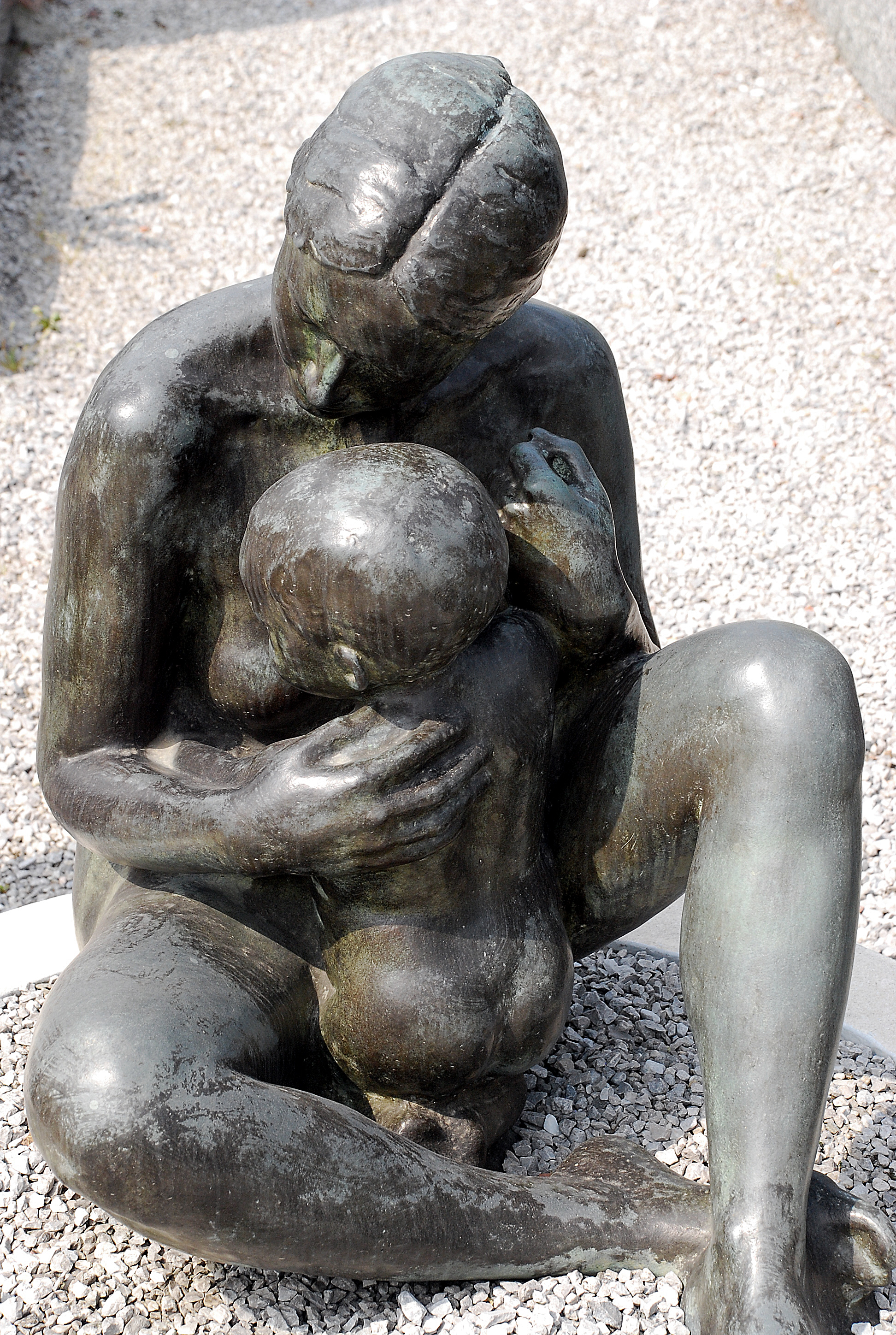
Bologna Certosa. The shapes of the past, the discovery of the present

Giacomo de Maria, Marte, Palazzo Hercolani, Bologna
The Museum of the Risorgimento of Bologna and Genus Bononiae - Musei nella città, organize six events, part of the series "The Bologna Certosa.

Cemetery of La Carriona (Aviles, Spain)

Cemetery of La Carriona (Aviles, Spain)
Cemetery of La Carriona was inaugurated in 1890 and designed by the municipal architect Ricardo Marcos Bausá, who later on worked on the project of Ciudad Lineal in Madrid (Spain).

About the cemetery

This cemetery contains an important artistic heritage that is mostly related to the prosperity of a village closely linked to Cuba, where a large number of Indianos, Asturian migrants, made their fortunes. This site contains works of art made by several leading artists, such as Manuel del Busto, Faustino Nicoli, Gargallo, Cipriano Folgueras, Federico Ureña, Fernández Cueto, etc.

Some of the heritage resources worth to be highlighted include important hypogea (an underground chamber) and sculptural works, such as those of families Marqués de San Juan de Nieva, Marqués de Teverga, Castro, Zaldúa Carbajal, María Suárez, Bonifacio Heres and the family of the most important local writer, Armando Palacio Valdés. This set of resources is located in the surroundings of the main avenue at the entrance of the cemetery. The Greek cross chapel, design by Ricardo Marcos Bausá, is also remarkable.


*Photo source: www.es.wikipedia.org

Address

Cemetery of La Carriona
La Carriona  9,
33401 Aviles,
Spain

Contacts

+34 985 11 16 80
+34 985 51 02 35

Opening hours

Monday to Sunday: from 9.00 to 19.00

Cemetery of San Amaro (A Coruña, Spain)

Cemetery of San Amaro (A Coruña, Spain)
The Cemetery of San Amaro, in A Coruña (Northwest of Spain), a small town of 250.000 inhabitants, has already celebrated more than 200 years of existence.

About the cemetery

Although the main tombs were established in that place already in 1781, the cemetery was oficially opened in 1812. It stands nowadays as the main cemetery of this small village with 2 more public necropolis and a public crematorium (there are also 4 more cemeteries handled by the Church).

It’s structured in three areas (civil, religious and british) and facing the sea. 200 of its 20.000 graves belong to distinguished painters, writers, politicians, local heroes, aristocracy and businessmen who have been buried there in the past two centuries along. The main entrance and chapel are one of the most beautiful examples of neoclasic style in that part of Spain.

A protected heritage site

Some of it’s elements are protected according to spanish heritage laws and a part of the council budget is reserved every year to preserve it.

In fact, for the next years there’s a Renewal Planning (Plan Director) for changing the cemetery paviment, increasing seriously the green area, renewing the furnishing and improving the accesses for handicapped people.

In the other hand, guided tours will be restablished getting better signs elements for helping visitors to see all the prominent vaults and monuments.

Cemetery stories

Between the cemetery walls are hidden many “curious stories” as that one of the child Juan Darriba, local hero for saving a woman who was drowing in the beach, losing himself its life. He was 11 and from his death it’s grave has fresh flowers each year brougth still by the descendants of that women. 

Or the issue that the younger sister of Picasso was buried here when she died of difteria during the 4 years Picasso’s family lived in town. 

There were also rests of some German soldiers found dead during the First and Second World War.

Address

Cemetery of San Amaro
Orillamar street s / n,
Bj. 15002 A Coruña,
Spain

Contacts

Phone: +34 981 189 825     
Website: www.coruna.es

Opening hours

Monday to Sunday from 09:00 to 18:00

Glasnevin Museum celebrates Phizzfest - September 6th

The Local Story of 1916, World War I and World War II.

The Cemetery of Père Lachaise (Paris, France)

The Cemetery of Père Lachaise (Paris, France)
The East Cemetery of Paris, well known as "Père Lachaise", was opened in 1804 as a response to the closure of ancient and overcrowded churchyards.

About the cemetery

The site was initially located in open country, now it towers over Paris. Alexandre Théodore Brongniart (the architect of the centre city la Bourse), designed the cemetery as a contemplative space, inspired by the British gardens.

The global fame and reputation of the cemetery is based on its many characteristics:
  • It still conserves material testimonies of its first appearance. The history of the foundation of cemeteries during the 19th century has been marked by the Romantic conception of Brongniart and several European burial sites have emulated it. 
  • It is the last home of many important figures (from Chopin to Jim Morrison) and shelters memorials of great importance (from the “Mur des Fédérés of the Commune of Paris to memorials of concentration camps). The associated monuments are often realized by the greatest artists of all nations. 
  • The walk through the place is always different and surprising because of numerous extravagant monuments (the smokestack of the Beaujour grave, the telegraph of the Chappe’s tomb, the Allan Kardec’s Dolmen, etc.) and the beauty of the park.
  • Last but not least, the cemetery also covers a complete set of funerary buildings, linked to the history and the organisation of the Mortuary Services, such as the Chapel, the Crematorium, the Columbarium and the Boneyard.

Address

The Cemetery of Père Lachaise
8, boulevard de Ménilmontant
75020 Paris
France

Contacts

Tel. +33 155258210
Tel/Fax: +33 143704216

Website: The Cemetery of Père Lachaise

Certosa Monumental Cemetery (Bologna, Italy)

Certosa Monumental Cemetery (Bologna, Italy)
Unlike many Italian monumental cemeteries, that were built from scratch, this cemetery was created by reutilizing the structures of the pre-existent monastery of San Girolamo di Casara, founded in 1334.

Beginnings of the cemetery

Even though nowadays it appears fully integrated into the urban environment of the city, its location was chosen in 1801 rightly because of its distance from the residential area and for the opportunity to adapt it easily. Starting from 1797, year of its suppression, the monastic building underwent many transformations, demolitions and extensions, so that the original structure is only partially visible.

Already in 1801, the fence at the north of the cemetery was built and decorated with terracotta sculptures by G. Putti, where a new monumental entrance was opened.

The first works included readjustments of the monastery spaces, whilst from 1833 the construction aspired towards a more complex structure, with exedrae, biaxial elements, symmetries aimed at a greater monumental ambition.

Main parts of the cemetery

Between 1816 and 1834 the main rooms of the Certosa were built: the "Hall of the Graves" (in 1816), the "Arcade of the Graves" (in 1833) and immediately after that the "Gemina Hall" and the "Colombario" - an impressive building with three naves inspired by the Roman thermal architecture. The building of the "Elliptical Hall", a small body to connect the nineteenth and twentieth-century group, dates back to 1834, while in 1860 the previous "Chapel of the Suffrages" was turned into the "Gallery of Angels". Soon after this last one, the "Three-Aisled Gallery" was built, connecting the structures built until then.

A different interpretation of the spaces started at the beginning of the twentieth century, according to a more monumental and rhetorical viewpoint: significant examples of this period are the "Sixth Cloister" with the "World War I Memorial", the "Eighth" and the "Ninth Cloister", with the annexed galleries. In 1924, the new entrance was built, at the end of the colonnade, near the Reno canal.

Cemetery artwork

Along these spaces of the cemetery, visitors can admire an impressive repertory of monuments, unique in Europe. The most ancient works are showed on the walls of the "Third Cloister" and are mainly frescoes belonging to the most important and distinguished Bolognese families. Only later, the graves started to be decorated with sculptures and different decoration bodies that, until the mid of the nineteenth century, were composed by ‘poor’ materials, such as plaster, stucco, scagliola or terracotta and only afterwards, marble.

Over a period of two centuries many distinguished architects, painters, sculptors worked there, contributing to its unique charm praised to the skies by all its foreign visitors, among whom we may mention Lord Byron and Charles Dickens, Jules Janin, Giacomo Leopardi, Giosue Carducci and many others.

Important people buried at the cemetery

In the cemetery are buried many important people from Italian and Bolognese history, including the statesman Marco Minghetti, the painters Giorgio Morandi and Bruno Saetti, the poet Giosue Carducci and the writer Riccardo Bacchelli, the composer Ottorino Respighi, the Polish officer Giuseppe Grabinski, the entrepreneurs Alfieri Maserati and Edoardo Weber and others.

Culural heritage

The Certosa, together with the Church of San Girolamo, the only building of the ancient monastery that was preserved integrally, represent therefore a journey through the history of Bologna and the lives of some of its most illustrious citizens, but also through Italian and European history and literature. It has been a source of inspiration for poets, men of letters or “simply” cultivated visitors, who would not turn down the possibility to stroll through its cloisters and walks and to take their guests to visit the place. The Certosa has been the subject of a noteworthy production of printed works, if not true tourist guides destined to become in some cases, best-sellers sold in Italy and abroad.


*Photo source: www.ar-tour.com

Address

Certosa Monumental Cemetery
Via della Certosa, 18
40133 Bologna
Italy

Contacts and other info

Phone: +39 051 347592 or +39 051 225583 (Museum of the Risorgimento)

www.museibologna.it/risorgimento
www.storiaememoriadibologna.it/certosa

Paris Catacombs Tour

Explore the ancient underground tomb that house over 6 million Parisian bodies.

AGM 2012 report

AGM 2012 in Maribor, Slovenia
On September 13th, the Annual General Meeting (AGM) took place. This time in European Capital of Culture 2012, Maribor.

AGM was guided by president of ASCE, Ms Lidija Pliberšek and all steering committee members were present or forwarded their votes to other members. During the AGM, several things were outlined and discussed with some important decisions being made:

1. Agenda Overview

  1. Financial report for the year 2011 and first 8 months of 2012
  2. Changes of the charter of ASCE
  3. Report on EUCEMET project
  4. Report on Cemeteries route project
  5. Report on Week of Discovering European Cemeteries 2012
  6. Presentation of new promotional and other tools within ASCE (flyer, banner and insignia at the bottom of this webpage)
  7. Report on regular secretariat work

2. Financial Report

Members took note of the financial reports and no issues were raised about them.

3. Charter Modifications

Members of ASCE voted about the important changes of the old ASCE charter. Due to changes in Italian legislation in 2009, we had to make minor expressive changes which do not change the content or meaning of the charter. Changes were accepted with 100% of present members voting for the changes. Secretariat will submit the new charter to Italian authorities.

4. EUCEMET Project Status

Mr. Yvan Corbat presented the EUCEMET project, its history, current status and further activities. The complete presentation of the project is avaliable for download on this link. Within project, 3 very important results are being achieved: photo exhibition (with opening ceremony that was held during AGM in Maribor), Augmented Reality Browser application which was presented during AGM and Q&A guides which will be presented at the next AGM. All the details will be presented at the ASCE website.

5. European Cemeteries Route & WDEC 2012

President Lidija Pliberšek briefed the members about the current status of Cemeteries route project, which is currently managed by outsurced company. Since it was not managed by the expectations of the members in the past year, further developments are being planned that will be introduced to all members. Steering Committee delegated president Lidija Pliberšek and Martin Ernerth to meet with current route managers and arrange future steps and developments.

This year, hundreds of events took place all over Europe in the Week of discovering European Cemeteries (WDEC). We have tried to gather them in the event calendar. All the events we have gathered are also presented in this PDF file.

6. Secretariat Work & IT Communications

In past 12 months, secretariat proposed and created many new tools for collaboration and promotion inside ASCE:

  • new website that already has editors from 3 countries; new editors from Netherlands and United Kingdom were arranged during AGM;
  • extended use of Google cloud with all documents now properly archived and accessible to other members;
  • managed photo archive in Picasa web albums that includes over 115 albums already;
  • many additional website services like Google maps and events calendar that make the IT and marketing structure of ASCE easier managable;

7. New Promotional Tools

Especially, all members can now use:

ASCE flyer may be used in any quantaties. Arrange your own printing after you download the flyer at this link. Also avaliable in simmilar design is the ASCE banner.
ASCE Insignia may be used as according to the Insignia rules, set by steering committee of ASCE. Any member who wishes to use the insignia, must ask the secretariat to receive the files necessary to use it.

8. New Members and Future Outlook

AGM 2012 ended with presentations of the new members (Westerveld, A Coruña, Alcoy) and invitation to the next AGM 2013 in Netherlands.

Photo exhibition

In the frame of EUCEMET project, a photo Exhibition opening ceremony occured at Dobrava cemetery in Maribor on Thursday, 13th of September 2012.

Conference at AGM

In 2 days of AGM 2012, 10 amazing presentations, covering different aspects of promotion of cemeteries and their surrounding territories, took place.

Students as ASCE guides

ASCE scholars guides in Maribor
At the AGM 2012 in Maribor, Slovenia, 6 children from Maribor elementary schools guided the ASCE members through Pobrežje cemetery.

Students becoming guides

With the students becoming guides, this represented a very special and different experience for visitors, scholars and the schools.

It all started at Pobrežje Cemetery in April, when Pogrebno podjetje Maribor (the cemetery management company) hosted scholars from 2 schools for the cultural day. Scholars were presented with the history of the cemetery and important people burried there.

With an excellent prepared guidance, scholars immediately became aware that cemetery is not just a place of death and sadness. It was a place of many interesting findings and as they have learned about the important people in the cemetery, scholars were actually learning about themselves and their own history.

For many of them, the experience was so impressive, that they have volunteered for becoming guides  themselves. Preparations started and soon, they were guiding their first visitors, during the Week of Discovering European Cemeteries (WDEC).

Guided tour at the AGM on September 14, 2012

After the first experience, the youngest guides worked with their english teachers and improved the guidance techniques and knowledge for their big challenge: guiding the ASCE members and partners through the cemetery at AGM 2012.

As it turned out, they were surprisingly relaxed, practical and interesting. Present members enjoyed the easy guidance where scholars presented the most important people of Maribor with just enough facts and interesting stories.

Importance of the project

The project has many important implications and presents one of the best possible ways to get every European citizen in touch with the heritage, preserved in the cemeteries. Because scholars are not the only ones impressed. Their families, friends and many others are now learning from them about the importance of our cemeteries.

AGM 2012 sponsors


Photo exhibition announcement

Opening of exhibition of photography under project EUCEMET

Conference of ASCE

Conference of Association of significant cemeteries in Europe (ASCE) from 13. – 15.9.2012 in Maribor, Slovenia

Sign up for AGM2012

Get ready for an amazing AGM 2012 in Maribor.

The Laorca Cemetery (Lecco, Italy)

The Laorca Cemetery (Lecco, Italy)
The Laorca Cemetery represents a particular example of a historic, landscaped cemetery and it is considered a national monument.

About the cemetery

The cemetery of Laorca is located in the Laorca district, north of Lecco, at the foot of Mount S. Martino, along the Gerenzone River, in the cradle of the Lecchese steel industry.

The environment is highly suggestive. At the foot of the Corno Medale stands a sort of natural amphitheater, created in a rocky spur and fraught with caves and ravines. The site holds the cemetery, several private chapels dating from the late 1800s and early 1900s, the ancient cemetery church of San Giovanni ai Morti and the chapels in Via Crucis.

In the early 1900s the industrial families of the zone chose this site to build their private chapels and monumental tombs in an eclectic style that melds classical features with the imposing features of Art Nouveau.

As a whole, the area of the Laorca Cemetery could be defined as a Sacromonte (a sacred mountain), that was considered for centuries a devotional site. The terraces enjoy a splendid view of the city of Lecco and the lake.

The Laorca Cemetery - view of the cemetery from the upper terrace The Laorca Cemetery The Laorca Cemetery - private chapels

Events at the cemetery

Many events regularly take place at the cemetery. Some of those are, for example, the guided tour and the theatre performance and concert at night that took place in 2012.

Guided tour at Laorca Cemetery Theatre performance at Laorca Cemetery Theatre performance at Laorca Cemetery Theatre performance at Laorca Cemetery Concert at Laorca Cemetery Concert at Laorca Cemetery

Address

The Laorca Cemetery
Via Crogno
23900 Lecco
Italy

Basic Information

Graves: 700
Private chapels: 14

The Monumental Cemetery of Lecco (Lecco, Italy)

Monumental Cemetery of Lecco (Lecco, Italy)
The Monumental Cemetery of Lecco was inaugurated in 1882 and today it represents a real open-air museum.

About the cemetery

Monumental Cemetery of Lecco

Based on a project by the engineer Enrico Gattinoni, the Monumental Cemetery of Lecco was inaugurated in 1882.

The fields designated as municipal burial grounds are flanked on three sides by private chapels, all joined by a walkway.

The lovely neo-gothic portico is an elegant exception to the dominating neoclassical style of the funerary architecture. On the far side, an octagonal oratorio stands at the center topped by a pavilion vault. In 1901 the entrance atrium and facade (by engineer Cesare Mazzocchi) was built in the Art Nouveau style.

An open-air museum

A wealth of sculptures commissioned in the late 1800s and early 1900s by acclaimed artists adorn the area, artists whose works can be found in the piazzas and cemeteries of Lecco and throughout Lombardy. Some of them are: F. Confalonieri, G. Branca, E. Bazzaro, C. Da Nova, L. Broggi, D. Barcaglia, P. Clerci, E. Agnati, R. Lainati, M.Vedani, A. Montegani, G. Castiglioni, F. Modena, L.Panzeri.

In the late 1900s, R. Rui, R. Piter, and P. Atchugarry worked beside such artists, Lecchese by adoption, as G. Mozzanica, R. Pedroli, G. De Candido, L.Milani, F. Simoncini, who sought infinite plastic, iconographic and material variations within the area of classic traditions.

Monumental Cemetery of Lecco Monumental Cemetery of Lecco Monumental Cemetery of Lecco Monumental Cemetery of Lecco

Events at the cemetery

Many events regularly take place at the cemetery. One such is a guided tour and concert on the theme "Female figure", which took place in 2012. 

Guided tour at the cemetery Guided tour at the cemetery Concert at the cemetery

Address

Monumental Cemetery of Lecco
Via Giuseppe Parini 29
23900 Lecco
Italy

Basic information

Surface: 20.000 m2
Graves: 2500
Private chapels: 84

Over 100 photos at AGM 2012

We have collected several hundred photos in recent 3 months from all over Europe.

Summer events at the Bologna Certosa Cemetery

Guided tours organized by Associazione Didasco.