Showing posts with label CEMR. Show all posts

Municipal Cemetery of Patras (Patras, Greece)

Municipal Cemetery of Patras (Patras, Greece)
Since 1880, the First Municipal Cemetery of Patras has grown into a city within a city, with four hills, grand family tombs, and the striking Church of the Angels.

Origins and foundation

The First Municipal Cemetery of Patras was founded on February 17, 1880, and opened on August 1st of the same year, under the initiative of the then mayor, Athanasios Kanakaris-Roufos. For this purpose, a special committee was formed, chaired by the mayor himself, together with the reputable Papatheodorou, Dionysios Fragkopoulos, Kyriakos Lappas, Andreas Kollas, Athanasios Athanasopoulos, and Alfredo Krov as members.

Following medical research, the Zavlani area was selected as the most suitable location. Initially, approximately 79.000 m2 of land were purchased. In 1928, the cemetery was extended by an additional 4.000 m2 to allow the construction of the Church of the Angels, following a donation by Antonios Papageorgakopoulos. The project was initially assigned to Major Papageorgiou of the Engineering Corps, who was later replaced by engineer Spyridon Tzetzos.

Major churches

The Church of the Angels was designed by Professor Michelis and completed in 1954. The original Church of Saint Paraskevi, which was built alongside the cemetery, was destroyed by the powerful earthquakes of 1993 and rebuilt on the same site. There is also a Protestant church within the cemetery grounds.

The decoration of the churches with various sacred vessels was undertaken by prominent members of Patras society, such as Athanasios Kanakaris-Roufos, Tzetzos, Aspasia Kremmydi, Kalliopi Green, Ioulia Tzetzou, and others.

The cemetery’s four hills

In addition to the Orthodox section, there are also sections for Catholics, Protestants, and Jews. The first person to be buried in the First Cemetery of Patras was a merchant from Parga named Anagnostis Petsalis.

The cemetery contains four hills:

  1. the Hill of the Fighters, named so because many freedom fighters of the 1821 War of Independence are buried there, such as Charalambis, Londos, etc.;
  2. the Roufos Hill, where the family tomb of Benizelos Roufos is located;
  3. the Saint Paraskevi Hill, where the church stands;
  4. and the German Hill, where Germans were buried during the occupation.

Important monuments

The interest of visitors is attracted mostly by the monumental character and the architectural heritage of the site, as well as the beauty of the natural environment with the stunning views of the city and the sea. Particularly impressive is the avenue of bankers and merchants, which hosts the graves of the wealthiest families of Patras during the 1880–1920 period. Notable examples include the tombs of the Kollas family, Koggos Triantis family, Karamanndanis, Kalamogdartis, Roufos, Langouras, and others.

Cemetery address

141 Panepistimiou Str.
26443 Patras
Greece

Basic data

Year of first burial: 1880
Cemetery area: 10ha
Approximate number of graves: 5.888

Brihuega Municipal Cemetery (Brihuega, Spain)

Brihuega Municipal Cemetery (Brihuega, Spain)
The cemetery lies within the historic Castle of La Peña Bermeja and retains its original 19th-century design.

About the cemetery

The cemetery of Brihuega, dating back to the 19th century, is located within the Castle of La Peña Bermeja, the oldest building in the town. The castle was likely constructed between the 9th and 11th centuries, during the Caliphate era. From the parade ground (Prado de Santa María), the site is accessed through the Puerta del Rastrillo, located next to the apse of the Church of Santa María. This gate leads into the courtyard, now referred to as the upper cemetery.

The exact year of the castle’s construction is unknown. The cemetery was established in 1834, prompted by a cholera epidemic that broke out in August of that year. Its design has since been restored to reflect its original state. Today, the cemetery remains in active use.

Important figures in the cemetery

Among the notable individuals buried there are:

  • Don Ramón Casas, a deputy and one of the main driving forces behind Brihuega's celebration of the 2nd Centenary of the Battle of Brihuega and Villaviciosa during the War of the Spanish Succession.
  • Don Jesús Ruiz Pastor, a true patron of Brihuega in the 20th century, who was responsible for the construction of one of the town’s most emblematic buildings, la Plaza de Toros, among many other contributions.
  • Don Valeriano Herrera, originally from Salamanca but a Brihuega local by marriage, to whom we owe the town’s largest photographic archive.
  • Don Juan Elegido Millán, a magician and hypnotist born in Brihuega. A tireless collector of miniatures from around the world. His passion is reflected today in the Miniature Museum housed in the Convent of San José.
  • Don Antonio Pareja Serrada, whose remains were recently brought to the Brihuega cemetery from Madrid's Almudena cemetery. Born in Brihuega in 1844, he was a provincial chronicler, historian, and devoted admirer of his hometown.

Cemetery address

Prado de Santa María
19400 Brihuega
Spain

Basic data

Year of first burial: 1834
Cemetery area: 3500 m2
Approximate number of graves: 650

Greek-orthodox cemetery (Livorno, Italy)

Greek-orthodox cemetery (Livorno, Italy)
Besides its architectural and artistic significance, the cemetery stands as an important symbol of the once bright Greek community and Diaspora in Livorno and wider area.

Cemetery history

The Greek Orthodox community of Livorno, after constructing their church in via della Rosa Bianca in 1760, was permitted to establish the first Greek-Orthodox cemetery near the Cisternone in 1776. This initial cemetery space was eventually closed due to the rapid development of the city, with the last burial occurring in 1838.

In the same year, the Greek confraternity purchased the field where the current cemetery stands, on via Marco Mastacchi, next to the same sized Dutch cemetery. The cemetery officially opened in 1840, and the burials from the older cemetery were moved there.

Cemetery features

Designed by Olinto Paradossi, renowned for other notable projects in Livorno's public spaces during the 19th century, the new Greek-Orthodox cemetery boasts a rectangular layout covering 3818 m2. It comprises the church of the Dormition of Virgin Mary, an entrance building shared with the neighboring Dutch cemetery, and an expansive tree-planted area housing scattered burial monuments and fencing.

In total there are 242 burial monuments in the cemetery, featuring inscriptions in Greek, Italian, and the Cyrillic alphabet. Notably, 64 of these tombs are situated within the church, covering the floor, and presenting an unusual typology, reminiscent of monastic-type churches found in Mount Athos. Surprisingly, behind these burials, instead of the holy step one might expect, there lies a rectangular space filled also with tombs covered with cross vaults. These graves belong to prominent figures of Livorno's flourishing Greek Community, intimately tied to the city's history and, most significantly, to the revolution and liberation of Greece in 1821.

Outdoors, numerous striking marble tombs and monuments complement the chapel's artistic elements, including a curved wood iconostasis, oil paintings, and special floor tombs, forming an architectural and landscape ensemble with significant cultural and historical value. 

There have been no alterations or changes to the original design and all the current efforts are now focused on preserving the original artistic elements and their integrity.

Cemetery significance

The cemetery with its church stands for much more than a religious space for the Greek and Orthodox community in Livorno. Is rather a symbol of recognition and acceptance. And still today, it represents a very much connected and alive part of the local Greek community.

The Greek-orthodox cemetery is also one of the few such old orthodox cemeteries, located outside Greece, operating independently rather than within another cemetery context. 

The temple that is bearing the floor tombs, along with the striking external marble tombs, forms a remarkable architectural ensemble, and it has been rightfully recognized by Italian authorities as a cultural monument to be preserved.

Cemetery address

Via Marco Mastacchi 227
57122 Livorno
Italy

Basic data

Year of first burial: 1820
Year of last burial: 2009
Current area: 0,38 ha
Approximate number of graves: 242

Best practices award 2022

Best practice award 2022
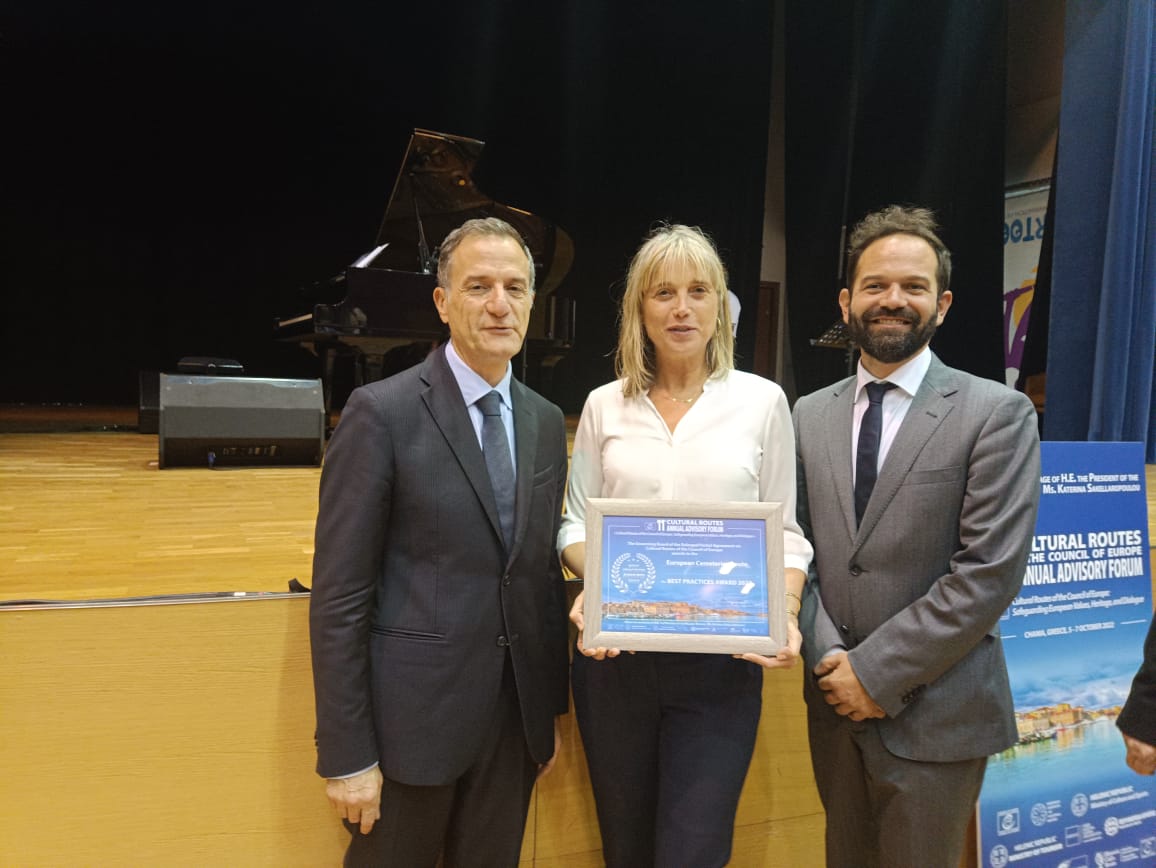
European Cemeteries Route received the Cultural Routes Best Practices Award by the Secretariat of the Enlarged Partial Agreement on Cultural Routes of the Council of Europe (EPA).

About the Cultural Routes Best Practices Award

The call for the “Cultural Routes Best Practices Award” was launched in 2022 by the Secretariat of the Enlarged Partial Agreement on Cultural Routes of the Council of Europe (EPA) in order to give recognition to best practices implemented by the certified Cultural Routes of the Council of Europe.

Award for Schools on cemeteries project

European Cemeteries Route received this exceptional award for the "Schools on cemeteries project", which has been implemented and developed for many years by European Cemetery Route members across Europe.

The ASCE president, Mrs Lidija Pliberšek, received the award certificate at the 11th Cultural Routes Annual Advisory Forum, that took place from 5th to 7th October 2022 in Chania, Greece.

The award is an important acknowledgement of the importance of the project. Thus, it will be further promoted and developed by the route management.

You can find more infromation about the project and the award itself HERE.


*On the photo from left to right: Mr. Stefano Dominioni (Executive Secretary of the Enlarged Partial Agreement on Cultural Routes of the Council of Europe and Director of European Institute of Cultural Routes), Mrs. Lidija Pliberšek (ASCE president and director of Pogrebno podjetje Maribor) and Mr. Julien Vuilleumier (Chair, Governing Board of the Enlarged Partial Agreement on Cultural Routes of the Council of Europe (EPA)).

Salgótarjáni Street Jewish Cemetery (Budapest, Hungary)

Salgótarjáni Street Jewish Cemetery (Budapets, Hungary)
Salgótarjáni Street Jewish Cemetery is a monument protected in its entirety and it recalls the 20th century tragedy of Hungary’s Jewry.

About the cemetery

Salgótarjáni Street Jewish Cemetery (Budapest, Hungary)
The Salgótarjáni Street Jewish Cemetery lies next to the Fiumei Road Cemetery and is separated from it only by a stone wall. The two of them represent the most prestigious cemeteries in Hungary where important personalities of the public, political and economic life, scientists, artists and athletes are buried. People who defined the history of Hungary in the 19th and 20th century. Both cemeteries are also unique for their architectural elements and tomb sculptures.

Much of the unparalleled built heritage of Salgótarjáni Street Jewish Cemetery is provided by the mausoleums of the business elite arising during the Age of Dualism. Furthermore, the remarkable atmosphere of this cemetery, which was opened to visitors in 2016, is given by the particular symbiosis of buildings and vegetation.

The cemetery recalls the 20th century tragedy of Hungary’s Jewry. For example, there is the mausoleum – ornamented with Jewish symbols and Hungarian motifs – of Vilmos Vázsonyi, the first Hungarian minister of Jewish origin, but there is also a memorial to the victims of the Budapest Ghetto, many of whom are buried here.

Important graves and monuments

Ceremony building (1908)
This building was designed by Béla Lajta. The tomb of Rachel of Bethlehem served as a model for its design. The dome collapsed decades ago, but the renovation is planned. Also the tomb of Vilmos Vázsonyi, the first minister of Jewish religion can be found near here.
Salgótarjáni Street Jewish Cemetery (Budapest, Hungary)

József Zwack (1916)
József Zwack was a liqueur and distillery manufacturer. He founded the well-known Zwack Unicum factory, which brand is now known all around Europe. He patented the Unicum brand and recipe in 1883. 
 
Ármin Herz (1917)
Herz Ármin is the founder of a salami factory. He made the Hungarian production of salami covered with noble mold a success. His brand became a Hungaricum (a thing or phenomenon unique to Hungary and representing great value) in 2014.

Graves of ghetto victims in Budapest (1945)
The grave of those who died in the Budapest ghetto and were buried in the graveyard after the liberation of the ghetto. According to cemetery books 2.700 people rest here.

Mausoleums along the walls (19th century - early 20th century)
There are 147 mausoleums in the cemetery, of which 126 are located along the cemetery walls. Building mausoleums is a unique feature of the neolog Jewish burial, which is unique also in Europe. Among them the Weiss Family (founder of Manfréd Weiss Steel and Metal Works in Csepel) and the Hatvany-Deutsch family (mayor producer in milling and sugar industry) are the most important.

Cemetery location

6 Salgótarjáni Street,
Budapest, 1086
Hungary

Postal address

16-18 Fiumei Street,
Budapest, 1086
Hungary

Contacts

Janos Prutkay
E-mail: janos.prutkay@nori.gov.hu
Phone: +36 70 382 90 57

Tourist information

The cemetery is opened from Sunday to Friday, and it is closed during Jewish religious celebrations.

Visitors can register for guided tours in advance. The tours are free of charge.

It can be reached by trams 37 and 37A.

More info on the website https://zsidotemeto.nori.gov.hu

Fiumei Road Cemetery (Budapest, Hungary)

Fiumei Road Cemetery (Budapest, Hungary)
The Fiumei Road Cemetery contains one of Hungary’s largest collections of statues and a fascinating arboretum-like landscaped area that has avenues harbouring 10 species of trees and 110 different birds.

About the cemetery

Fiumei Road Cemetery (Budapest, Hungary)
The Fiumei Road Cemetery was opened on the 1st of April, 1849 as a new public cemetery and by the turn of the century it became a national pantheon. Since the cemetery functioned as a public cemetery for a long time, the composition of those who rest here is extremely mixed, both nationally and religiously.


The cemetery lies next to the Salgótarjáni Street Jewish Cemetery and is separated from it only by a stone wall. The two of them represent the most prestigious cemeteries in Hungary where important personalities of the public, political and economic life, scientists, artists and athletes are buried. People who defined the history of Hungary in the 19th and 20th century. Both cemeteries are also very unique for their architectural elements and tomb sculptures. The 56-hectare green area of the Fiumei Road Cemetery in the centre of Budapest also serves as a recreational place for those living in the area.

Cemetery highlights

Wall tombs (after 1849)
The wall tombs were established after the opening of the cemetery, as most prestigious burial places for the citizens of the capital city. Its significance lies in the fact that this is a part of the cemetery that has been an unchanged, unified, cohesive part of the Fiumei Road Cemetery since its opening in 1849.

Fiumei Road Cemetery (Budapest, Hungary)
Arcade buildings (earley 20th century)
Once these spots for representative tombs were sold out, a complex of arcade buildings was established in the early 20th century with the aim of serving as the most representative burial site of the cemetery. The row of arcades, built in Art Nouveau style on the basis of the Italian example, consists of the richest tombstones of the capital, designed by the most famous sculptors of the period. The domes are decorated with mosaics covered in 23.5 carat gold leaf.

Apponyi mourning carriage (between 1928 and 1932)
At the entrance of the cemetery the "Apponyi mourning carriage" is presented. The nearly four-meter-high, five-and-a-half-meter-long carriage is considered to be one of the largest mourning carriages in the world. It was manufactured in Budapest between 1928 and 1932 and was used only four times for highly prestigious, protocol burials of famous statesman.

Important graves and monuments

Batthyány Mausoleum (1872-1874)
Fiumei Road Cemetery (Budapest, Hungary)
The mausoleum was designed by Albert Schikedanz and it is a highly prestigious building in its simple, terraced design. The decorative elements of the building are stone lions on both sides of the staircase, as well as reliefs on the walls: a portrait of Lajos Batthyány, the family coat of arms, and the Hungarian national coat of arms. A staircase leads down inside of the mausoleum. The special feature of the building is that it is only large mausoleum in the cemetery where free-standing coffins can be seen.

Deák Mausoleum (1887)
The mausoleum was designed by Kálmán Gerster. The dome of the 26-meter-high Neo-Renaissance mausoleum is covered with ornamental tiles from the famous Zsolnay porcelain factory. There is a 6 meter high bronze angel statue on the dome. The symbolic sarcophagus of Ferenc Deák can be seen inside the building. (This is the second sarcophagus as the original was destroyed during World War II.) The interior walls of the mausoleum are decorated with frescoes (covered with glass mosaics) of the allegorical figures of the four main virtues. 

Kossuth Mausoleum (1902-1909)
Fiumei Road Cemetery (Budapest, Hungary)The designers of this mausoleum were Kálmán Gerster and Alajos Stróbl. It is the largest funeral building in Hungary. The structure of the upper level evokes the Parthenon in Athens. At the top of the tomb a group of statues represent the revolution and the war of independence. Above the entrance, the female figure of Hungária, the symbol of the nation griefs the deceased on her throne. Two stone panthers on both sides of the staircase guard the entrance. The centrepiece of the mausoleum in form of a Greek Cross is a elaborately decorated sarcophagus made of green onyx. The interior walls are covered with mosaics of Murano glass gilded with 23.5 carat gold. The family members of Lajos Kossuth rest in the side of the mausoleum.

The tomb of József Antall (1999)
The grave memorial around the actual tomb was designed by Miklós Melocco. József Antall was the first democratically elected prime minister of the Hungarian Government after the regime change of 1989. The artwork depicts shrouded horseman figures pulling in four different directions, displaying both ancient Hungarian and Christian motifs at the same time. 

The grave of Imre Kertész (2019)
Designers are Rita Czakó and Máté Takács. In 2002, writer Imre Kertész won the Nobel Prize for Literature for “Fatelessness”, his autobiographically inspired novel about Holocaust. The tombstone is a bronze column with an open door. The door leads to immortality, eternity, infinity. On the back of the tomb you can read a quote from Imre Kertész's note "love redeems". 

Fiumei Road Cemetery (Budapest, Hungary)

Address

Fiumei Road Cemetery
16-18 Fiumei Street,
Budapest, 1086
Hungary

Contacts

Janos Prutkay
E-mail: janos.prutkay@nori.gov.hu
Phone: +36 70 382 90 57

Tourist information

The cemetery is opened every day of the year and offers free of charge guided tours for visitors.

It is located just a few minutes’ walk from the Keleti railway station where metro lines 2 and 4 stop.

More info on the website https://fiumeiutisirkert.nori.gov.hu

Pobrežje Cemetery (Maribor, Slovenia)

Pobrežje Cemetery
Cemetery Pobrežje was opened in 1879. With its rich 140-year history it is a part of the historical and architectural image of the Maribor city.

Park of Memories

This is a place of memory which appears in the list of the significant European cemeteries. Its calmness, tidy trails, green gardens and benches allow us to step back from the noisy city for a moment and think about memories in silence.

Our desire is to create a Park of Memories at cemetery Pobrežje. Like a green oasis of peace in the middle of the city with a rich cultural and historical heritage.

Cemetery Pobrežje consists of three parts:

  1. Town Cemetery: purchased in 1879 in order to gain more land for non-Catholic’s and poor, which was late in 1914 blessed by Catholic Church.
  2. Magdalena Cemetery: establish for the Catholics.
  3. Franciscan Cemetery: youngest and was establish in 1927 solely for Franciscans.

War monuments

There are three burial grounds connected to the war field heritage. The first one commemorates soldiers from World War 1; the second soviet war prisoners from 1941 – 1942; and the last one commemorates partisans warfare.

Address

Pogrebno podjetje Maribor
Cesta XIV.divizije 39/a
2000 Maribor
Slovenia

Contacts

Company management:
+386 2 480 09 00

Pobrežje Cemetery:
+386 2 480 01 32
+386 2 480 01 38

Other information:

Website
ARtour

ASCE at the Open Day in the Ministry of Foreign Affairs of Germany

ASCE
On the 25th of August there will be an "Open Day in the Ministry of Foreign Affairs of Germany" in Berlin.

Municipal Cemetery of the Capuchins (Mataró, Barcelona)

Municipal Cemetery of the Capuchins (Mataró, Barcelona)
The Catholic cemetery of the Capuchins began to provide services in 1817 and today consist of 13.612 graves.

About the cemetery

The Catholic cemetery of the Capuchins (Cementiri Municipal dels Caputxins) began to provide services in 1817, when members of the Board of Works of Santa Maria started to be buried at the top of the convent’s grounds. This area was then purchased by the Capuchin community in 1820. The rest of the estate of the Capuchins (including the ruins of the convent, abandoned because of the fire in 1835), was expropriated by the state and auctioned in 1844 as a “Bé Nacional” (National asset) where it was purchased by the Board of Works of Santa Maria. The same year, Miquel Garriga i Roca designed a new cemetery and a few years later, in 1876, the construction started. The new cemetery was located next to Catholic cemetery (recognized as the Protestant or Spiritualists cemetery). In 1982, the Catholic Church offered both cemeteries to the City Hall, which were then merged under the name Municipal Cemetery of the Capuchins.

Basic data

The Cemetery of the Capuchins is a municipal and civil cemetery, owned by the Mataró City Hall (Spain), managed by Cementiris Metropolitans CGC, S.L. and protected by the Local cultural heritage for the Government of Catalonia. It extends on the surface of 34.243 m² and holds 13.612 graves, of which 61 Pantheons, 56 Tombs and 13.497 Niches. The deceased are mainly Catalans of catholic religion.

Important graves and monuments

Some of the graves and monumenst on Municipal Cemetery of the Capuchins with historical and cultural meanings are:
  • Josep Puig i Cadafalch: He was born in Mataró and he was a “modernista” architect, the Catalan Art Nouveau, who designed many significant buildings in Barcelona like Casa Amatller, near the Casa Batlló, one of the most important buildings designed by Antoni Gaudí. Josep Puig i Cadafalch was the President of the Commonwealth of Catalonia (1917-24). He died in 1956 in Barcelona.
  • Miquel Biada i Bunyol: He founded in 1848 the first railway line in the Iberian Peninsula and that connected Barcelona with Mataró. However, he died 6 month before the inauguration so he couldn’t see his work.
  • Pantheon Marfà - Mesquera: Pantheon designed by Emili Cabanyes, 1906.
  • Josep Castellà i Vilà: He was a boat captain who transported people to New York, Cuba and Mexico during the war between Spain and USA. He repatriated soldiers after de Cuba’s war. He died in 1916 in Barcelona.
  • Domènec Rovira i Castellà: He was a young musician, an excellent pianist and the director of the Municipal Band of Mataró (1939-1944). He died in 1944, when he was 31 years old.
  • Tomb of the International Brigades:  Monument in memory for the international brigades that fought against fascism and dead in Mataró during the Spanish Civil War (1936-1939).
  • Eugeni Pere Cendoya Oscoz: He was an important architect and disciple of Lluís Domènech i Montaner, who was highly influential on “Modernisme català”, the Catalan Art Nouveau. He died in 1975 in Barcelona. The sculptor was Frederic Marès, a famous sculptor who was made a lot of urban sculptures in Barcelona.


*Photo source: www.cementeriosvivos.es

Cemetery address

Carretera de Cirera, 239,
08304 Mataró
Barcelona
Spain

Contacts

Tel: +34 93 7574767
Fax: +34 93 7986905
Email: administracio@cementirismetropolitans.com

Vår Frelsers Cemetery (Oslo, Norway)

Vår Frelsers Cemetery (Oslo, Norway)
Vår Frelsers Cemetery - the romantic park where Munch and Ibsen rest in peace.

History

When Vår Frelsers Cemetery was consecrated on June 17, 1808, it was primarily a cemetery for well-to-do Oslo citizens. Those who lived in the city were affluent, and at that time, it was possible for the rich to by a burial plot before they died, something the poor could not afford to do.

In 1864, a Chapel was first built in the eastern section of the burial grounds and was later altered a number of times. The plain stone building was used for funerals about ten times per year and one of the reasons for such limited use was that those being buried were often rich and their funerals took place in one of the two important churches in Oslo at that time, Trefoldighetskirken (Trinity Church) and Oslo Cathedral.

By 1911, the cemetery was full. Afterwards, new plots were only created on the sites of those whose lease had expired. After 1952, no new plots were allotted, although it was still possible to intern urns in old family graves. From now on, it is again possible to acquire a new urn plot in the honorable cemetery.

Cemetery as a historical monument

Today, the cemetery is listed for preservation and is regarded as an important historical monument. Therefore, old graves monuments cannot be removed and it is not permitted to erect new ones. 4500 monuments are registered as especially worthy of preservation; 1600 graves of significant national or local personalities in the field of economics, politics and culture from the last half of the eighteenth century to the mid-twentieth century were recorded in a database.

Garden of honor

The most important feature, in the heart of Vår Frelsers Cemetery, is the Garden of honor. The idea of a “garden of honor” for the most significant Norwegian citizens first surfaced around the end of the nineteenth century. This explains why so many important people are buried outside its edges. In 1903, the artist Hans Gude was the first to be buried in the garden and, after 1981, no new graves were created.

Two of the famous Norwegians who found their final resting place in the garden are painter Edvard Munch (1863-1944) and author Henrik Ibsen (1828-1906). The paintings “The Scream” and “Madonna” have granted Munch worldwide renown, and he drew his inspiration for them from his home and from the Oslo community of artists to which he belonged. Ibsen’s play “Brand” and “Peer Gynt” made him the best-known and controversial writer in Scandinavia. However, outside Norway, he is known above all for his drama “A Doll’s House”. No Nordic author matched him in depicting his contemporary times, or had such a world impact as his bourgeois dramas did.

Characteristics of the cemetery

Classicism and Romanticism are the two styles that characterize the cemetery in their own ways. Romanticism features throughout the cemetery, and shady copses, narrow paths and rocky outcrops are all reminders of the nature of Norway. Classicism appears most strongly in the details, in the use of symbols and in the design of individual monuments, especially in the oldest section of the cemetery. Functionalism, with its unbroken lawns and non-elaborate, plain monuments plays a significant role in the current Vår Frelsers Cemetery panorama.

Address

Vår Frelsers Cemetery
Akersbakken 32
0172 Oslo kommune
Norway

Contacts

Phone: +47 22 13 31 80
Fax: +47 52 51 60
Email: varfrelsers.gravlund@gfe.oslo.kommune.no

Website: www.oslo.kommune.no

Eastern Cemetery (Innsbruck, Austria)

Eastern Cemetery (Innsbruck, Austria)
Today, Eastern Cemetery covers an area of approximately 67.700 m2.

About the cemetery

The Eastern Cemetery was built according to the plans of Eduard Klingler between 1912 and 1913. 

In November 1915 new burial grounds for fallen soldiers were built beyond the cemetery walls to the south and west, and in 1930 these were integrated into the Eastern Cemetery in Pradl.

In 1985 the cemetery was expanded generously towards the southwest with a new sector (Eastern Cemetery 2). The consecration hall is decorated with Nazarene paintings and a painted coffered ceiling.

The soldiers' chapel, which is located in the south of the cemetery, was built in 1916 according to the plans of Theodor Prachensky.

Some of the other important gravesites are:
  • Grave of the lonely - used for the burial of single people or those who want an anonymous grave.
  • Children's field - used for the burial of babies and small children.
  • The bomb victims' grave - contains the remains of 108 victims of air raids in World War II.
  • The anatomy monument - memorial to the persons who donated their bodies to the medical and scientific purposes.


*Photo source: www.wikipedia.org

Cemetery Address

Kaufmannstraße 1 (old part)
Wiesengasse 100 (new part)
Innsbruck
Austria

Cemetery opening hours

November to February: 7.30 - 17.00
March to October: 7.30 - 18.00
April to September: 7.30 - 19:00

Administration Contacts

Kaufmannstraße 1
Innsbruck
Austria

Tel.: 0512/5360-7145

Western Cemetery (Innsbruck, Austria)

Western Cemetery (Innsbruck, Austria)
A 19th-century cemetery with unique Jewish heritage in Tirol, and notable neo-gothic art and architecture.

About the cemetery

The Western Cemetery was built between 1856 and 1858 according to the plans of Carl Müller, with a southern expansion added in 1889. In the 1920s, the site was significantly developed: the cemetery chapel was rebuilt and enlarged with a chapel of rest (1926–1927), a columbarium was established in 1927, and residential and administrative buildings were constructed.

The cemetery suffered considerable damage during World War II due to air raids, followed by restoration and reconstruction efforts in the 1980s; the columbarium was also expanded in 1959. In the southern section, the Jewish and Evangelical cemeteries are separated by walls, with the Jewish cemetery holding particular significance as the only one in Tirol and the burial place of several notable figures.

The cemetery’s character is shaped by a rich interplay of art, architecture, and sculpture. Highlights include frescoes by Franz Plattner in the neo-Gothic chapel and statues by Franz Santifaller in the consecration hall, while honorary graves are located within the arcades.

Today, the Western Cemetery spans approximately 47.700 square meters.

Cemetery address

Fritz-Pregl-Straße 2
6020 Innsbruck
Austria

Administration Contacts

Tel.: 0512/5360-7142

Cemetery opening hours

November till February: 7.30-17.00
March till October: 7.30-18.00
April till September: 7.30-19:00

New Cemetery Mühlau (Innsbruck, Austria)

New Cemetery Mühlau (Innsbruck, Austria)
The New Mühlau Cemetery, commonly referred to as the Mühlau Cemetery, is the final resting place of Georg Trakl and many other notable poets.

About the cemetery

The construction of a new cemetery in Mühlau was agreed on in 1914/15 and it was built in 1926 according to the plans of architect Willi Stigler. In 1986 a generous expansion towards the north according to the plans of Luis Nothdurfter was carried out.

Several well-known personalities found their final resting place here, such as:

  • Georg Trakl,
  • Ludwig von Ficker,
  • Josef Leitgeb,
  • Gerhild Diesner,
  • Wilfried Kirschl,
  • Heinrich Caesar Berann,
  • Hermann Alexander Graf Keyserling,
  • and others.

The most famous among them is certainly the poet Georg Trakl. He is considered one of the most important Austrian Expressionists.

Other characteristic features of the cemetery are its location directly at the edge of a wood, the stunning view of Innsbruck and the unbelievably mountain scenery.

Today, the Mühlau Cemetery covers an area of approximately 10,400 m2.

Cemetery address

at the Mühlenweg

Administration Ccontacts

Fritz-Pregl-Straße 2
Tel.: 0664/154-90-42 or 0512/5360-7142

Catholic Cemetery Dubovac (Karlovac, Croatia)

Catholic Cemetery Dubovac (Karlovac, Croatia)
Near Karlovac, under the walls of the Old Town Dubovac, which dates from the 12th century, there is the old Catholic cemetery on Dubovac.

The Company Zelenilo d.o.o.

Zelenilo d.o.o. from Karlovac is a company owned by the City of Karlovac. The company exists and works in the city Karlovac for more than 50 years. It operates with cemteries that are located in the metropolitan area and they are in property of goverment the Karlovac City. For all the visitors of these cemeteries we published, in the year 2007, the monography "Karlovac cemeteries." It can serve as a guide, and is intended for those who are also reading the history of the city at the cemetery. It describes in detail all the graves of famous people, monuments and works of art. Because "with the appearance of the cemetery, the richer and poorer areas are discovering the truth of their taste."

About the cemetery

Near Karlovac, under the walls of the Old Town Dubovac, which dates from the 12th century, there is the old Catholic cemetery on Dubovac. It was founded in the year 1820 in the place which in the 17th and 18th century served for burying the dead from the plague. For the decoration the cemetery was positively impacted by the construction of Mirogoj Cemetery Zagreb. The impact of Mirogoj construction is seen in Karlovac where several families build their tombs so that the outer wall of the operational fence is toward the road while the inner side of the tomb is designed with pilasters and arcades. The turning point in the history of the cemetery is in 1899, when the city government issued "Regulations on the cemetery at Dubovac", and since then burial and cemetery maintenance becomes a concern of the City.

Important monuments

At the entrance to the cemetery there are four first-class architectural monuments. These are the mausoleums of families Vranytzany and Turk, and tombs of families Hoffman and Turkovic. The Vranytzany Mausoleum was built in 1885 and was designed by famous architect Otto von Hofer, while the Turk Mausoleum is the work of Zagreb architect Pound Waldman from 1892. The model for the construction of Hoffman's tomb was a Greek temple. The Turkovic family tomb is the oldest tomb and was built by the famous Karlovac merchant and politician Wenceslaus Turkovic.

The oldest tombstone is a distinguished classical obelisk for Karlovac merchant Mihalj Stipić. On the pedestal there is an epitaph written in Latin, and a kind of Stipić resume.

Among the important monuments worth mentioning are: "The Chapel of All Saints" with a mortuary from 1870, the tombs of mayors of Karlovac, and the grave of writer and "first lady of the Illyrian era", Dragojla Jarnević, along with many graves of other deserving people of Karlovac.

A place of memory

For all those who visit this cemetery, the monuments, the smell of flowers and candles, the sound of trees and birds singing reminds them that this is a place of memory, reflection and encouragement. From trees, the conifers dominate. Evergreens symbolize eternal life and the trees that grow in height are symbols of connecting the Earth with Heaven and the way to eternity.

Contacts

Zelenilo d.o.o.
Put D. Trstenjaka 6
47000 Karlovac
Croatia

Phone: 047/609-920
Website: http://www.zelenilo.hr/


*𝘗𝘩𝘰𝘵𝘰 𝘴𝘰𝘶𝘳𝘤𝘦: 𝘸𝘸𝘸.𝘻𝘦𝘭𝘦𝘯𝘪𝘭𝘰.𝘩𝘳

Flaybrick Memorial Gardens (Birkenhead, United Kingdom)

Flaybrick Memorial Gardens (Birkenhead, United Kingdom)
Rapid growth in Birkenhead's population made it necessary for the provision of a municipal cemetery.

About the cemetery

The cemetery was originally planned in the 1840s and Joseph Paxton was approached to make a design but due to the recession and subsequent decrease in population the plan went no further.

By the 1860s, the construction of a municipal cemetery was made a priority. A competition was held for the design which Edward Kemp, Curator of Birkenhead Park won. The site chosen was Flaybrick Hill, a prominent location outside of Birkenhead overlooked by Bidston Hill. 16,5 acres were purchased but were later extended to 26 acres in the 1890s. Kemp was assisted by Edward Mills, a prominent Birkenhead surveyor from Hamilton Square, and Messrs Lucy and Littler, architects of Liverpool. The general contractor was William Rimmer of Bidston Hall, with John Miller of St. Helens the contractor for buildings.

The cemetery was officially opened on May 30th, 1864, and named Birkenhead Cemetery. Three Chaples were built on the site. One is the Roman Catholic Chapel which was demolished in 1971 and a Memorial Wall erected on its site. The two other Chapels are for the Non-conformists and the Church of England. They were last used in 1975. The Registrar's office and Sexton's Lodge are now in private hands.


*Photo source: www.wikimedia.org

Address

Flaybrick Hill Cemetery
Tollemache Rd
CH41 0DG
United Kingdom

St. Nicholas and St. Mary Cemetery (Berlin, Germany)

St. Nicholas and St. Mary Cemetery (Berlin, Germany)
St. Nicholas and St. Mary Cemetery is devided in the old and new part, named St. Nicholas and St. Mary Cemetery I and St. Nicholas and St. Mary Cemetery II.

About the cemetery

The St. Nicholas and St. Mary Cemetery I is located in Berlin's Prenzlauer Berg district of Pankow. It is right on the Prenzlauer Allee and is the final resting place for the parishioners of Mary and St. Nicholas' Church.

The opening of this cemetery dates back to the year 1802. At that time, however, the cemetery covered only a very small area, so that an extension was necessary already in 1814 and then again in 1847. This area is referred to as the Old Cemetery of St. Nicholas and St. Mary's church.

Another acquisition in 1858, covered the area of Prenzlauer Allee No. 7, which today is the St. Nicholas and St. Mary Cemetery II or the New Cemetery of St. Nicholas and St. Mary's church.

Together, the two cemeteries comprise an area of approximately 65,000 square meters.

Cemetery address

Prenzlauer Allee 1 / Prenzlauer Allee 7
10405 Berlin
Germany

Cemeteries at Hallesches Tor (Berlin, Germany)

Cemeteries at Hallesches Tor (Berlin, Germany)
This cemetery complex consists of six cemeteries that were established at the beginning of the 18th century, at that time still outside the city gates.

About the cemetery

The Cemeteries at Hallesches Tor can be traced back to 1735. In terms of its cultural history, it has become the most significant burial site in West Berlin.

Among the most beautiful works of art are the heads of two women by the “Art Nouveau” sculptor Ignatz Taschner. They decorate the gravestones of the landscape painter Karl Wilhelm Bennewitz von Loefen and his wife.

The area includes a total of twenty-two famous graves, among them the poets E.T.A. Hoffmann and Adelbert von Chamisso, the architects David Gilly and Georg Wenzeslaus von Knobelsdorff, the composer Jakob Ludwig Felix Mendelssohn Bartholdy, his sister Fanny Hensel, his parents and other family members and many others.

Cemetery address

Mehringdamm 21
10961 Berlin
Germany

Website

www.evfbs.de

Cemetery of the March Revolution (Berlin, Germany)

Cemetery of the March Revolution (Berlin, Germany)
The Cemetery of the March Revolution is a cemetery in the public park in the Berlin district of Friedrichshain.

About the cemetery

It was designed by the Berlin architect Ludwig Hoffmann in 1925 and it is the burial place and a memorial to the heroes and victims of the 1848 March Revolution and the November Revolution of 1918 in Berlin.

The Cemetery of the March Revolution was restored in 1948 when it acquired the name  Märzgefallenen, and again in 1957. Today in the cemetery you can find 18 grave plates, three iron grave crosses, a stele and two grave monuments made of cast iron.

Address

Friedhof der Märzgefallenen
Ernst-Zinna-Weg 1
10249 Berlin
Germany

Contacts

Memorial Site Friedhof der Märzgefallenen
Paul Singer e.V. (Office)
Strausberger Str. 39
10243 Berlin
Germany

Email: kontakt@paulsinger.de

Website: www.friedhof-der-maerzgefallenen.de

The Dorotheenstadt Cemetery (Berlin, Germany)

Dorotheenstadt Cemetery (Berlin, Germany)
The Dorotheenstadt Cemetery was established for the new Berlin parishes developing during the reign of Kaiser Friedrich the Great.

About the cemetery

The Dorotheenstadt Cemetery was founded in 1780 as the "Dorotheenstädtisch-Französischer Friedhof" (Dorotheenstadt French Cemetery) by the protestant French Huguenot community in Berlin.

It is certainly worth to visit because of the many illustrious personalities of German culture that lie buried here. On the tombstones are names such as Schinkel, Schadow, Fichte, Hegel, Dessau, Brecht and Weigel.

Furthermore, on the northern edge of the cemetery is located the house of German poet, playwrighter and theatre director Berthold Brecht (1898-1956) and his wife, actress Helene Weigel (1900-1972). They lived there from 1953 until their deaths. The house contains manuscripts, typescripts and collections of Brecht’s printed works.

Address

Chausseestraße 126
10115 Berlin

Contacts

Ev. Friedhofsverband Berlin Stadtmitte (Geschäftsstelle)
Südstern 8-10
10961 Berlin

Phone: (030) 612027-14
Email: info@evfbs.en

Website: www.evfbs.de

General Cemetery of Valencia (Valencia, Spain)

General Cemetery of Valencia (Valencia, Spain)
The cemetery was inaugurated in the morning of Sunday 7th June, 1807, and the first deceased was buried the next day.

History of burials

With Christianity, people got used to bury the dead near churches. At first, the graves were on the outside of the temples and along its walls. As the faithful went to the place to do their religion duties, it was necessary to put these early graveyards under cover of the ravages of time. So, soon the halls and the arcade were built, which were the origin of the chapels where the faithful gathered when they wanted to pray over the graves. This burial ground was joint to the church itself through porches and arcades, until it was shut to separate it from the church building but forming a continuation of the religious center itself.

Cemeteries outside the city walls

The parish burial practice remained in Spain until the second half of the eighteenth century. In 1785 Benito Bails had written a work to stress how detrimental it was for people to keep parish cemeteries within towns. In 1786 the councilor Tomás Pascual de Almunia, representative of the nobility, had also advocated the closure of all cemeteries inside the city walls. The proposal had also the approval of the Faculty of Medicine. It was then Carlos III who would issue a Royal Order, on April the 3rd, 1787, outlawing such custom and ordering the setting-up of cemeteries away from the city, as a measure against previous unhygienic and unhealthy practice.

Beginning of the General Cemetery of Valencia

In Valencia, the law was fulfilled in the nineteenth century with the Proclamation of April 26, 1804, issued by Manager Chief Magistrate Cayetano de Urbina. It was from that moment that truly begins the demolition of the parish cemeteries in Valencia and the creation of a General Cemetery for all its citizens.

The profits from the sale of land from parish cemeteries was used to actual construction of the new cemetery. The project was designed by the city architect Cristóbal Sales, in partnership with fellow architect and scholar Manuel Blasco, and was approved by the Fine Art Academy of San Carlos. The new cemetery was located at the mill land Molí de Tell, along the path of Picassent. Work began in July 1805 and concluded in 1807. The cemetery was inaugurated in the morning of Sunday 7th June, 1807, and the first deceased was buried the next day, using a common grave. A year after the official opening the first 80 tombs were rosen.

Cemetery development

After thirty years of its opening all capacities of the cemetery were exceeded tand fully occupied. That's when first enlargements happened.

In 1846 it was built the first Mausoleum: the one of Juan Bautista Romero, followed by the ones of the family Dotres and White-Llano.

In 1876 a new expansion was approved. Around 1880 the terms to build new tombs and porticoes were adopted. According to the original plans from the 1871, it was decided to use the area of over 15.000 square metres in the current section 3. There are the so-called Gates or Columns Gallery - a gallery formed by 170 robust monolithic columns and Doric capitals. The works, which were completed in 1892, were paid by the profits from the sale of the mausoleum lands.

In 1886 the waiting room was built and in 1907, the Patio de las Palmeras. Architects like Sebastian Monleón, Joaquin Maria Arnau, Francisco Almenar, Gerardo Roig, Vicente Sanchoand Antonio Martorell, designed the mausoleums with renowned sculptors of the era: Mariano Benlliure, Ricardo Boix, Eugenio Carbonell, Carreras and Alfonso Gabino, to name some of them, that along with other professionals, helped to give splendor to the current image of the cemetery.

In following years, the common graves were opened to bury the dead, according to the circumstances of death and the time lived. Epidemics of the Nineteenth Century and especially the Civil War (1936-1939) caused the necessity for this type of burial.

In the decades of the 50’s to 80’s, there is an extensive development of the cemetery. The economic boost and the population growth produced an increase in burials and the emergence of more artistic headstones, which, in turn, introduced a changing image of the cemetery.

In March 1988, following the Mortuary Sanitary Police’s new laws, Municipal Crematorium opened. An Avant-garde building, designed by the architect Fernando Romeu, being surrounded by tall eucalyptus, palms and pines. An evocative Garden of Remembrance for the burial of ashes was allocated in Section 11, composed of four quadrants and a pyramidal mound in the center. One of another recent constructions is the City Funeral Home (2000), a modernist design building planned by architect Jordi Pinyol.

Currently the cemetery is divided into 21 sections, with their quadrants, blocks, letters and numbers, individual in each of the blocks. Section 20th, the most recently built, is located in the southern area of the city near the new river channel, next to the Funeral Home and the administrative offices.

Islamic Cemetery

Following the November 1992 law,  the Islamic Cemetery was constructed by section No. 14 in the year 2000 and with the agreement on the Islamic Community of Valencia. This new installation has two entrances. The first is used for family visits, it is connected to the General Cemetery and it exhibits a horseshoe arch at the gate with the Islamic Cemetery identification written in Arabian. The second one is used exclusively for burials and leads directly to the outside, facing the district of San Isidro.

Address

SOCIEDAD ANÓNIMA AGRICULTORES DE LA VEGA DE VALENCIA (SAV)
Plaza Santo Domingo de Guzmán, nº 27
Camino Viejo de Picassent s/n.
46017 - Valencia, Spain

Contacts

Tel.: 96 352 54 78 (extensions 2502-2807-2808)
Fax.: 96 378 22 90

E-mail: sercementerios@valencia.es
Website: www.ayto-valencia.es