Showing posts with label The Non-Catholic Cemetery. Show all posts

Vacancy for Director of the The Non-Catholic Cemetery in Rome

The Non-Catholic Cemetery (Rome, Italy)
The Non-Catholic Cemetery in Rome is seeking a director. Applications deadline is July 11, 2022.

The Non-Catholic Cemetery for Foreigners in Rome is seeking a DIRECTOR

The Director of the Non-Catholic Cemetery for Foreigners in Rome will be responsible for managing the funerary activity of an active burial-ground which is also widely recognised as a historic site of great cultural significance.

Main functions

The main functions are: organisation of funerals, burials and commemorations, and planning and implementation of a long-term strategy; administration, human resource management, site maintenance and protection, visitor management and external relations. The Director reports to the President of the Assembly of Ambassadors which is responsible for the Cemetery, and to the Advisory Committee.

Conditions

The following are required: experience of financial management in a cultural organisation, excellent knowledge of written and spoken Italian and English, strong skills in interpersonal relationships, good computer skills, ability to work independently and to delegate and coordinate with consultants as required, and above all integrity, enthusiasm and empathy.

The terms and conditions of employment will be reviewed with successful applicants.

Application procedure

Further details for submitting applications should be requested from vacancy@cemeteryrome.it
Deadline for submitting applications is midnight 11 July 2022.

Job starting date: 1 January 2023.


Il Cimitero Acattolico per Stranieri di Roma cerca DIRETTORE

Al Direttore del Cimitero Acattolico per Stranieri di Roma spetta la gestione dell'attività funeraria di un attivo cimitero, ampiamente riconosciuto anche come luogo storico di grande rilevanza culturale.

Funzioni principali

Le funzioni principali sono: organizzazione di funerali, sepolture e commemorazioni e pianificazione e attuazione di una strategia a lungo termine; amministrazione, gestione delle risorse umane, manutenzione e protezione del sito, gestione dei visitatori e relazioni esterne. Il Direttore riporta al Presidente dell'Assemblea degli Ambasciatori che è responsabile del Cimitero, e al Comitato Consultivo.

Condizioni

Sono richiesti: esperienza di gestione finanziaria in un'organizzazione culturale, ottima conoscenza della lingua italiana e inglese scritta e parlata, spiccate capacità nelle relazioni interpersonali, buone competenze informatiche, capacità di lavorare in autonomia e di delegare e coordinarsi con consulenti secondo necessità, e soprattutto tutta integrità, entusiasmo ed empatia.

I termini e le condizioni di lavoro saranno esaminati con i candidati prescelti.

Procedura di domanda

Maggiori dettagli per la presentazione delle domande devono essere richiesti a vacancy@cemeteryrome.it
Il termine per la presentazione delle domande è la mezzanotte dell'11 luglio 2022.

Data di inizio del lavoro: 1 gennaio 2023.

A theatrical performance at the Non-Catholic Cemetery in Rome

The Non-Catholic Cemetery in Rome (Italy)
On 23th June 2016, a theatrical performance will take place in the Cemetery Chapel at the Non-Catholic Cemetery in Rome.

The Maritime Cemetery of the Island of Capri (Italy)

Cemetery of Capri (Italy)
Hidden by the shadow of cypresses and forest trees, in a position protected by winds, this cemetery contains the tombs of more than 2000 deceased.

The grave as a home and the literary garden

The Catholic and non-Catholic cemeteries lie below the rock face of Mount Solaro, on the north side of the coast, facing the Gulf of Naples. Where the slope diminishes and the main streets branch off, the entire complex extends along the terraces of the quarter of Aiano di Sotto, facing the port area of Marina Grande at about 130 meters above sea level. Hidden by the shadow of cypresses and forest trees, in a position protected by winds, the two cemeteries contain the tombs of more than 2000 deceased. The cemeteries were built almost contemporarily after 1870, one close to the other. The municipal cemetery, situated in an upper position, is separated by the non-Catholic one by high walls. From the common entrance situated in the sharp bend on the street leading to Marina Grande, the flight of steps going to the upper cemetery starts. The visit starts at the entrance of the non-Catholic cemetery at the beginning of the curvilinear flight.

The difference between the two cemeteries is the anthropologic and architectonic value of the tombs, which expresses a different way of conceiving burial sites. The anglo-saxon concept identifies itself with the image of a garden as a place of rest and meditation, where the luxuriant vegetation and the tombs complement each other and look at the landscape. In the fields where foreign people from 21 nationalities are buried, the funeral celebration expresses itself in many examples of monuments made of marble, as burial monuments, small obelisks, sarcophagi with horizontal crosses and headstone facing the sea. Literary quotations are written on the more important tombs and on the simpler ones describing the lives of the dead. Family Chapels dominate in the Catholic cemetery as in many Mediterranean graveyards; the Catholic cult of the last abode housing the mortal remains of the dead, has a funeral architecture with different peculiarities, sometimes close to building typologies of the houses of living people.

The trend and the distribution into plots of the noble chapels seems to imitate the settlement trend typical of the caprese landscape, reproducing the architectural features of the place. The environmental quality, the univocity of the site and the promiscuity of the historical and monumental values identify the whole as a unique maritime cemetery.

The entire cemetery area extends from south-east towards north-west, along the ground terraces that cover a gross surface of almost a hectare. Close to the road to Anacapri, with the entrance from the curve of the street to Marina Grande, the maritime cemetery lies at a small distance from the more ancient inhabited centre and is easily reachable from the two main churches: the church of San Costanzo in Marina Grande (XI-XII and XIVcentury) and the church of Santo Stefano (XVII century), located in the "piazzetta" of Capri.

The Catholic cemetery

The history of the two cemeteries dates back to the second half of 1800, when, as is well known, first with Napoleon’s edicts at the beginning of the century and then the royal decree approving the law on public health in 1865, instituted municipal cemeteries, in opposition to canon law that till then had established burial in consecrated places, such as churches and graveyards. The plan of the old Catholic cemetery was drawn up in Naples in 1874 by the engineers M. Bottari and A. Giordano. On the tongue of a small rural field it was born the first area of 1820 square metres with a regular plan and at the same height, another area of 870 square metres. In the document of the plan is related another enlargement of 1278 square metres, drawn up in 1891 by engineer E. Mayer that fits to the irregular surface of the terrace.

The more ancient entrance zone of the cemetery area is crossed from a central tree-lined path, that leads to the Holy Mother Chapel. On the sides of the path there are ground tombs, whose simplicity is exalted by many votive figures finely decorated. Behind the mortuary chapel and along the wall which bounds the area occupied by the confraternity of San Filippo Neri, with relative chapel, you arrive at the most representative area of the Catholic cemetery: a real residential quarter, divided into different lots with many units of burial and each one occupied by wonderful examples of noble chapels surrounded by flowerbeds, by magnificent tombstones placed on terraced bases and by small neoclassic style temples. Many of these monuments were built at the beginning of 1900, according to the teaching of the local tradition, and each of them represents, in a different way, the past styles and the tastes of the current period.

The non-Roman Catholic Cemetery

The presence in Capri, in the late 1800, of a numerous colony of foreign people, landing on the Island to discover its romantic myth, resulted in guests from beyond the Alps who died in Capri having a respectable burial. As indicated in the original municipal plan, a small piece of ground on the lower terrace was used to build the non - Catholic cemetery. Founded in 1878, thanks to the will of an English man, George Hayward, secretary of the committee for more than 30 years, the cemetery occupied firstly a rectangular surface of 780 square meters, with a tortuous entrance path made of cobblestones, a storage room and four lines for burial.

In the next decade, close to the death chamber, on an area of 16 square metres, the family Cerio’s chapel was built by one of the most known descendants of this family, Ignazio, doctor and famous character of Capri, who, at that time had frequent relationships with the foreign community present on the island, and held, in 1898, the office of President of the institution. In the same year, another enlargement of about 360 square meters was added on a rural field below the old cemetery and linked to this one by a small flight of steps.

The administrative and financial management of the board had difficult moments after the first world war and, although there were various attempts at enlargements through the sale of nearby fields (600 mq) the realization of small enlargements (1957) and the slow and progressive annexation of the complex in the municipal cemetery, happened definitively only in the last decade of the last century.

The garden holds the mortal remains of famous Anglican, Lutheran, Calvinist, Greek-Orthodox and Jewish guests buried there. There are numerous examples of funeral monuments where the classic style and the the clear-cut language from north Europe meet. The spiritual and linguistic uniqueness of the site is recognizable in the composition of the sculpture that are based on the ground and in the details of the artistic decorations that increase the value of lityc patterns. Many gravestones become reading stones thanks to epitaphs and moral aphorisms written on them so making the cemetery a literary cemetery.


*Text by arch. Gianvito Conte
**English text by prof. Anita de Pascale

Contacts

Cemetery of Capri
Via Provinciale Marina Grande
80073 Capri (Na)
Italy

Tel: (+39)08183866226
Email: cimitero@cittadicapri.it

The Non-Catholic Cemetery (Rome, Italy)

The Non-Catholic Cemetery (Rome, Italy)
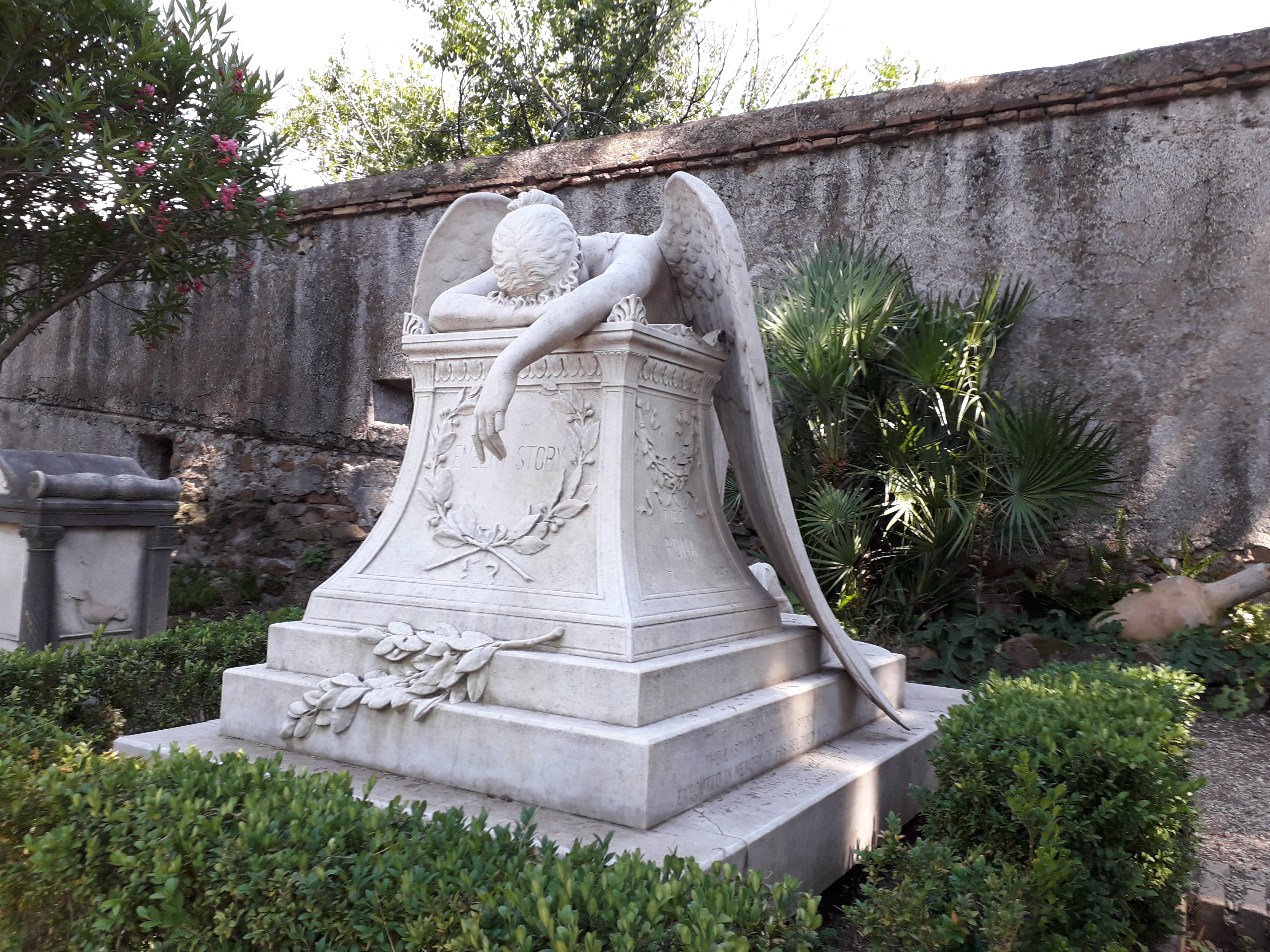
Rome's Non-Catholic Cemetery contains possibly the highest density of famous and important graves than anywhere else in the world.

About the cemetery

This cemetery is the final resting-place of many important persons, such as poets Shelley and Keats, of many painters, sculptors and authors, a number of scholars, several diplomats, Goethe's only son, and Antonio Gramsci, a founding father of European Communism, to name only a few.

The Non-Catholic Cemetery for Foreigners in Testaccio, Rome (to give it its full name) is also widely known as the Protestant Cemetery although it contains the graves of many Orthodox Christians, Jews, Muslims and other non-Christians. It is one of the oldest burial grounds in continuous use in Europe, having started to be used around 1730. It was also referred to in the past as ‘The English Cemetery’ because of the many English people buried there.

It is hard to think of another urban site quite so glorious. Its towering cypress trees and abundant flowers and greenery shelter a heterogeneity of elaborate and eclectic graves and monuments, nestled on a slope in the shadows of the Pyramid of Cestius (dated between 18 and 12 B.C.) and adjacent to a section of Rome's ancient Aurelian wall.

"It might make one in love with death, to think that one should be buried in so sweet a place," wrote Shelley, not long before he drowned and was buried here.

Throughout the 19th century and into the 20th, the little Cemetery was something like a pilgrimage site, revered by authors. Daisy Miller, the heroine of Henry James's eponymous novella, was buried there. After an audience with Pope Pius IX in 1877, Oscar Wilde visited the Cemetery, proclaiming it "the holiest place in Rome." 

The Cemetery is a private one but is operated in accordance with national and municipal regulations concerning cemeteries and historic sites. A board of foreign ambassadors resident in Rome is ultimately responsible for its operations (Governance and Funding). Burials continue to be made today of those who qualify. Other than income derived from burial and tomb maintenance fees, we are dependent on donations, fundraising and volunteers to keep the Cemetery the tranquil and beautiful place that it is.

Tourist information

Group Visits 

The Non-Catholic Cemetery welcomes group visits. For organisational reasons we ask you to please email the Cemetery on ornella.forte@cemeteryrome.it at least a week in advance to book your visit specifying where the group is from, name and contact details of group leader/guide, date and time of visit and approximate number of people.

Groups are kindly asked to leave a donation of at least 3,00 EUR per person. All donations go towards the upkeep of this important historical site.

Guided Tours 

The Cemetery can provide a guide in Italian, English or German for groups of 5 to 20 people. The tours last approximately one hour. Please book your tour at least a week in advance as described above.

For guided tours kindly leave a donation of 6,00 EUR per person (for schools 3,00 EUR per person). All donations go towards the upkeep of this important historical site.

Notes for group leaders 

Group leaders should read the Regulations for Visitors and make sure their group members abide by these. If you book a tour and need to cancel or think you might be late, please call the Cemetery as soon as possible.

On arrival please report first to the Visitors’ Centre to leave donations and gather further information.

You are reminded that the ground in the Cemetery is uneven – comfortable shoes are a must! Toilets are available but there are no refreshment facilities – there are plenty of bars and restaurants in the nearby Testaccio area a few minutes walk from the site. To plan your tour better, you might like to consult the map of the Cemetery. To find out about our latest activities see our Newsletters. If you would like to support the Cemetery click on Friends or become a Volunteer.

There is an excellent view of the Pyramid of Cestius from the site, but it is not possible to access the pyramid from the Cemetery.

Cemetery address

Cimitero Acattolico
Via Caio Cestio, 6
00153 Roma
Italy

Contacts

Tel: + 39 06 574 1900
Fax: + 39 06 574 1320
Email:mail@cemeteryrome.it
Website: www.cemeteryrome.it

Main entrance address

Via Caio Cestio, 6
00153 Roma

Opening hours

Monday - Saturday: 9.00 - 17.00
(last entrance at 16.30)

Sundays and public holidays: 9.00-13.00
(last entrance at 12.30)

How to get there

Buses
3-75-23-60-95-280-30-175

Metro
Underground B line to Piramide