Showing posts with label Dublin. Show all posts

AGM 2016: Photo glimpses

AGM 2016: Photo glimpses
First official photos of the AGM and Conference 2016.


➤ Ahead of full albums here are the first official photos. You can see them in the album at the following link.

AGM 2016: Detailed location at Dublin castle

AGM 2016: Detailed location at Dublin castle
Guidelines for Getting to the AGM and Conference at Dublin Castle.

AGM 2016 and Conference will take place on the 6th,7th and 8th of October at Dublin Castle and Glasnevin Cemetery

Detailed map of how to reach the Dublin castle is available at this link. Conference is taking place in Georges Hall in the West Range Suite of conference rooms.

There will be a member of the castle staff to direct ASCE members to the entrance to the conference.

You can check the position of the hall up in front at this page.

AGM 2016: Programme

AGM 2016: Programme
Programe of the Annual General Meeting and Conference 2016, taking place from 6 to 8 October in Dublin, Ireland.

The program development is still in progress and may be changed within following week.

Title of the conference: Conflict, Memorialization = Reconciliation".

AGM and Conference will take place on the 6th,7th and 8th of October at Dublin Castle and Glasnevin Cemetery.

Detailed map of how to reach the Dublin castle is available at this link. Conference is taking place in Georges Hall in the West Range Suite of conference rooms. There will be a member of the castle staff to direct ASCE members to the entrance to the conference. You can check the position of the hall up in front at this page.

You can click on this link (iCal) to add the programme to your personal calendar.

Calendar view
print
    Close

    AGM 2016: Accomodation and directions

    AGM 2016: Accomodation and directions
    AGM 2016 accomodation and directions Reserve yourself a place to stay in Dublin.

    This year's AGM is scheduled for 6th, 7th and 8th of October and is going to take place at Dublin Castle and Glasnevin Cemetery.

    Detailed map of how to reach the Dublin castle is available at this link. Conference is taking place in Georges Hall in the West Range Suite of conference rooms. There will be a member of the castle staff to direct ASCE members to the entrance to the conference. You can check the position of the hall up in front at this page.

    Our host, the Glasnevin cemetery, has 124 acres and 1.5 million burials, and they are a prime example of what ASCE stands for.

    Dublin is beautiful and big city. To enjoy your visit, our host prepared some transport directions and maps. Keep in mind that taxis in Dublin are quite expensive so in the provided directions you have the appropriate buses you should take to reach your destination.

    To help you get around Dublin, we have as well prepared a short guide to AGM 2016 (will be updated in following weeks). It includes the most important points of event and recommended hotels.

    AGM 2016: Sign up

    AGM 2016: Sign up
    It's time to sign up for the Annual General Meeting and Conference 2016, taking place from 6 to 8 October 2016 in Dublin, Ireland.

    Taking place on the 6th,7th and 8th of October at Dublin Castle and Glasnevin Cemetery, the conference will examine the theme of Conflict, Memorialization = Reconciliation.

    The speaker programme features some of Europe's leading cemetery academics and our key note speakers are lead by Professor
    James Stevens Curl.

    In addition we have two other keynote speakers, Ian Hussein, Director of Commonwealth War Graves Western  Europe and Richard J Moylan president of Green-Wood Cemetery New York.

    Sign up is now closed.

    AGM 2016: Call for papers

    AGM 2016: Call for papers
    The theme of the ASCE Conference 2026 is "Conflict, Memorialization = Reconciliation".

    Conference Theme: Conflict, Memorialization = Reconciliation

    Our preference is for presentations which relate to cemeteries which have had a direct involvement in conflict, classically Pere Lachaise and the Communards, although this is not essential.

    Presentations should bring out any contentious issues caused by the siteing of memorials to victims of conflict, how a sense of balance has been achieved in the interpretation of those memorials and how that interpretation has helped to achieve reconciliation.

    Speakers must present in English, with visuals, a presentation lasting 30 minutes.

    Call for papers is open until March 10th 2016.

    Speakers should forward their abstract for consideration to the Editorial Board at flaybrick.m.garden@ntlworld.com . If accepted we will require presentations to be submitted at least 4 weeks in advance of the conference on power point.

    Editorial Board members:

    • John Moffat ASCE Steering Group Member for the UK
    • Professor Javier Barberan, Seville University
    • Mervyn Colville, Deputy CEO Glasnevin Cemetery

    AGM 2016: Save the date

    AGM 2016: Save the date
    The conference will take place on 6th, 7th and 8th October in Dublin Castle.

    The conference will be held in the year of the 100th Anniversary of the Easter Rising in Ireland in 1916, one of the pivotal events in modern Irish history, on 6th, 7th and 8th October in Dublin Castle.

    The theme, “Conflict, Memorialization = Reconciliation” is appropriate to both the 1916 anniversary and to our hosts Glasnevin Trust.

    Delegates will be able to experience the full splendour of Glasnevin CemeteryIrelands National Cemetery, containing within its walls all the key players in the foundation of modern Ireland.

    The conference will be of special interest as it addresses the sustainability of cemeteries in new innovative ways – through Europe’s largest cemetery restoration, state of the art museum telling the stories of the dead, and engaging education programme.

    Registration for this event will start shortly.

    Look out for further announcements and be sure not to miss what promises to be a very special conference in the ASCE calendar.

    Bloomsday 2015 at Glasnevin Cemetery. Dublin.


    "When I die, Dublin will be written in my heart"

    One million Dubliners

    Glasnevin Cemetery in Dublin, Ireland
    “One million Dubliners” is a soon coming documentary film about Glasnevin Cemetery, the largest and oldest cemetery in Ireland.

    Bloomsday at Glasnevin Cemetery, Dublin

    Bloomsday at Glasnevin 16th June

    Revolutionary 1916 Tours at Glasnevin Cemetery

    Commemorate the Easter Rising at Glasnevin Cemetery with a Revolutionary Tour.

    Heritage Week

    Heritage Week at Glasnevin Cemetery Museum

    Bloomsday

    It is not unusual to see dedicated Joyceans make the annual trip to Glasnevin Cemetery in hired horse-drawn carriages; some even rent a hearse for full authenticity.

    Padraig Pearse Oration Re-enactment

    “The Fools, the Fools, the Fools! – they have left us our Fenian dead – And while Ireland holds these graves, Ireland unfree shall never be at peace.”

    A Soldier’s Story: The photographer

    Father Francis Browne SJ (1880-1960) – A Jesuit Priest, Father Francis Browne was a Photographer who took over 42,000 photographs including the last pictures of The Titanic and Photos of the front line during WW1.

    Online Photo Competition | Glasnevin Museum


    For the month of June Share your Glasnevin Museum Experience on Twitter #instaglasnevin

    WDEC: events at Glasnevin, Ireland

    "How many! All these here once walked around Dublin Faithful Departed. As you are now so once were we."

    Glasnevin Cemetery (Dublin, Ireland)

    Glasnevin Cemetery (Dublin, Ireland)
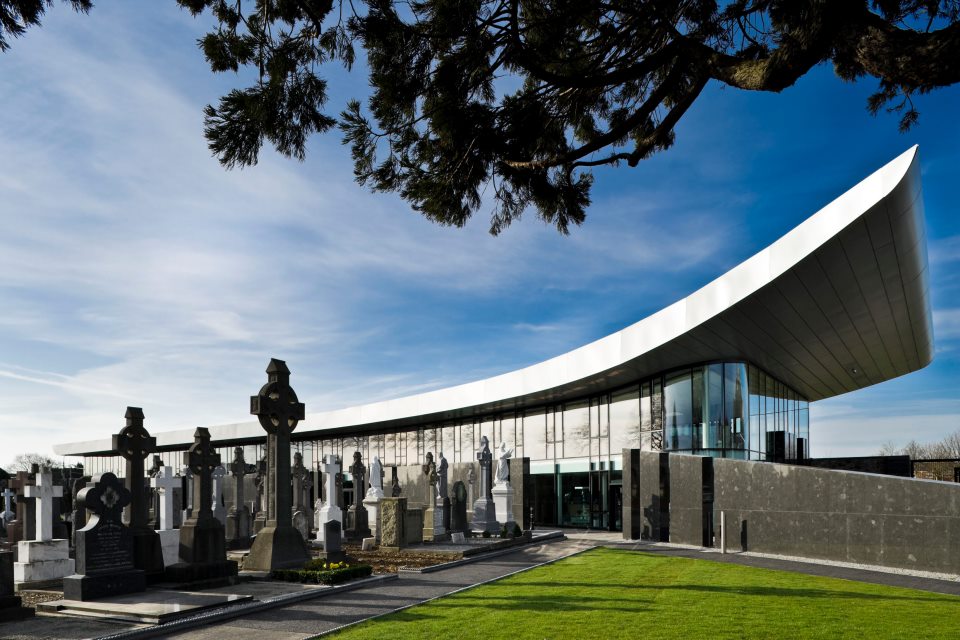
    Glasnevin Cemetery was established in 1832 under the direction of Daniel O’Connell for the purpose of burying “people of all religions and non”.

    About the cemetery

    The Glasnevin cemetery encompasses 124 acres and 1.5 million burials. It has a great national heritage through the social and historical history of the people buried there from all walks of life over 178 years. 

    Famous people

    Famous people interred there include the founder of the Cemetery - Daniel O’Connell, Charles Stewart Parnell, O’Donovan Rossa, Eamon De Valera, Michael Collins, Countess Markiewicz, Maud Gonne McBride, Gerard Manley Hopkins, Brendan Behan, Christy Brown, Jimmy O’Dea, Luke Kelly, Alfred Chester Beatty, Michael Cusack and Liam Whelan. Less acclaimed people include victims of the Great Famine, the Cholera outbreaks and the Air India crash as well as the babies in the old Angels plot which was renovated and inaugurated by Presi dent McAleese in 2005. 

    Architecture

    The Cemetery’s most famous architectural feature is the 55 meters high O’Connell Tower, designed by George Petries and made of Wicklow granite, where the remains of Daniel O’Connell are interred in a family crypt directly below the tower. It is still one of the highest structures in Dublin. The crypt and tower have recently been restored in conjunction with the OPW and are open to the public for the first time since 1970. The Mortuary Chapel, designed in the 1870s, is appointed with stone carvings by James Pearse (father of Padraig and Willie).

    Design

    The opening of Père Lachaise cemetery in Paris in 1815 provided much-needed inspiration for cemetery designers, who had hitherto designed fairly functional cemeteries. With Père Lachaise as an example, the garden cemeteries were initially informally landscaped, with sweeping roads wide enough for carriages, and smaller paths for strolling. Careful planting (particularly of trees) and architectural features that impressed or drew the eye were key features. The whole effect was that of a private, landscaped park, with a central chapel instead of a country house. Unlike churchyards, these cemeteries were independent of a parish church, were located outside the city in what were then suburbs. These cemeteries became known as  'garden cemeteries'.


    *Main photo source: www.dctrust.ie

    Glasnevin Museum

    Finglas Road
    Dublin 11
    Ireland

    Phone: + 353 (0) 1 882 6550
    Email: museum@glasnevintrust.ie

    Office Opening hours

    Mon - Fri: 10.00am to 5.00pm
    Sat - Sun: 11.00am to 5.00pm

    Glasnevin Cemetery Monuments

    Finglas Road
    Dublin 11
    Ireland

    Phone: +353 (0) 1 882 6520
    Mobile: + 353 (0) 86 331 3432
    Email: momuments@glasnevintrust.ie

    Office Opening hours

    Mon - Fri: 8.00am to 5.00pm
    Sat: 8.00am to 1.00pm

    Glasnevin Cemetery

    Finglas Road
    Dublin 11
    Ireland

    Phone: + 353 (0) 1 882 6500
    Fax: + 353 (0) 1 830 1594
    Email: info@glasnevintrust.ie

    Website: www.dctrust.ie

    Access to Glasnevin Cemetery grounds

    Mon - Sun: 9.00am to 6.00pm

    Dardistown Cemetery & Crematorium (Dublin, Ireland)

    Dardistown Cemetery & Crematorium (Dublin, Ireland)
    Dardistown Cemetery was established by Dublin Cemeteries Trust in 1990 to serve the communities of North West Dublin.

    About the cemetery

    Dardistown Cemetery, located near Dublin airport, was opened in 1990. The cemetery covers 42 acres and is developed as a lawn cemetery. In order to retain the attractive features of older cemeteries, such as Glasnevin Cemetery, Dardistown is divided into sections. Each section is named after saints associated with the locality – for example St.Columba, St. Margaret and St.Doulagh. The entrance to Dardistown is through the original gates and piers for St.Paul’s Section of Glasnevin Cemetery which date back to 1860.

    Locality

    Dardistown is located in the heart of Fingal whose rich heritage and long history is evident in the many famous buildings, churches, castles, great houses and archaeological sites located in the area. This wealth of monuments, some dating as far back as 5.000 years, reflect the various periods of Fingal’s history from Viking occupation to the diversity of Anglo-Irish history through to modern day Fingal.


    *Photo source: www.dctrust.ie

    Dardistown Cemetery

    Address:
    Dardistown Cemetery
    Collinstown Cross
    Old Airport Road
    Cloghran
    Co. Dublin

    Contacts:
    P: + 353 (0) 1 8424677
    F: + 353 (0) 1 8424294
    E: dardistowncemetery@glasnevintrust.ie

    W: www.dctrust.ie

    Opening hours:
    Mon - Wed 9.30am to 4.30pm
    Thurs 9.30am to 4.00pm
    Fri 9.30am to 3.30pm

    Dardistown Florists

    Address:
    Collinstown Cross
    Old Airport Road
    Cloghran
    Co. Dublin

    Contacts:
    P: + 353 (0) 1 8424677
    E: florist@glasnevintrust.ie

    Opening hours:
    Mon - Sun 9.30am to 4.30pm

    Dardistown Cemetery Monuments

    Address:
    Collinstown Cross,
    Old Airport Road,
    Cloghran,
    Co. Dublin.

    Contacts:
    P: +353 (0) 1 882 6520
    M: + 353 (0) 86 331 3432
    E: momuments@glasnevintrust.ie

    Opening hours:
    Mon - Fri 8.00am to 5.00pm
    Sat 8.00am to 1.00pm

    Goldenbridge Cemetery (Dublin, Ireland)

    Goldenbridge Cemetery (Dublin, Ireland)
    Goldenbridge is the first cemetery to be opened by Daniel O'Connell and the Dublin Cemeteries Committee in 1828.

    About the cemetery

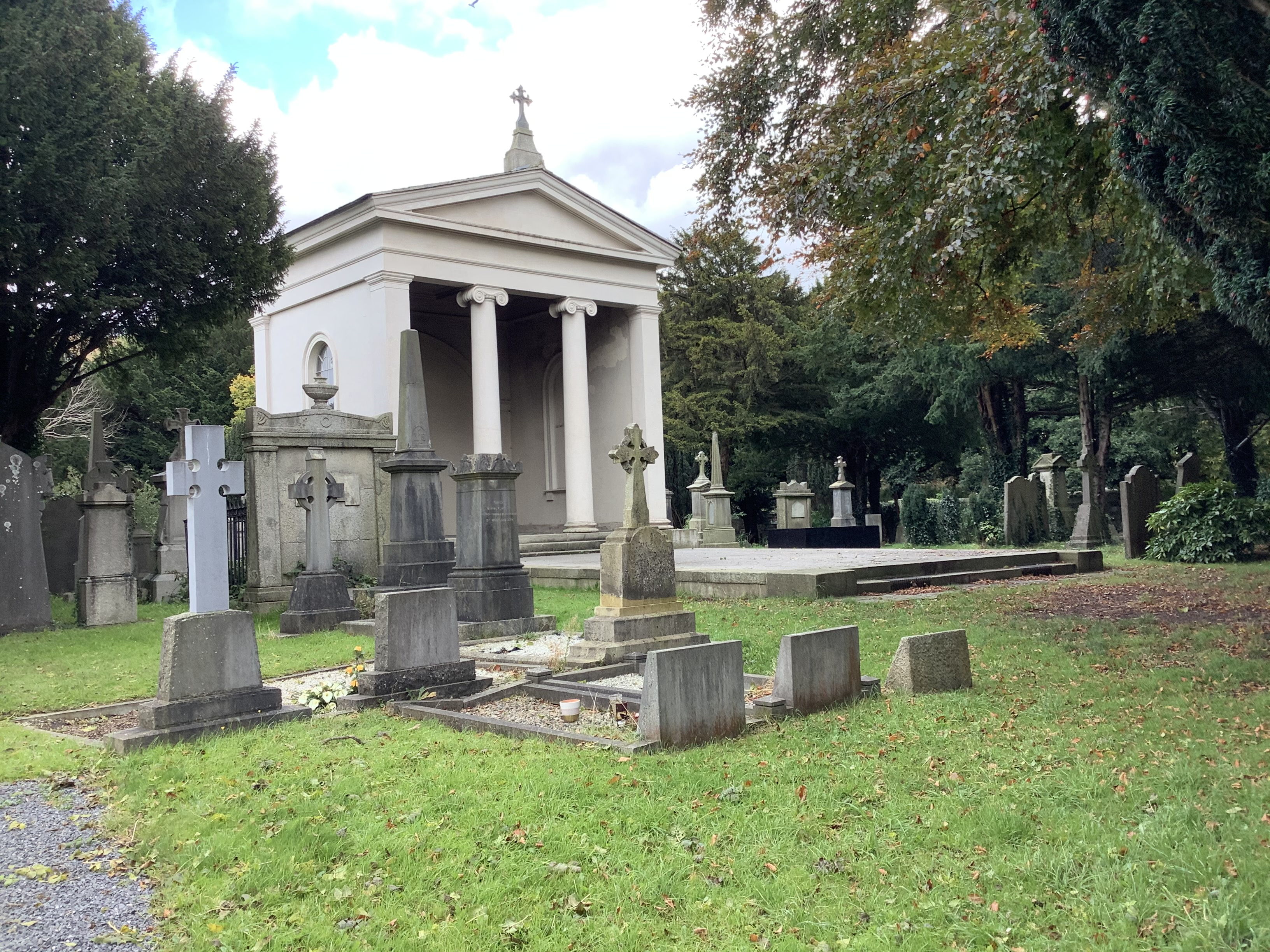
    With the passing of the 'Act of Easement of Burial Bills' in 1824, a committee was formed to administer the proposed cemetery. A small plot of land had been acquired for this purpose at Goldenbridge. The cemetery was opened in 1828 and the first burial took place on the 15th October of that year.

    Set on just two acres of land, Goldenbridge incorporates many of the classical features that were to dominate the 19th century. With delinated pathways and surrounded by high walls, it is an oasis of tranquility in the hearth of a busy suburb.

    Garden Cemeteries

    Unlike churchyards, these cemeteries were independent of a parish church, were located outside the city in what were then suburbs. These cemeteries became known as 'garden cemeteries'.

    Locality

    Inchicore (Irish: InseChór) is a southern inner suburb of Dublin, Ireland, south of the River Liffey and west of the city centre, in the Dublin 8 postal district. The district was originally a village just outside Dublin city until it was swallowed up by the expanding city more than a century ago. It has a strong association with the railways, with the main engineering works for the Irish railway network having been first located there in the nineteenth century.

    Address

    Goldenbridge Cemetery
    St. Vincents Street
    Inchicore
    Dublin 8

    Contacts

    Phone: + 353 (0) 1 8301133
    Fax: + 353 (0) 1 8301594
    Email: info@glasnevintrust.ie

    Website: www.dctrust.ie

    Visits

    Cemetery can be visited by appointment only.