Showing posts with label France. Show all posts

New Guillotière Cemetery at WorldSkills Lyon 2024

WorldSkills Lyon 2024
As part of the WorldSkills 2024 event, the Municipality of Lyon will host two workshops at the New Guillotière Cemetery in Lyon, France.

About the WorldSkills event

WorldSkills is an international competition that brings together young professionals from around the globe to showcase their expertise in a variety of skilled trades and vocational disciplines. It serves as a platform to promote global standards in education and industry skills. This year, the event will take place in Lyon, France, from September 10 to 15, 2024, featuring competitions, workshops, and exhibitions that highlight technical and vocational skills.

Workshops at the New Guillotière Cemetery

As part of the WorldSkills 2024 event and the company open days on September 13 and 14, the Municipality of Lyon, a member of ASCE, will host two unique workshops at the New Guillotière Cemetery in Lyon, France.

The first workshop invites attendees to stroll through the cemetery's tranquil paths, where they will discover famous tombs, renaturation efforts, and various traces of history with the help of a dedicated guide using the mobile app ARtour.

While the cemetery itself is a place of beauty and history, the work behind the scenes is equally vital. The second workshop focuses on the administrative side of cemetery management, offering a rare glimpse into the services and professions that are sometimes hidden from public view.

For additional information, please contact vincent.tripier@mairie-lyon.fr.

Cemeteries as versatile places of learning

The Guillotière Nouveau Cemetery’s participation in WorldSkills Lyon 2024 is a testament to the diverse educational opportunities cemeteries offer. Beyond their traditional role, cemeteries serve as valuable resources for learning about art, history, architecture, flora, and fauna. Additionally, they provide insights into various professions and skills and demonstrate how modern technology can be effectively used to enrich the learning experience.

WDEC 2024 at the Carmes Cemetery

To commemorate the Spring of Cemeteries event, coinciding with the WDEC time period, the City of Clermont-Ferrand is organizing a guided tour at the Carmes Cemetery.

The Carmes cemetery in Clermont-Ferrand, France, is a true open-air museum, condensing two centuries of artistic expressions and telling stories of Clermont's history.

The 9th edition of the Spring of Cemeteries event, taking place from May 24 to 26, 2024, will highlight the important female personalities who rest in the cemetery, including Cécile Cruzilles, who headed the famous candied fruit company. As part of the event, the City of Clermont-Ferrand is organizing a guided tour at the Carmes Cemetery.

  • Date and time: Saturday, May 25, 2024 at 4:30 pm
  • Departure: Meeting point in front of the Carmes-Déchaussé chapel at 4:30 pm, Chaussée Claudius
  • Price:  €9.30 / reduced €6.80 / free up to and including 18 years old
  • Tickets: Tickets must be purchased in advance at the Metropolitan Tourist Office (no ticket office on site).
  • Online reservation: www.clermontauvergnetourisme.com

Carmes Cemetery (Clermont-Ferrand, France)

Carmes Cemetery (Clermont-Ferrand, France)
The Carmes Cemetery is an open-air museum and one of the few public places in Clermont-Ferrand where visitors can see the river Tiretaine.

History of the Carmes Cemetery

The Carmes Cemetery is located on a site that has been occupied since the creation of the Roman city of Augustonemetum. The ancient thoroughfare between Vichy and Limoges runs through the site, which also adjoins the Via Agrippa, a major Roman road crossing Gaul from east to west. In Roman times, Augustonemetum was an important enough stopping point to feature on the Peutinger Table, a huge map of the Roman Empire and lands conquered by Alexander the Great as far away as India. The site has been used for funerary purposes since the first centuries AD.

There is evidence of a monastery in the 10th century, then again at the end of the 12th century. In the 17th century, the Order of the Discalced Carmelites occupied the site. A century later, the Carmelite Chapel was rebuilt in a baroque style that was unique in Clermont-Ferrand. In 1816, Clermont-Ferrand City Council purchased part of the former Carmelite site and the land was returned to its original function as a cemetery.

The new cemetery was inaugurated on 21 July 1816. In 1846, the first extension of the cemetery took it south of the old Roman road up to the modern-day Chaussée Claudius. The last extension commenced in 1908 with the purchase of the Pré Bertrand, a field to the north of the river Tiretaine.

It is no surprise that this iconic cemetery became the site of the Jewish section and the military sections for the French, German, English and New Zealand soldiers who died in the two world wars.

Its past gives it an international dimension that justifies its inclusion in Clermont-Ferrand’s bid to become European Capital of Culture in 2028.


Architectural and landscape features of the cemetery

The Tiretaine, Clermont-Ferrand’s river, which is now to a large extent buried, runs through the cemetery. The site of the Carmelites is one of the very few public places where it is possible for visitors to see the river. It was partially diverted and canalised in 1886, but still forms the boundary between the “old” and “new” cemetery. Lined with trees, it forms a natural island of freshness amidst the 11 hectares of graves. The cemetery is home to a wide variety of tree species, the most significant being maple, cedar and lime.

The architects who worked on the Carmes Cemetery between 1816 and 1908 were employed by the city council. They spent most of their career in Clermont-Ferrand, where their creations can be found (extension of the Hôtel-Dieu, the City Hall).

The cemetery has retained its original design. It has grown through extensions and the acquisition of land to the north and south. The ancient thoroughfare that crossed through it in the south was moved (to the location of the current Chaussée Claudius) in 1886, but its old route still runs along row 13. The fence that was built at the end of the 19th century is still present today. The entrance gate is the original gate. The cemetery also benefits from the presence of the baroque-style Carmelite Chapel, which is the only example of 18th-century religious architecture in Clermont-Ferrand.

The Carmes Cemetery is an open-air museum reflecting two centuries of artistic expression. A museum of architecture thanks to the diversity of styles used over the ages - Neoclassical, neo-Gothic, neo-Romanesque, Art Nouveau, Art Deco, etc. A museum of fine arts thanks to its sculptures, stained-glass windows, ironwork, etc., which accompany, depict or watch over the deceased. A museum of history thanks to the status of those buried there - politicians, artists, architects - who led, built or embellished the city.

The Carmes Cemetery also bears testimony to the distinctive choices of materials used to build the tombs. Although limestone and marble are present, Volvic stone is the predominant material used. This lava stone is a trachyandesite extracted from the lava flow from the La Nugère volcano and has been used since the 13th century. The Gothic Clermont-Ferrand Cathedral, construction of which began in 1248, is made exclusively from Volvic stone. This dark grey material is resistant to frost and pollution, including to acids, and is easy to sculpt. Its physical properties, coupled with its dark colour, made it the perfect stone for funerary monuments.

Video of the Carmes Cemetery

Address

11 Rue du Souvenir Français
63000 Clermont-Ferrand
France

Events at cemeteries in Rennes

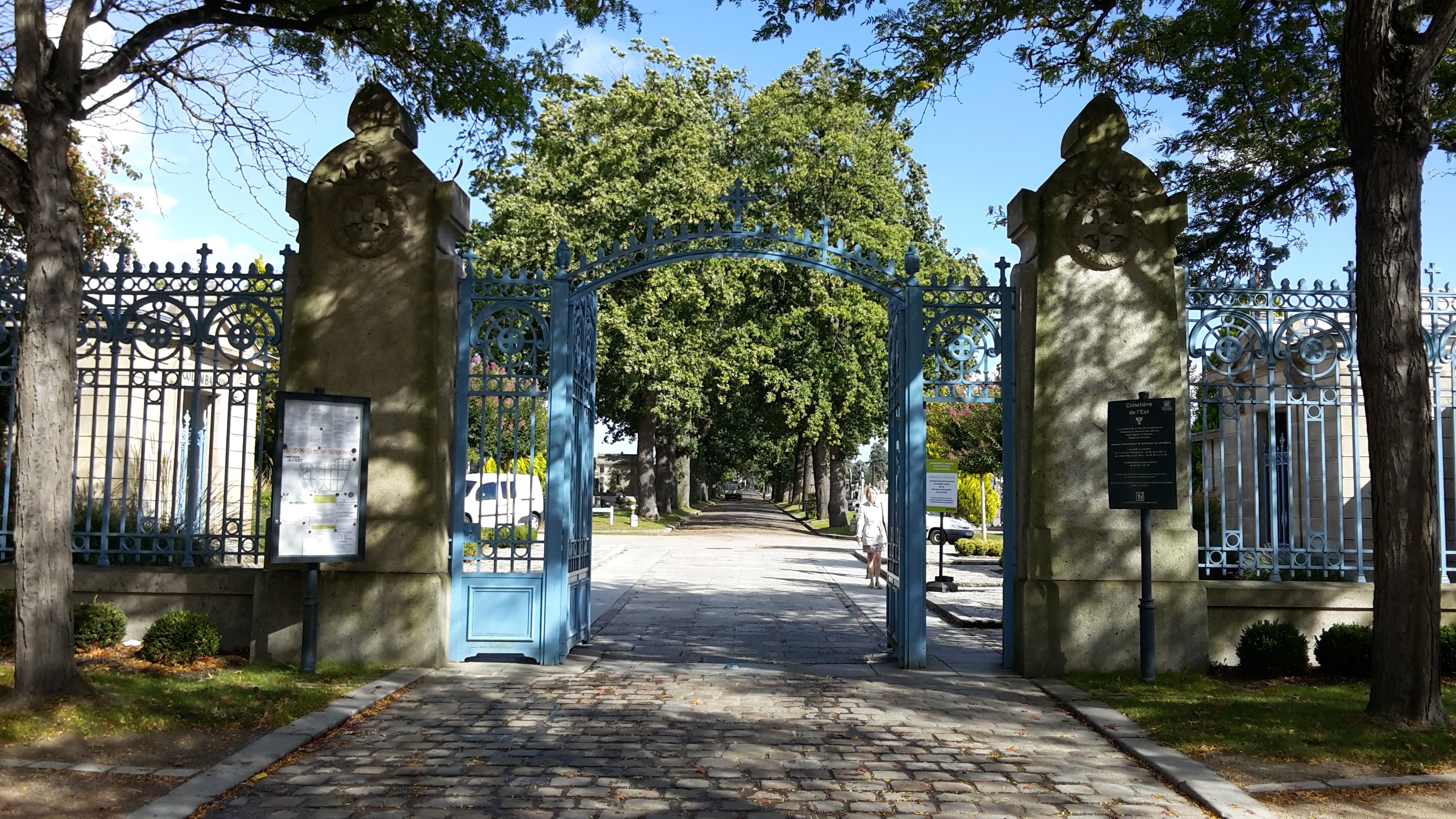
Eastern Cemetery (Rennes, France)
From October 28 to November 1, 2022, the 6th edition of the "Toussaints Musicales Rennaises" took place at the cemeteries in Rennes, France.
A rich and varied program highlighted the beauty of cemeteries in Rennes with:
  • tours in horse-drawn carriages at the Eastern Cemetery (every day from October 28 to  November 1),
  • Jazz concert with the "Singing in the Rennes" trio at the Eastern Cemetery (on Sunday, October 30, 2022, and Tuesday, November 1, 2022, at 3 p.m.),
  • Baroque Music Concert with the quartet "La Pie qui Joue" will perform "Le Souffle et l'Oiseau" at the Northern Cemetery (on Tuesday November 1, 2022, at 3.30 p.m.)
The original flyers (in French) for these events are accessible HERE.

WDEC 2017 - Northern cemetery of Rennes

Le samedi 20 mai et le Dimanche 21 mai 2017 au Cimetière du Nord de Rennes, Anthanagor,  le gardien imaginaire du lieu, ouvrira de nouveau les portes de sa nécropole pour deux visites étonnantes, inédites et incroyables ! 

“In the Middle of a Lake of Pearls”: strolling in the North cemetery of Rennes


After "Lecteurs" in 2009 and "Happy Protest" in 2015, David Rolland, a choreographer from Nantes (west of France) proposes a new project called "Au milieu d'un lac de perles" (“In the Middle of a Lake of Pearls”). It takes place during "Les Tombées de la Nuit", a festival created in Rennes (Brittany, west of France) in the 1980s. This cultural and artistic event has been looking for alternatives to occupy the public space and to conceive the relation to the viewer.

Commentated Walk «THE UNKNOWN PEOPLE SOCIETY »


Mélodie, the Mourner (Jérôme Sbranna)

This took place on June 26th in the Northern Cemetery of Rennes, and attracted about 100 visitors. The Lysandore company led a commented walk in the very heart of this outdoor museum, with a lot of music, poetry, emotion and smiles ! 

WDEC 2016 at the Significant Northern Cemetery of Rennes

During the Week of Discovering European Cemeteries, the Significant Northern Cemetery of Rennes will be open to reveal its cultural wealth too often unrecognized

Eastern Cemetery (Rennes, France)

Eastern Cemetery (Rennes, France)
The Eastern Cemetery (“Cimetière de l’Est”) was created in 1887 and it is the largest cemetery in the city of Rennes.

About the cemetery

This contemporary cemetery, where diversity and innovation are keywords, is a true reflection of the modern city of Rennes, its inhabitants and also developments of the funeral practices since the end of the 19th century. The architectural and sociological perspectives aspects of this location are interesting.

In addition to the interesting architectural and sociological aspects of the cemetery, the military heritage is also very important. The German military section and the Commonwealth section show the European dimension of the Eastern cemetery. Every summer, many foreign tourists come to visit these graves.

Furthermore, some important personalities are buried at the Eastern cemetery. One of them is Guy Parigot, a well-known actor theater producer who had a brilliant career in Rennes, in France and also worldwide, mostly in the United States and Canada.

In the middle of the cemetery, one can see a central way planted by bicentenary oak trees on each side, which were offered by the Tsar Nicolas II of Russia. At the main entrance of the cemetery, a room is available for families who want to pay their respect to the deceased and to organize civil funerals.

Basic data

The Eastern Cemetery is owned by the City of Rennes and managed by the City Hall of Rennes and the Funeral Department. At present, it isn’t protected, except through the Eco Label - a quality label for ecological green spaces.

The cemetery covers 163.142 m2 of land and includes 29.000 graves, of which 2.000 are military graves. There are also 1.600 cinerary niches (1.000 places in columbarium, 500 urn tombs, and 100 cinerary places).

The most representative nationalities buried at the cemetery are French and Maghreb (mainly Algerian and Moroccan). The predominant religions present are Catholic, Islamic, Jewish and Buddhist.

Important graves and monuments

The Rallé Chapel
The funeral chapel of Rallé family was created in 1967. It was designed and built by the architect Charles Rallé, son and brother of building contractors, for the family’s burials.

The French Remembrance’s monument
The monument of the national and local association French Remembrance (in French “Souvenir Français”) was created in 1901. This monument was constructed thanks to an initial public offering. It is the work of the architect L. Balle and the marble worker V. Folliot. This is an ossuary for the 1870 War Veterans and also the soldiers deployed in Rennes, died before the First World War. This monument of 31 m2 is a major component of the Eastern cemetery. In front of it, there is a central way bordered by bicentenary oak trees. Behind it, the French remembrance space protects more than 2.000 burials of fallen soldiers of the World War 1.

The Small eastern lighthouse
The small eastern lighthouse (in french “petit phare de l’Est”) was created in 2011.This space mainly receives the remains of lifeless children. It has been designed and built by Stéphane Bernigaud, plastic artist, in collaboration with the Funeral Department of Rennes. On the small eastern lighthouse, there is a fresco with some volutes and naïve arabesques. In this place there are also a tree with tapes, a box to receive some letters, a little memory column. All of those items have been created for deceased children, and for the mourning of their family.

The common grave
The common grave of the Eastern Cemetery was created in 2006. It is the final resting place for much deceased people. This ossuary was inaugurated in October 31, 2006. Philippe Le Ray, a blacksmith and a carver, he created this masterpiece named “The flower of life” (in French “La fleur de vie”), in cooperation with Anne Nazart, a landscape architect who designed the space around it. The Flower of life lies on a blue and red checkerboard made of shale. It is more than 4 meters high and represents all the dignity and respect for their dead people. This creation was promoted by The “Dignity Cemetery” Collective (in French Collectif “Dignité Cimetière”), and also by Rennes city.

Jean Boucher’s grave
The burial place of the sculptor Jean Boucher was created in the 20th century. In this grave are the human remains of the famous sculptor: Jean Boucher (1870-1939), who won the Second Rome Prize of sculpture in 1894 and 1898. His work was marked by an impressive creation of war memorial dedicated to WW1 soldiers, which are located in neighbour communities of Rennes as also in Paris, Verdun, Lyon and Guernsey…Jean Boucher was also popular for teaching. He tutored some famous sculptors such as Paul Belmondo. This grave is ornate by two bronze sculptures of his creation.

More on this LINK.

Innovative spots at the cemetery

  • The White Garden, unique in France, with a successful landscape in terms of meditation for cremated lifeless children.
  • The Common Grave is now seen as a real place for meditation, and not only for an unwelcome place for families.
  • The creation of a "river of dispersal" and a cinerary space with columbaria (influenced by Brittany Region), urn tombs and cinerary fields, is being elaborated. This area is planted with several kind of trees.

For visitors of the cemetery

The virtual tour allows seeing the graves of some personalities, with texts, photographs, videos. The website dedicated to cemeteries of Rennes. It will have a digital platform, online databases, preview of locations and detailed routes, information about funeral services, news… The first online databases version will become operational in the middle of 2015. In its second version, the website shall be provided for e-payment. By the end, there will be a virtual meditation of the dead. For already 15 years, the tourist office of Rennes City offers guided-tours inside the Eastern Cemetery to allow visitors to discover this location.

Programmes of research, conservation and preservation

  • A Heritage census of the Eastern Cemetery is being implemented by the city of Rennes.
  • Gaëlle Clavandier, professor at Saint-Etienne University, and Philippe Charrier, scientist at the CNRS of Lyon ("Centre Max Weber" in Lyon), as part for their research about perinatal bereavement, have contacted the city of Rennes, in relation to the White Garden. With the virtual tour, this project was presented in their class.
  • The student Rozenn HUAULT (University of Rennes 2), in 1989-1990, has written a thesis in sociology: "Life in the Eastern Cemetery of Rennes".
  • In 2007, Guillaume Perrette has obtained a specialty certification "Management of ornamental trees", with his "Analysis of arboreal heritage of the Eastern Cemetery".
  • The Eastern Cemetery is listed on the websites www.tournagesbretagne.com and www.filmfrance.net

Cemetery contacts

Cimetière de l’Est
Place du Souvenir Français
35000 Rennes
France

Tel: (+33) 2 23 62 16 00

Other contacts

Nathalie Bidan (in charge of Funeral heritage)
Address: Northern Cemetery, 36 avenue Gros Malhon, 35000 Rennes, France
Tel: (+33) 2 23 62 10 15
Email: n.bidan@ville-rennes.fr

Eliane Ammi (Funeral Department co-manager, in charge of digital innovation)
Address: East Cemetery, 1 place du Souvenir Français, 35000 Rennes, France
Tel: (+33) 2 23 62 16 00
Email: e.ammi@ville-rennes.fr

Patrice Quénot (Funeral Department manager)
Address: City Hall of Rennes, Place de l’Hôtel de Ville CS 63126, 35031 Rennes, France
Tel: (+33) 2 23 62 10 10
Email: p.quenot@ville-rennes.fr

Northern Cemetery (Rennes, France)

Northern Cemetery (Rennes, France)
The Northern Cemetery (Cimetiére du Nord), designed as an English-style garden, with sinuous drives and varied vegetation, is an incentive for walks and peace.
Built in the aftermath of the French revolution, this place enables to discover the History of Rennes to the end of the 18th century, with its public figures who are buried here. Indeed, many politicians, scientists, architects, painters, scholars, writers… lie in this emblematic place of Rennes.

The funeral symbolism, now forgotten in modern graves, is conserved here. So we can see truncated columns, stars, religious symbols, palm, winged hourglasses… that give some information about the decedent’s life.

The quality and the diversity of the graves and funeral chapels are a significant part of the Northern Cemetery of Rennes. One can find some neo-classical, neo-gothic and Art Deco styles, evolving during 19th and 20th centuries in France and across Europe.

The Northern Cemetery is also characterized by a space dedicated to Travelers’ community graves. They want impressive monuments for their deceased people. No doubt, these graves will soon integrate the funeral heritage of Rennes.

Basic data

The Northern Cemetery is owned by the City of Rennes which displayed significant resources to enhance the city funeral heritage and to improve the services offered to the inhabitants. The cemetery is managed by the City Hall of Rennes and the Funeral Department. It extends on the surface of 85.526 m² and holds 13.600 graves and 200 cinerary niches. The deceased are mainly French of catholic religion.

Important graves and monuments

Some of the graves and monumenst on Northern Cemetery with historical and cultural meanings are:

Programs of research, conservation and preservation

  • Inventory service of Brittany has realized in the 1990’s a Funeral Heritage census at the Northern Cemetery.
  • In 1993, a master’s thesis, written by the student of Rennes University Perrine Picard, deal with “The Northern Cemetery of Rennes, History and Funeral Art”.
  • In 2007, Bernard Lebeau, Rennes University student, wrote his license report: “Story of the Northern Cemetery”.
  • A Heritage census of the Northern Cemetery is being implemented since 2012 by the city of Rennes.
  • The Funeral Department of Rennes is identifying a series of abandoned monuments in Rennes cemeteries, and is establishing a recuperation policy for these graves.
  • The city of Rennes is working about the restoration of a funeral chapel, remarkable for its art. The city wants to create a columbarium inside. This would allow completing the places dedicated to cinerary urns.

For local residents and tourists

  • For already 15 years, the tourist office of Rennes offers guided-tours inside the Northern Cemetery to allow visitors to discover this location.
  • Rennes City has conceived an exhibition in the cemetery named “Balade Intemporelle du Cimetičre du Nord” (“Timeless Walk of the Northern Cemetery”). This is a memorial route where visitors can discover some emblematic personalities of the city, and also an introduction to the funeral symbolism in this location.
  • A virtual visit of the Rennes cemeteries is available online: www.visitesvirtuelles.metropole.rennes.fr/cimetieresrennais. By going to the website, everyone can discover the two necropolises of Rennes (the Northern Cemetery and the Eastern Cemetery), the specific locations and the famous people buried there. The website give some details, guidance, visual documents and sometimes even videos, to discover the history of the cemeteries and those who died.
  • Rennes City is also working with cultural institutions (museums, Conservatory of Music, Opera, associations…) in order to offer soon some cultural events in Rennes cemeteries (exhibitions, musicals walks…).
  • A website dedicated to cemeteries of Rennes is being established. It will have a digital platform, online databases, preview of locations and detailed routes, information about funeral services, news… The first online databases version will become operational in the middle of 2015. In its second version, the website shall be provided for e-payment. By the end, there will be a virtual meditation of the dead.

Address

Northern Cemetery
36 avenue Gros Malhon
35000 Rennes
France

Contacts

Nathalie Bidan (in charge of Funeral heritage)
Northern Cemetery, 36 avenue Gros Malhon, 35000 Rennes (France)
P: (+33)2 23 62 10 15
E: n.bidan@ville-rennes.fr

Eliane Ammi (Funeral Department co-manager, in charge of digital innovation)
East Cemetery, 1 place du Souvenir Français, 35000 Rennes (France)
P: (+33)2 23 62 16 00
E: e.ammi@ville-rennes.fr

Patrice Quénot (Funeral Department manager)
City Hall of Rennes, Place de l’Hôtel de Ville, CS 63126, 35031 Rennes (France)
P: (+33)2 23 62 10 10
E: p.quenot@ville-rennes.fr

Symbols

Our members are about to start a new EU funded project.

Bicentennial Cemetery Loyasse

From September 20 to October 20, the Cemetery department of Lyon City organizes many cultural events.

The Park Cemetery (Clamart, France)

The Park Cemetery (Clamart, France)
A cemetery without high walls that merges with its surrounding.

About the cemetery

After the World War II, in 1957, the architect Robert Auzelle created a park cemetery integrated in a global reflexion of urban planning of Clamart, establishing a perfect harmony with the surrounding area of which he was also the author.

Inspired by the anglo-saxon and northern Europe experiences, Robert Auzelle wanted to break the traditional isolation of cemeteries (enclosed by high walls), creating boundaries of charm trees offering a “transparency” with homes nearby allowing people and the breath of life to circulate peacefully around the final resting place.

After crossing the plazza with a permanent exhibition of sculptures, an impressive front with austere and large porche emerges - allegory of the humility of the “passing across”. Once passed the entrance, the visitor are put in the light in front of a large circular lawn bordered with flowers and remarkable trees. Environment providing calmness and serenity favorable for contemplation and meditation.

In this cemetery, there is no War memorial but a simple parallelogram, concrete totem, ornamented with low reliefs zodiacal items, anonymous witnesses of diversity of cults and religions.

Visitors will will walk on undergrowth paths, bordered by Redwood, Red oak, Lebanon cedars… and meet one after another, landscapes with scattered graves and traditional squares, offering a sensation of peace between two worlds - the one of the darkness and the one of the light.

Address

SYNDICAT INTERCOMMUNAL DU CIMETIERE DE CLAMART
108 Rue de la Porte de Trivaux – 92130 Clamart
France

Contacts

Phone: +33 1 46 32 05 25
Mail: conact@cimetiere-du-parc.com

Websites: www.cimetieres-de-france.fr

Mobile guiding in WDEC

During this year's Week of Discovering European Cemeteries, participating members in EUCEMET project will provide visitors with possibility to discover cemetery with mobile guide.

The Cemetery of Père Lachaise (Paris, France)

The Cemetery of Père Lachaise (Paris, France)
The East Cemetery of Paris, well known as "Père Lachaise", was opened in 1804 as a response to the closure of ancient and overcrowded churchyards.

About the cemetery

The site was initially located in open country, now it towers over Paris. Alexandre Théodore Brongniart (the architect of the centre city la Bourse), designed the cemetery as a contemplative space, inspired by the British gardens.

The global fame and reputation of the cemetery is based on its many characteristics:
  • It still conserves material testimonies of its first appearance. The history of the foundation of cemeteries during the 19th century has been marked by the Romantic conception of Brongniart and several European burial sites have emulated it. 
  • It is the last home of many important figures (from Chopin to Jim Morrison) and shelters memorials of great importance (from the “Mur des Fédérés of the Commune of Paris to memorials of concentration camps). The associated monuments are often realized by the greatest artists of all nations. 
  • The walk through the place is always different and surprising because of numerous extravagant monuments (the smokestack of the Beaujour grave, the telegraph of the Chappe’s tomb, the Allan Kardec’s Dolmen, etc.) and the beauty of the park.
  • Last but not least, the cemetery also covers a complete set of funerary buildings, linked to the history and the organisation of the Mortuary Services, such as the Chapel, the Crematorium, the Columbarium and the Boneyard.

Address

The Cemetery of Père Lachaise
8, boulevard de Ménilmontant
75020 Paris
France

Contacts

Tel. +33 155258210
Tel/Fax: +33 143704216

Website: The Cemetery of Père Lachaise

Paris Catacombs Tour

Explore the ancient underground tomb that house over 6 million Parisian bodies.

The Parisian Cemetery of Thiais (Paris, France)

The Parisian Cemetery of Thiais (Paris, France)
The Parisian Cemetery of Thiais is one of three so called cemeteries "extra muros" located in the commune of Thiais in Paris.

Cemetery "extra muros"

As a result of various expansions, the city of Paris has integrated numerous cemeteries amongst which six are said to be “extramuros” because the proper territory of the town doesn’t include them. The cemetery of Thiais belongs to this category.

Landscape and funerary districts

Opened in 1929, Thiais shows some contrast characteristics:
  • The natural environment is rich of 6000 trees of various species. In the course of the seasons, they reinvent the landscape. 
  • The “garden of brotherhood” offers a tomb to anyone who needs it. It’s a very specific district which only exists in Thiais. 
  • The confessional districts host confessional gatherings that are allowed as long as the districts are not physically defined. The grouping of obedience in Thiais remains without equal in France.

Important monumens

  • The design of the main entrance is an example of modernist architecture of the 1930’s. It comines concrete and metal. 
  • The cemetery shelters specific memorials such as the one of the dead who gave their bodies to Science or the victims of Ermenonville’s one (an airplane catastrophe).
  • There are also several famous personalities buried at Thiais such as Joseph Roth (author of the Radetzky March), Leon Sédou (Trotsky’s son) or Paul Celan (writer, said to be the “poet of the holocaust”) and others..


*Photo source: www.blog.kermorvan.fr

Address

Conservation du cimetière parisien de Thiais
Route de Fontainebleau 261
94320 Paris
France

Contacts

Tel. +33 141732730
Fax: +33 146872188

Website: Cemeteries of Paris

The Cemetery of Montparnasse (Paris, France)

The Cemetery of Montparnasse (Paris, France)
The Cemetery of Montparnasse owns a double identity - both traditional and avant-gardist.

About the cemetery

The cemetery of Montparnasse was originally known as Le Cimetière du Sud (Southern Cemetery) and it officially opened 25 July 1824. Since its opening, more than 300,000 people have been buried there. The actual space of the cemetery was formerly a huge stone heap, hence its quite ironical the name of  “Mount-Parnassus”. From these days remains a mill at the heart of the cemetery, which has no mortuary use. 

Like the other main cemeteries of the city, the Cemetery of Montparnasse could also be considered as a real garden-museum for the 19th century monuments and home to numerous historic personalities (from Aloysius Bertrand and Saint-Saëns or Huysmans).

But the cemetery also offers an exceptional concentration of artwork realisations and celebrities of the 20th century. Here lie the Surrealist authors (like Desnos), the exile writers (like Ionesco, Cioran and Beckett) and other famous artists (from Brassaï to Gainsbourg). 


*Photo source: www.wikipedia.org

Address

The Cemetery of Montparnasse
3, boulevard Edgard-Quinet
75014 Paris
France

Contacts

Tel. 00 33144108650
Tel/Fax: 00 33144108686

Website: Cemeteries of Paris

The Cemetery of Montmartre (Paris, France)

The Cemetery of Montmartre (Paris, France)
The Cemetery of Montmartre is the third largest necropolis in Paris, after the Père Lachaise Cemetery and the Montparnasse Cemetery.

About the cemetery

The funeral vocation of the area was born during the French Revolution, when this former plaster pit has been used for the burial of the executed royal guards. Finally, the place was officially opened as the “North Cemetery” in 1825. Though smaller, the cemetery evokes the Pere-Lachaise, for numerous reasons:
  • The hilly site and its sinuous ways create a Romantic atmosphere.
  • The cemetery appears like a natural reserve with its 750 trees at the heart of a hectic district.
  • Most of all, the cemetery offers an artistic and cultural heritage worthy of the Père-Lachaise.
The recumbent statue of Cavaignac (by Rude) and the surprising monument of Osiris (with a copy of Michelange’s Moses) evoke the artistic richness of the place whereas the graves of the Montmartre artists (such as Zola, Degas, Berlioz) highlight its historic importance.

In conclusion, the Cemetery of Montmartre is as rich and poetical as the Père-Lachaise, but less crowded, calmer and suitable for understanding the history of the neighbourhood and the city.


*Photo source: www.wikipedia.org

Address

The Cemetery of Montmartre
Avenue Rachel 20
75018 Paris
France

Contacts

Tel. +33 153423630
Fax: +33 143875379

Website: Cemeteris of Paris

Cemetery of Loyasse (Lyon, France)

Cemetery of Loyasse (Lyon, France)
The Cemetery of Loyasse (formerly named St. Just Cemetery) was planned by the architect Joseph Gay.

About the cemetery

The Cemetery of Loyasse is known as the "4 winds cemetery" because of its geographic location. Indeed it is placed on the elevated plateau of the town (Fourvière area) and overhangs Lyon’s center. It is the oldest cemetery of Lyon and the second most notable in France - well known for its architecture and historical monuments.

The most famous tomb, which is flowered all the year, is Maître Anthelme Philippe’s (a famous thaumaturgy who made healings and gave cares to the Russian imperial family). All over the cemetery we can discover mausoleums, tombs, sepulchral chapels, obelisks, funerals columns built with elegance and sumptuousness. It is truly an outdoor museum of funerals sculptures.

Other cemeteries in Lyon

The two others important cemeteries in Lyon are located on Guillotière area - the “Old” founded in 1854 and the “New” built in 1857. The smallest are Croix-Rousse and St. Rambert cemetery. 

Throughout these cemeteries, lay to rest many historical persons who worked for Lyon’s fame.


Photo source: www.en.lyon-france.com

Address

Cemetery of Loyasse
43 rue Cardinal Gerlier
69005 Lyon
France

Contacts

Tel. +334 78252851
Email: cimetieres@mairie-lyon.fr

Website: http://www.lyon.fr

Opening hours

In summer:
from 2nd May to 2nd November: 8.00 - 17.30

In winter:
from 3th November to 30th April: 8.00 - 17.00

Opened all year except the 1st May and 14th July.