

Showing posts with label monumental cemetery. Show all posts
Showing posts with label monumental cemetery. Show all posts
WDEC2016 in the Monumental Cemetery of TURIN, Italy

Join us in the Week of Discovering European Cemeteries 2016 in TURIN.
Monumental Spirit: Guided tours at the Monumental Cemetery of Turin

"Spirito" is an Italian word that can have several meanings: spectrum, shade or joke.
Touristic tours at the Monumental Cemetery of Turin (Italy)

Guided tours will take place on the occasion of the XXVII International Day of touristic tours 2016.
.jpg)
XXVI International Day of the Tourist Guide at the Monumental Cemetery of Turin (Italy)
 |
| Monumental cemetery of Turin (Italy) |

 |
| Panoramic view of the Superga hill from the Cemetery with the snow |
 |
| Under the arch to see the family grave of Pongiglione |
 |
| How much art! |
 |
| Have a look at this beautiful vew! |
 |
| The sun comes out after the snow |
 |
| There were two thematic routes |
 |
| There were more than 350 participants divided into groups of 25 people. It 'was a success! |
The church of San Girolamo della Certosa

Certosa Monumental Cemetery (Bologna, Italy)

Unlike many Italian monumental cemeteries, that were built from scratch, this cemetery was created by reutilizing the structures of the pre-existent monastery of San Girolamo di Casara, founded in 1334.
Beginnings of the cemetery
Even though nowadays it appears fully integrated into the urban environment of the city, its location was chosen in 1801 rightly because of its distance from the residential area and for the opportunity to adapt it easily. Starting from 1797, year of its suppression, the monastic building underwent many transformations, demolitions and extensions, so that the original structure is only partially visible.
Already in 1801, the fence at the north of the cemetery was built and decorated with terracotta sculptures by G. Putti, where a new monumental entrance was opened.
Already in 1801, the fence at the north of the cemetery was built and decorated with terracotta sculptures by G. Putti, where a new monumental entrance was opened.
The first works included readjustments of the monastery spaces, whilst from 1833 the construction aspired towards a more complex structure, with exedrae, biaxial elements, symmetries aimed at a greater monumental ambition.
Main parts of the cemetery
Between 1816 and 1834 the main rooms of the Certosa were built: the "Hall of the Graves" (in 1816), the "Arcade of the Graves" (in 1833) and immediately after that the "Gemina Hall" and the "Colombario" - an impressive building with three naves inspired by the Roman thermal architecture. The building of the "Elliptical Hall", a small body to connect the nineteenth and twentieth-century group, dates back to 1834, while in 1860 the previous "Chapel of the Suffrages" was turned into the "Gallery of Angels". Soon after this last one, the "Three-Aisled Gallery" was built, connecting the structures built until then.A different interpretation of the spaces started at the beginning of the twentieth century, according to a more monumental and rhetorical viewpoint: significant examples of this period are the "Sixth Cloister" with the "World War I Memorial", the "Eighth" and the "Ninth Cloister", with the annexed galleries. In 1924, the new entrance was built, at the end of the colonnade, near the Reno canal.
Cemetery artwork
Along these spaces of the cemetery, visitors can admire an impressive repertory of monuments, unique in Europe. The most ancient works are showed on the walls of the "Third Cloister" and are mainly frescoes belonging to the most important and distinguished Bolognese families. Only later, the graves started to be decorated with sculptures and different decoration bodies that, until the mid of the nineteenth century, were composed by ‘poor’ materials, such as plaster, stucco, scagliola or terracotta and only afterwards, marble.
Over a period of two centuries many distinguished architects, painters, sculptors worked there, contributing to its unique charm praised to the skies by all its foreign visitors, among whom we may mention Lord Byron and Charles Dickens, Jules Janin, Giacomo Leopardi, Giosue Carducci and many others.
Over a period of two centuries many distinguished architects, painters, sculptors worked there, contributing to its unique charm praised to the skies by all its foreign visitors, among whom we may mention Lord Byron and Charles Dickens, Jules Janin, Giacomo Leopardi, Giosue Carducci and many others.
Important people buried at the cemetery
In the cemetery are buried many important people from Italian and Bolognese history, including the statesman Marco Minghetti, the painters Giorgio Morandi and Bruno Saetti, the poet Giosue Carducci and the writer Riccardo Bacchelli, the composer Ottorino Respighi, the Polish officer Giuseppe Grabinski, the entrepreneurs Alfieri Maserati and Edoardo Weber and others.
Culural heritage
The Certosa, together with the Church of San Girolamo, the only building of the ancient monastery that was preserved integrally, represent therefore a journey through the history of Bologna and the lives of some of its most illustrious citizens, but also through Italian and European history and literature. It has been a source of inspiration for poets, men of letters or “simply” cultivated visitors, who would not turn down the possibility to stroll through its cloisters and walks and to take their guests to visit the place. The Certosa has been the subject of a noteworthy production of printed works, if not true tourist guides destined to become in some cases, best-sellers sold in Italy and abroad.
*Photo source: www.ar-tour.com
Address
Certosa Monumental CemeteryVia della Certosa, 18
40133 Bologna
Italy
Contacts and other info
Phone: +39 051 347592 or +39 051 225583 (Museum of the Risorgimento)www.museibologna.it/risorgimento
www.storiaememoriadibologna.it/certosa
The Monumental Cemetery of Lecco (Lecco, Italy)

The Monumental Cemetery of Lecco was inaugurated in 1882 and today it represents a real open-air museum.
About the cemetery

Based on a project by the engineer Enrico Gattinoni, the Monumental Cemetery of Lecco was inaugurated in 1882.
The fields designated as municipal burial grounds are flanked on three sides by private chapels, all joined by a walkway.
The lovely neo-gothic portico is an elegant exception to the dominating neoclassical style of the funerary architecture. On the far side, an octagonal oratorio stands at the center topped by a pavilion vault. In 1901 the entrance atrium and facade (by engineer Cesare Mazzocchi) was built in the Art Nouveau style.
An open-air museum
A wealth of sculptures commissioned in the late 1800s and early 1900s by acclaimed artists adorn the area, artists whose works can be found in the piazzas and cemeteries of Lecco and throughout Lombardy. Some of them are: F. Confalonieri, G. Branca, E. Bazzaro, C. Da Nova, L. Broggi, D. Barcaglia, P. Clerci, E. Agnati, R. Lainati, M.Vedani, A. Montegani, G. Castiglioni, F. Modena, L.Panzeri.
In the late 1900s, R. Rui, R. Piter, and P. Atchugarry worked beside such artists, Lecchese by adoption, as G. Mozzanica, R. Pedroli, G. De Candido, L.Milani, F. Simoncini, who sought infinite plastic, iconographic and material variations within the area of classic traditions.


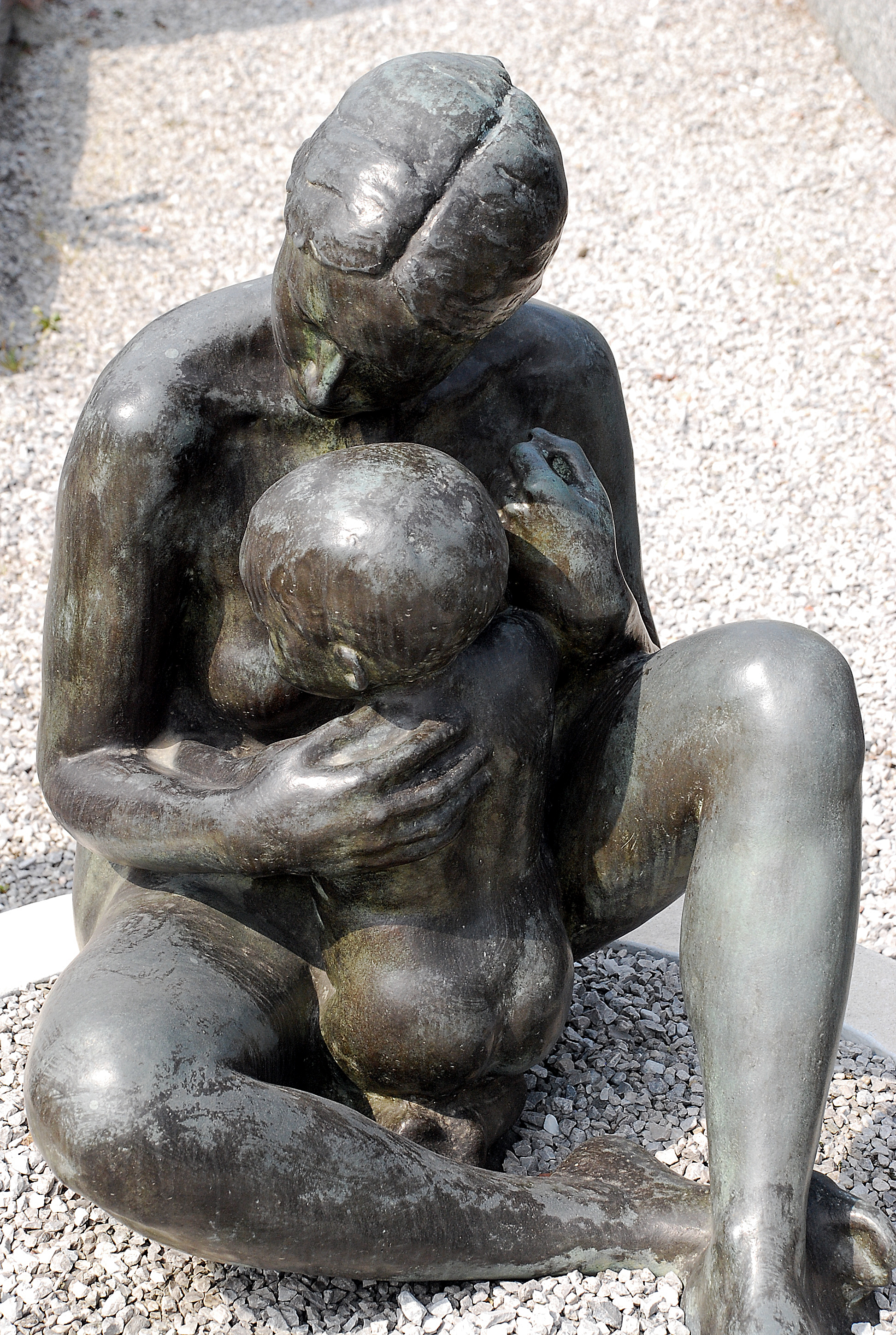

Events at the cemetery
Many events regularly take place at the cemetery. One such is a guided tour and concert on the theme "Female figure", which took place in 2012.


Address
Monumental Cemetery of LeccoVia Giuseppe Parini 29
23900 Lecco
Italy
Basic information
Surface: 20.000 m2Graves: 2500
Private chapels: 84

Subscribe to:
Posts (Atom)