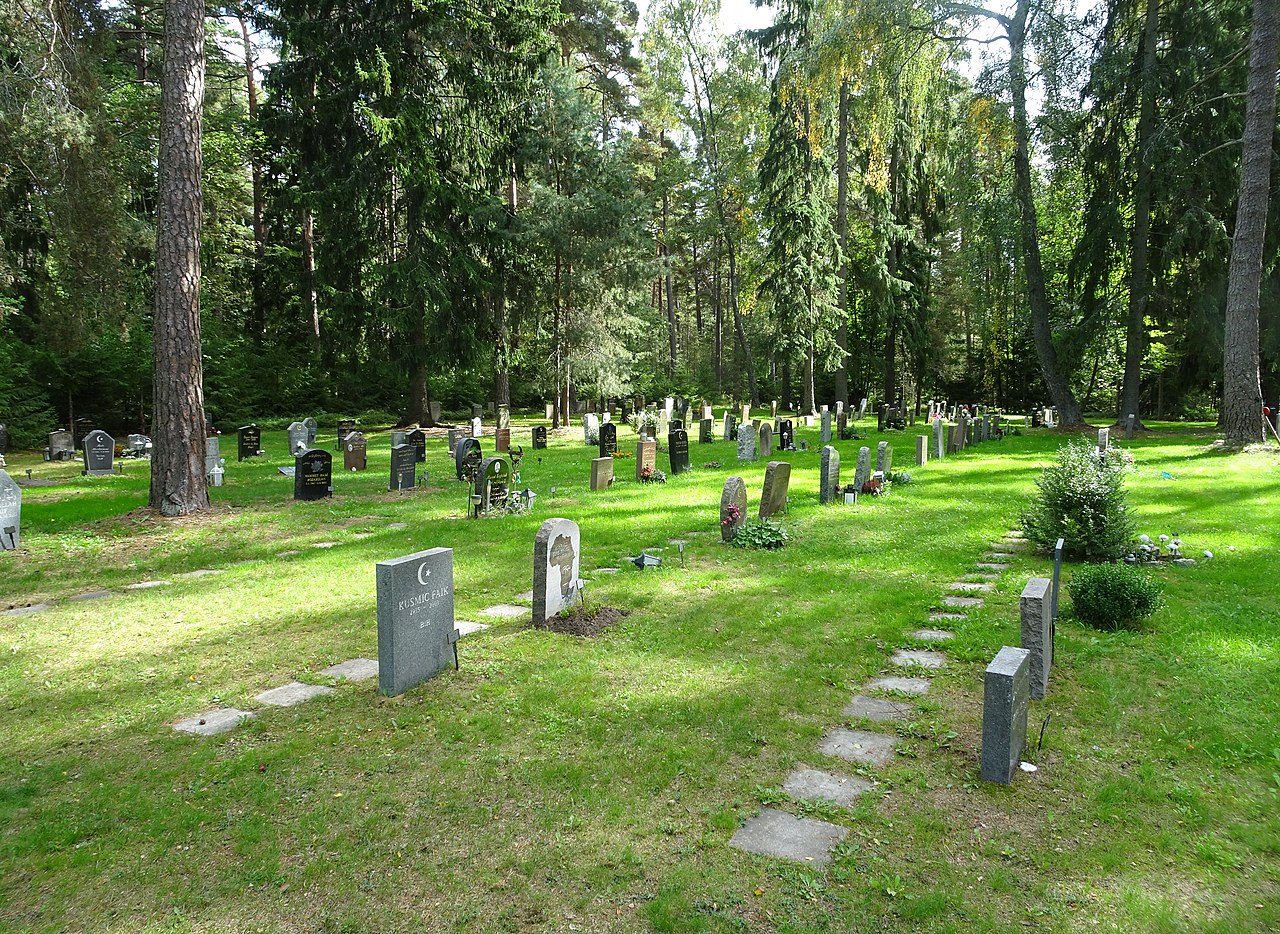
Skogskyrkogården (The Woodland Cemetery) is unique in its own way. It is characterized by the interaction between landscapes and buildings, richness of detail, essential vegetation and varied lines of sight.
For 20 years, the Association of Significant Cemeteries in Europe (ASCE) has been a select group for cemeteries considered to be of historical or artistic importance. Through activities and dissemination of knowledge, ASCE has drawn the attention of citizens and tourists to the values that the significant cemeteries possess. ASCE has also created an important network and meeting place for cemetery enthusiasts around Europe who work for the preservation of these essential and valuable environments.
 The member cemeteries represent a diversity of; culture, religion, tradition, history and architect-
ural expressions. What all the cemeteries have in common, is that they are unique, in their own way, and that is what makes them significant.
The member cemeteries represent a diversity of; culture, religion, tradition, history and architect-
ural expressions. What all the cemeteries have in common, is that they are unique, in their own way, and that is what makes them significant.
For 20 years, Skogskyrkogården (The Woodland Cemetery) in Stockholm, Sweden, has been one of the significant cemeteries. What makes Skogskyrkogården unique is that it has also been a UNESCO World Heritage Site for 20+ years.
It all started in 1914 when the cemetery committee announced an international competition to design Stockholm’s new southern cemetery. Cemetries of that time were designed as magnificent parks with lavish grave monuments as a tribute to the dead. The cemetery committee now wanted to create a unique cemetery where nature and architecture formed a harmonious whole. The winners of the competition were the young, Swedish, architects Gunnar Asplund and Sigurd Lewerentz.
The cemetery is surrounded by a 4km long stone wall. Inside the semi-circular main entrance, the rolling landscape opens up. The iconic Almhöjden (Elm Hill) and the stone cross, designed by Gunnar Asplund, catches the visitor’s eye. In the distance, the pine woodland of the burial ground appears as a dark green silhouette. The 900m long processional path Sju brunnars stig (Seven wells path) leads you through the woodland to the southern part of the cemetery.
Landscape architect Sigurd Lewerentz was the one who designed the majority of the landscape, such as Almhöjden and the garden of remembrance, which was inaugurated in 1961.
Skogskyrkogården is unique in its kind and is characterized by the interaction between landscapes and buildings, richness of detail, essential vegetation and varied lines of sight. Throughout the design is the idea of the journey between light and darkness, between joy and sorrow, through the cycle of life-death-life.
 The member cemeteries represent a diversity of; culture, religion, tradition, history and architect-
ural expressions. What all the cemeteries have in common, is that they are unique, in their own way, and that is what makes them significant.
The member cemeteries represent a diversity of; culture, religion, tradition, history and architect-
ural expressions. What all the cemeteries have in common, is that they are unique, in their own way, and that is what makes them significant.For 20 years, Skogskyrkogården (The Woodland Cemetery) in Stockholm, Sweden, has been one of the significant cemeteries. What makes Skogskyrkogården unique is that it has also been a UNESCO World Heritage Site for 20+ years.
It all started in 1914 when the cemetery committee announced an international competition to design Stockholm’s new southern cemetery. Cemetries of that time were designed as magnificent parks with lavish grave monuments as a tribute to the dead. The cemetery committee now wanted to create a unique cemetery where nature and architecture formed a harmonious whole. The winners of the competition were the young, Swedish, architects Gunnar Asplund and Sigurd Lewerentz.
The Landscape
With the competition entry Tallum, the architects fulfilled the requirements to create a cemetery integrated with the existing nature by making use of the site’s existing topography and forest.The cemetery is surrounded by a 4km long stone wall. Inside the semi-circular main entrance, the rolling landscape opens up. The iconic Almhöjden (Elm Hill) and the stone cross, designed by Gunnar Asplund, catches the visitor’s eye. In the distance, the pine woodland of the burial ground appears as a dark green silhouette. The 900m long processional path Sju brunnars stig (Seven wells path) leads you through the woodland to the southern part of the cemetery.
Landscape architect Sigurd Lewerentz was the one who designed the majority of the landscape, such as Almhöjden and the garden of remembrance, which was inaugurated in 1961.
Skogskyrkogården is unique in its kind and is characterized by the interaction between landscapes and buildings, richness of detail, essential vegetation and varied lines of sight. Throughout the design is the idea of the journey between light and darkness, between joy and sorrow, through the cycle of life-death-life.
The Woodland
Skogskyrkogården is not only a World Heritage Site but also an active cemetery. The 107 hectare large cemetery houses over 100,000 graves, which makes it one of northern Europe’s largest cemeteries. The graves interact with the woodland on the pine-covered grassy areas. The cemetery’s 10,000 pine tree trunks tower up between the gravestones like roman pillars and their crowns form a green canopy against the sky.
The pines at Skogskyrkogården are one of the building blocks that make the World Heritage Site unique and the importance of its preservation is specially designated to maintain the World Heritage Status. One of the cemetery’s biggest threats is damage to the trees due to disease, grave digging or age. To ensure regrowth, new pines are planted in the cemetery every year. Seeds plucked from the original pine trees ensure that the right plant material is used.
The Five Chapels
Inside the forest lies Skogskapellet (The Woodland Chapel). The chapel, which is the cemetery’s smallest, was designed by Gunnar Asplund and is modestly subordinate to the pines and fir trees. Skogskapellet was inaugurated in 1920 in conjunction to the inauguration of Skogskyrkogården.
Soon after, it was established that the chapel was too small for a large funeral party. In 1925, Uppståndelsekapellet (The Chapel of Resurrection) was completed, which was designed by Lewerentz and was twice as big as Skogskapellet. The chapel with its neoclassical design acts as the destination at the end of Sju brunnars stig and is visible all the way from the top of Almhöjden.
At the entrance of Skogskyrkogården, Asplund designed the cemetery’s main buildings. Due to financial and practical reasons, construction was delayed. In 1940, however, Skogskrematoriet (The Woodland Crematorium) was completed with its three chapels, Tron (Faith), Hoppet (Hope) and Heliga korset (the Holy Cross). Functionalism now had its impact, which permeates through the entire design.
The unique layout of each building shows the architects’ eye for richness of detail, focus on the visitors experience and the cycle of life-death-life.


 In 2009, history repeated itself when the cemetery committee announced a new architectural
competition at Skogskyrkogården. After more than 60 years in operation, Gunnar Asplund’s crematorium closed down, as a more modern facility was now required. Five international architectural firms were invited to compete and the winning entry was En sten i skogen (A Stone in the Forest) by Johan Celsing in collaboration with Müller Illien Landschafts-
architekten.
In 2009, history repeated itself when the cemetery committee announced a new architectural
competition at Skogskyrkogården. After more than 60 years in operation, Gunnar Asplund’s crematorium closed down, as a more modern facility was now required. Five international architectural firms were invited to compete and the winning entry was En sten i skogen (A Stone in the Forest) by Johan Celsing in collaboration with Müller Illien Landschafts-
architekten.
Nya krematoriet (The New Crematorium) was inaugurated in 2014 and opened for business in 2015 after Skogskrematoriet conducted its last cremation No. 285,944. Once again, a unique building had been constructed at Skogskyrkogården, which was discreetly integrated into the surrounding woodland. In 2013, Nya krematoriet received the national Swedish Kasper Salin-Prize for high architectural quality.
Skogskyrkogården is unique in its kind as the world’s only active cemetery established as a UNESCO World Heritage Site. In 2001 ASCE was founded with the City of Stockholm being one of the founder members. Soon afterwards, Skogskyrkogården was recognized as being significant.
In September 2020, Skogskyrkogården celebrated its 100 years anniversary. For more than 20 years, it has been a World Heritage Site and of course, it also celebrates 20 years as a significant cemetery.
The Woodland Cemetery is proud to be part of ASCE and in the celebration of its 20th anniversary. We hope to be a member for another 20+ years alongside all the other unique significant cemetery.
Photos by: Per Stjernberg & Sara Carlquist
Soon after, it was established that the chapel was too small for a large funeral party. In 1925, Uppståndelsekapellet (The Chapel of Resurrection) was completed, which was designed by Lewerentz and was twice as big as Skogskapellet. The chapel with its neoclassical design acts as the destination at the end of Sju brunnars stig and is visible all the way from the top of Almhöjden.
At the entrance of Skogskyrkogården, Asplund designed the cemetery’s main buildings. Due to financial and practical reasons, construction was delayed. In 1940, however, Skogskrematoriet (The Woodland Crematorium) was completed with its three chapels, Tron (Faith), Hoppet (Hope) and Heliga korset (the Holy Cross). Functionalism now had its impact, which permeates through the entire design.
The unique layout of each building shows the architects’ eye for richness of detail, focus on the visitors experience and the cycle of life-death-life.


The Crematoria
 In 2009, history repeated itself when the cemetery committee announced a new architectural
competition at Skogskyrkogården. After more than 60 years in operation, Gunnar Asplund’s crematorium closed down, as a more modern facility was now required. Five international architectural firms were invited to compete and the winning entry was En sten i skogen (A Stone in the Forest) by Johan Celsing in collaboration with Müller Illien Landschafts-
architekten.
In 2009, history repeated itself when the cemetery committee announced a new architectural
competition at Skogskyrkogården. After more than 60 years in operation, Gunnar Asplund’s crematorium closed down, as a more modern facility was now required. Five international architectural firms were invited to compete and the winning entry was En sten i skogen (A Stone in the Forest) by Johan Celsing in collaboration with Müller Illien Landschafts-
architekten.Nya krematoriet (The New Crematorium) was inaugurated in 2014 and opened for business in 2015 after Skogskrematoriet conducted its last cremation No. 285,944. Once again, a unique building had been constructed at Skogskyrkogården, which was discreetly integrated into the surrounding woodland. In 2013, Nya krematoriet received the national Swedish Kasper Salin-Prize for high architectural quality.
The World Heritage Site
Since 1994, Skogskyrkogården has been recognized on the UNESCO World Heritage List of invaluable cultural and natural heritage sites. The motivations for this recognition are as follows:
- ”The creation of Swedish architects Gunnar Asplund and Sigurd Lewerentz at Skogskyrkogården established a new form of cemetery that has exerted a profound influence on cemetery design throughout the world”.
- “The merits of Skogskyrkogården lie in its qualities as an early 20th century landscape and architectural design adapted to a cemetery”.
Skogskyrkogården is unique in its kind as the world’s only active cemetery established as a UNESCO World Heritage Site. In 2001 ASCE was founded with the City of Stockholm being one of the founder members. Soon afterwards, Skogskyrkogården was recognized as being significant.
In September 2020, Skogskyrkogården celebrated its 100 years anniversary. For more than 20 years, it has been a World Heritage Site and of course, it also celebrates 20 years as a significant cemetery.
The Woodland Cemetery is proud to be part of ASCE and in the celebration of its 20th anniversary. We hope to be a member for another 20+ years alongside all the other unique significant cemetery.
About the article
Text by: Sara Carlquist, City of Stockholm, Cemeteries DepartmentPhotos by: Per Stjernberg & Sara Carlquist