Showing posts with label Students. Show all posts

WDEC 2026 tour and performance at the Monumental Cemetery of Turin

Silent-Fit-area at Meidling Cemetery in Vienna
Highlights of the WDEC 2026 guided tour and live student performance honoring civilian war victims at the Monumental Cemetery of Turin on 5 June 2026.

About the event

On Friday, 5 June 2026, the Monumental Cemetery of Turin hosted a special event as part of the Week of Discovering European Cemeteries (WDEC) 2026 and Archivissima 2026. The event was organised by AFC Torino S.p.A. in collaboration with the National Association of Civilian War Victims (ANVCG) and the Historical Archive and Cultural Heritage Office of the Waldensian Board.

Guided Tour

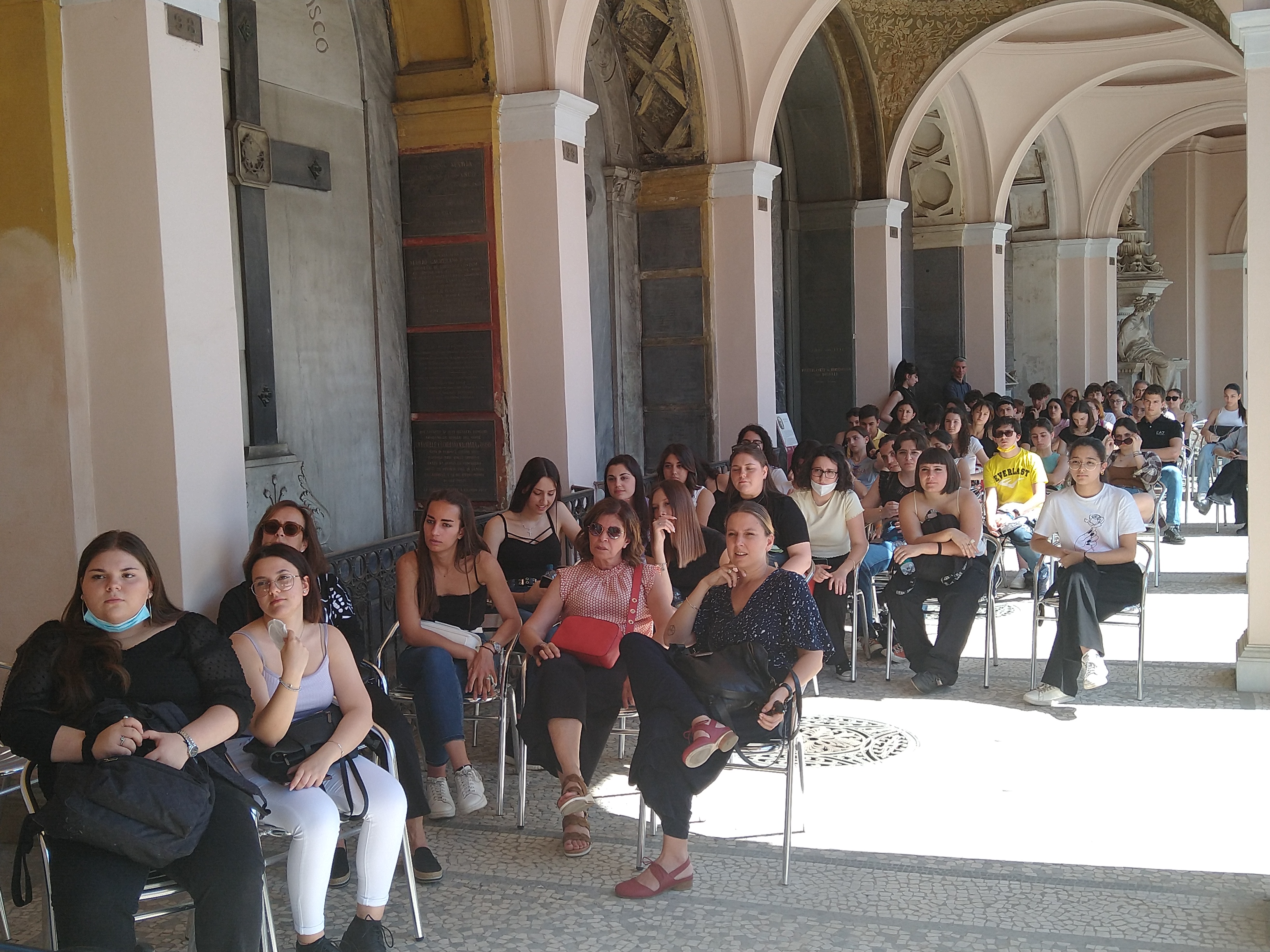
Starting at 5:30 PM, the programme featured a guided tour titled “La ______ mancante. Perdite e lacune nelle storie delle vittime civili di guerra” (“The Missing ______. Losses and gaps in the stories of civilian war victims”). Led by Federica Tammarazio, a prominent art historian and archivist, the tour explored themes of memory, archival gaps and the stories of civilian victims of war, in line with Archivissima’s 2026 core topic, “Quello che non c’è” (“What is not there”).

Live Performance

The historical exploration concluded with a powerful emotional impact at the Campo della Gloria (Field of Glory). Students from the Liceo Coreutico Teatrale Germana Erba delivered a moving live performance. Using the universal languages of dance and theater, the young artists brought the archival narratives to life, giving voice to those who could no longer speak and transforming historical memory into a vibrant call for peace.

You can watch the full performance in the video below.


Severed: A Tribute to Peace

Video project Severed
Torino, Italy, presents a moving video created as part of the WDEC 2025, commemorating the 80th anniversary of the end of World War II with a powerful message of peace, memory, and reflection.

About the project

As part of the 2025 Week of Discovering European Cemeteries (WDEC), Turin, Italy, has unveiled a moving video production titled Severed, reflecting on the enduring impact of war and the urgent call for peace. The project coincides with the 80th anniversary of the end of the Second World War and aligns with this year’s WDEC theme, Gardens of 80, which emphasizes Peace, Justice, and Strong Institutions – the goal 16 of the United Nations 2030 Agenda for Sustainable Development.

Severed is a collaborative effort by the Associazione Nazionale Vittime Civili di Guerra di Torino, Piemonte e Valle d'Aosta, AFC Torino S.p.A., Liceo Coreutico Teatrale Germana Erba, and the Fondazione Germana Erba's Friends. The production blends a musical performance with video storytelling, utilizing historical archives from the ANVCG, the Monumental Cemetery of Turin, and the Ossuary Monument dedicated to civilian war victims.

Featuring young performers, the video encourages reflection on the devastating consequences of war, linking historical memory with a vision for a peaceful future. The project serves as a moving reminder of the human cost of conflict, urging viewers to consider past tragedies and the continuous importance of peace and justice.

Ultimately, Severed stands out as a great example of how art and memory can combine to inspire dialogue and reflection, giving voice to younger generations.

Video:

WDEC 2025 in Turin

WDEC 2025 in Turin
As part of the Week of Discovering European Cemeteries 2025, a variety of interesting events will take place in Turin, Italy. View the complete program for details.

About the event

For WDEC 2025, Turin has organized various events closely aligned with this year's theme, "Garden of 80", including several guided tours.

The highlight is "Green Visit", part of the Festival del Verde, taking place on Sunday, 25 May 2025. Another key moment is the closing event on Friday, 9 June 2025, during which 125 students from the choreographic and theatrical high school will perform at the Monumental Cemetery of Turin to call for a future of PEACE.

Turin is also included in a promotional booklet created by Utilitalia SEFIT in collaboration with other Italian cemeteries, highlighting events and activities planned for WDEC 2025. The complete program of events in Turin can be found HERE.

Milada Horáková - the woman who would not bend

Event at Vyšehrad Cemetery in Prague
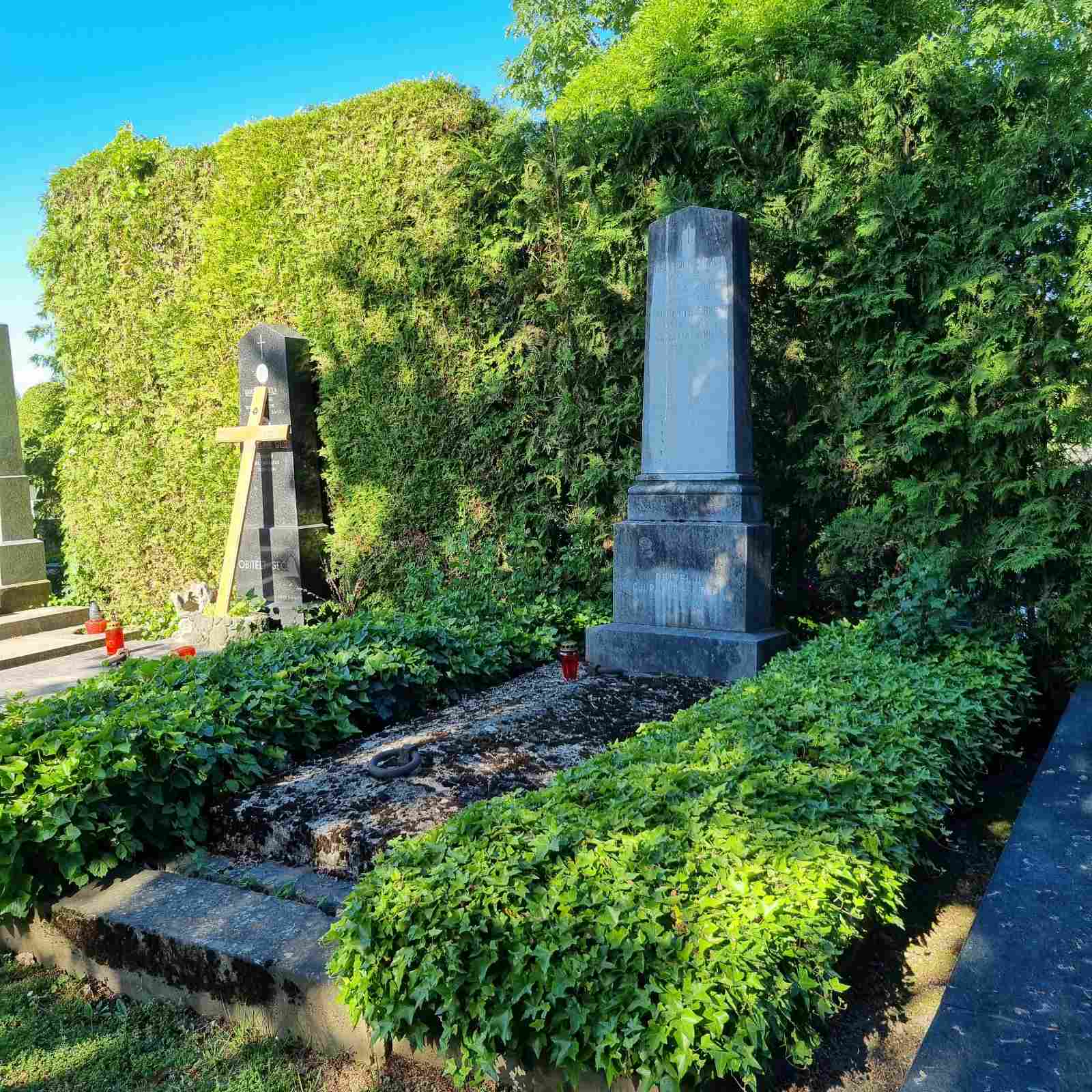
On April 15, 2025, a multicultural, intergenerational gathering took place at Dr. Milada Horáková’s symbolic grave at Vyšehrad Cemetery in Prague, marking 75 years since her execution for defending democracy and human rights.

About Milada Horáková

A lawyer, politician, and mother, Milada Horáková became a symbol of courage and moral integrity. She resisted both Nazism and Communism, refusing to betray her beliefs—even under the threat of death. Her final words, “I am falling, I am falling...,” still echo as a chilling reminder of the price of truth. Executed in 1950 after a show trial, her legacy lives on in the fight for freedom, democracy, and human rights.

Reflection on the Commemorative Act for Milada Horáková: Memory, Media, and Performativity in the Digital Age

The commemorative event for Milada Horáková, symbolically held at her fictional grave at Vyšehrad Cemetery in Prague, is not only a remembrance of a historical figure but also a media and performative event with deeper cultural and political dimensions. Since the event brought together students of the University of the Third Age (A3V) and master's students of the New Media Marketing program, it offers a unique opportunity to connect a commemorative gesture with reflection on public communication, propaganda, and PR in both historical and contemporary contexts.

Milada Horáková and the Media Staging of Power

The 1950 trial of Milada Horáková is often cited as a prime example of a political show trial, intended not to deliver justice but to consolidate power. The regime used all available communication channels to create an illusion of legitimacy and public support. The accusations were spread through radio, daily newspapers, posters, and petitions—tools aimed not only at discrediting the accused but also at mobilizing public displays of loyalty to the regime.

This "staged justice" (in the sense used by Hannah Arendt) served as political theatre where facts mattered less than effects—fear, obedience, and control over the narrative. Communist propaganda systematically used language, imagery, and emotion—the very tools that we now analyze in marketing and media communication. That is why reflecting on these events holds great value for today’s media students; it reveals how structured messaging can deeply shape reality.

Digital Media, Democracy and Truth

Today’s media landscape has changed radically. The internet, social media, and digital technologies have democratized access to information but also brought new challenges—disinformation, post-truth, and algorithmic content filtering. While 1950s propaganda operated in a centralized way, today’s is decentralized, often hidden, and masked as entertainment, opinion, or personal expression.

From the perspective of New Media Marketing, it is crucial to observe not just the evolving forms but also the strategies used to influence public opinion. The experience of historical propaganda—such as the Horáková trial—can serve both as a warning and an inspiration. It reminds us that the media are never neutral—they always carry ideological weight, whether consciously or unconsciously.

The Importance of Physical Presence in the Digital Age

We live in an era of hybrid communication, where physical and digital intersect. The COVID-19 pandemic accelerated this trend—online platforms became the primary spaces for education, work, and social interaction. In this context, the gathering at the symbolic grave of Milada Horáková gains special meaning—as a cultural and civic act occurring "offline", emphasizing shared physical presence in space and time.

From a phenomenological perspective, physical presence has a unique character—it allows for sharing not only words, but also silence, atmosphere, eye contact, and emotional responses. Memory thus becomes not only a mental but also a bodily experience. At the same time, it functions as a form of counterculture—at a time of constant digital mediation, in-person participation has the potential to be more powerful than online content.

The Commemorative Act as a Performative Gesture

The commemorative event, that took place on April 15, is not just a reflection of the past but also a performative gesture in the present. Judith Butler reminds us that every public assembly is also a political act—it reveals who has access to space, who gets to speak, and who is heard. In this case, it is both an act of respect for a woman who was silenced, and a means of giving voice to current concerns about democracy, media responsibility, and civic engagement. The presence of participants from different generations—from seniors to young students—encourages intergenerational dialogue and the sharing of experience, which is especially valuable in a society often divided into closed bubbles. It is also a chance to reflect on what it means to be a citizen in the digital age.

Conclusion

Remembering Milada Horáková through the commemorative event at Vyšehrad was more than a remembrance. It was a starting point for deeper reflection on how communication evolves, how public space is shaped and misused, and what role we play in all this—as citizens, as media users, as students.

In an era when reality can be easily manipulated through images and narratives, it remains essential to return to truth—even when it is complex, uncomfortable, or painful. And to remember that the ability to listen, to think critically, and to meet face-to-face may be the most powerful expressions of democracy we have today.

The commemorative event was organized by students of the University of Finance and Administration in Prague and the Svatobor Association.

The gathering was held at the symbolic grave of Dr. Milada Horáková, located at the Vyšehrad Cemetery in Prague. This cemetery is the final resting place of the Czech Republic’s cultural and scientific elite. Among those buried here are some of the most prominent figures of the 19th century, such as Alfons Mucha, Ema Destinn, Karel Čapek, Antonín Dvořák, and many others.


Adapted from the text by: Bc. Jana Matusova, student University of Finance and Administration
Email: matus.jana@gmail.com
Phone: +420773976504
More information: https://www.slavin.cz/miladahorakova/.


*Photo source: www.slavin.cz

Restoration of Maciachini’s family tomb

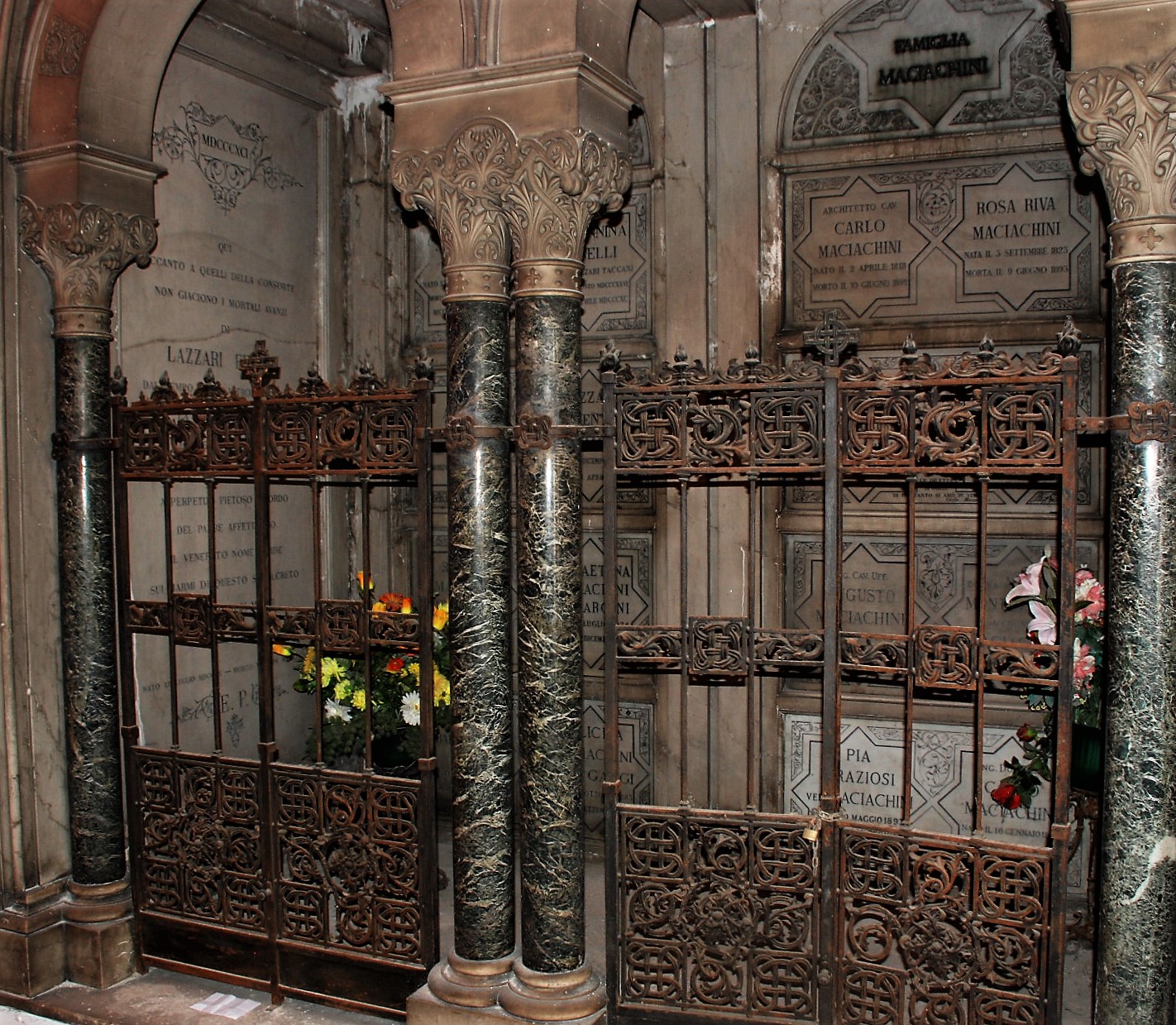
Maciachini’s family tomb
On April 2, 2023, the official unveiling of the restored Maciachini’s family tomb will take place at the Milan Monumental Cemetery in Italy.

Carlo Maciachini (1818 - 1899)

Maciachini’s Tombstone

The architect Carlo Maciachini was born on April 2, 1818, in Induno Olona and died on June 10, 1899, in Varese. He studied Architecture and Ornamentation at the Brera Academy of Fine Arts in Milan. 

His first major work as an architect was the construction of the Serbian-Orthodox Church of San Spiridione in Trieste. Then, in 1863, the international competition launched for building a bigger cemetery in Milan chose his proposal for the design of the new Milan Monumental Cemetery.

Maciachini is universally acclaimed by historians and academics as his eclectic style is a prelude of modern architecture, even if it does not miss tradition.

Restoration of Maciachini’s family tomb

Plan of the Maciachini’s tomb

Maciachini’s family tomb is located between two arches in Section A-B of the West Lower Gallery at the Milan Monumental Cemetery and is fully neglected. The association Amici del Monumentale di Milano was established in 2013 with the purpose of safeguarding, perpetuating, enhancing, and promoting the history, art, and cultural heritage of this important cemetery. Considering the great symbolic, historic, and artistic importance of this tomb, the association decided to finance and promote its restoration.

The restoration project has the patronage of the Municipality of Milan, Induno Olona, the Chamber of Architects, City Planners, Landscape-Architects and Curators of the Province of Milan. Pending is the patronage of the Brera Academy of Fine Arts.

During the restoration works, students of the art schools of Milan and province as well as members of the Italian Agency for the Deaf will have a chance to listen to the restorers explaining the various stages of their work, materials and techniques employed.

Amici del Monumentale is also a member of ASCE and FIDAM (Italian Federation of the Friends of Museum). The association has already financed three remarkable restorations: Ave Maria by Giulio Branca, Ecce Puer by Medardo Rosso and The Guardian Angel by Luigi Buzzi Giberto.

Unveiling of the restored tomb (program)

Detail on the Maciachini’s tomb

The official unveiling of Maciachini’s restored tomb will take place on April 2, 2023, on Maciachini's 205th birth anniversary, at the Milan Monumental Cemetery.

Conference

At 9.30 am, there will be a conference on the topic "Maciachini, an eclectic positivist", with the participation of prestigious speakers Ornella Selvafolta (architectureal historian) and Sergio Rebora (art historian and history and art curator of the Monumentale). The two restorers, Matteo Pelucchi and Maria Facchinetti, will also participate and will report about the restoration process, respectively for the stone elements and metal parts.

All visitors will receive a brochure "Account of a restoration work" illustrating the various restoration stages.

Musical interlude

At 10.30 am, there will be a musical interlude with "La Banda d'Affori".

Unveiling ceremony

At 11.00 am, the unveiling ceremony will take place, attended by the Councillor Gaia Romani and Marco Cavallin, mayor of Induno Olona, Maciachini's birthplace. A guided walk to the chapels and monuments executed by Maciachini will take place soon after the ceremony.

You can find the official invitation (in Italian) HERE.

WDEC 2022: Students visited the Catholic Cemetery Dubovac

Students at the Catholic Cemetery Dubovac
Photos of Dubovac Elementary School students visiting the Catholic Cemetery Dubovac during this year's Week of Discovering European Cemeteries.

On the first day of June, on the occasion of the "Week of Discovering European Cemeteries 2022", a free tour of the Catholic Cemetery Dubovac in Karlovac, organized by the company Zelenilo, was held under the expert guidance of tourist guide Ivančica Šebalj.

This year's tour of the Dubovac cemetery, which has been a member of the ASCE since 2014, was joined by students from the Dubovac Elementary School, who listened with interest to the appealing and instructive stories of Ivančica Šebalj.

WDEC 2022: Funerary symbols and famous people of the Italian Risorgimento

Funerary symbols and famous people of the Italian Risorgimento
An online conference about the project "Funerary symbols and famous people of the Italian Risorgimento" will be held on June 7, 2022.

About the conference

The online conference about the project "Funerary symbols and famous people of the Italian Risorgimento" will address the tours studied and identified in the Monumental Cemetery of Turin by the students of the Liceo Regina Margherita. 

The online conference will take place on June 7, 2022, at 17.30. 

Here is the LINK to join the conference.

WDEC 2022 in Varaždin

Varaždin Cemetery (Varaždin, Croatia)
As part of the Week of Discovering European Cemeteries 2022, the Electromechanical School in Varaždin has implemented a project that combines mathematics, historical heritage and the Varaždin Cemetery.

Combining mathematics and history

Students of the first grade of the Electromechanical School in Varaždin (Croatia), majoring in media technician, joined the research of the Varaždin Cemetery as a topic for applying to the "Mathematics+" competition. The result was an interesting blend of mathematics and history.

About the project

After visiting the State Archives in Varaždin, students got the idea to statistically process data from the Registry of the Dead of the Parish of St. Nicholas in the period 1891-1896. The research was conducted through several days of work in the archive.

The aim of the research was to find out the average age of death of Varaždin people from the end of the 19th century, the most common causes of death, and to analyze data by age groups, gender and time period.

Varaždin Cemetery Students at Varaždin Cemetery Varaždin Cemetery

Project video

After the research, a promotional video about the cemetery was made in cooperation with the second grade students, also in the field of media technicians. The video itself shows the valuable heritage and special atmosphere of the Varazdin cemetery.

WDEC 2022: A hundred students at the Monumental Cemetery of Turin

WDEC 2022 in Turin
A public event with 100 students took place on May 28, 2022, in the Monumental Cemetery of Turin (Italy).
WDEC 2022 at the Monumental Cemetery of Turin


On May 28, 2022, at 15.30, as part of this year’s Week of Discovering European Cemeteries, a public event took place at the Monumental Cemetery of Turin with the presentation of the research, mapping and drafting of the PCTO Project of the third and fourth grades of the Regina Margherita State High School of Turin "Funeral symbols and illustrious citizens of the Italian Risorgimento" in collaboration with the FAI Delegation of Turin.

At the end the students guided those present on a walk in the historic area of the cemetery.

More information on www.cimiteritorino.it.

You can see photos from the event on this link.


WDEC 2022 in Athens

The First Cemetery of Athens
Students of the University of West Attica will introduce you to the conservation profession and its contribution to the protection of cultural heritage.

Involving the youth

The First Cemetery of Athens has become a classroom, an amphitheater, a laboratory. Visits from Universities took place throughout the academic year 2021-2022. In this context, the First Cemetery of Athens became a place of teaching and practical training for students of the Department of Preservation of Antiquities and Works of Art of the University of West Attica. Their study concerns the documentation of the most important types of surface damage, causes and effects, as well as the establishment of a preservation management system.

From theory to practice (in situ)

“Mother of the Occupation period” statueFrom 3 to 5 June 2022, during the Week of Discovering European Cemeteries (WDEC), students of the University of West Attica will carry out surface cleaning and conservation of the sculpture "Mother of the Occupation period” in the central square of the First Cemetery. Visitors can watch live and get acquainted with the profession of conservator and his contribution to the protection of cultural heritage.

This initiative and collaboration not only benefits the monuments. It mainly promotes the systematic contact and interaction of young people with cultural heritage, as well as the development of skills and critical thinking for the sustainability of the cemetery landscape.

About the “Mother of the Occupation period” statue

“Mother of the Occupation period” statueThe “Mother of the Occupation period”, made by Costas Valsamis (1908-2003), is a bronze sculpture that refers to the death from starvation during the years of the Occupation in Athens (1941-1944). The image of the dead mother lying on her back, skeletal, with her baby on her chest, was a real scene that the sculptor experienced in the winter of 1941. 

The mention of this tragic moment in an expressionist style in the cemetery is a monument of the sufferings of that period, but also of Motherhood. It was installed in 1979.


Contacts:

City of Athens / Department of Cultural Heritage
T: +30 2103721596, 2103721555
E-mail: t.pol.klironomias@athens.gr

Project: School to school in remembrance

School to school in remembrance
On the basis of cultural days for schools at Maribor cemeteries in Slovenia, the "School to school in remembrance" project was developed.

2019: Drago Kobal primary school to Bojan Ilich primary school

Drago Kobal primary school to Bojan Ilich primary school

On March 26, 2019, the students of Drago Kobal primary school introduced their peers from Bojan Ilich primary school to European cemeteries and the path of sports legends of Maribor at the Pobrežje cemetery.

A special part was dedicated to the presentation of a sports legend Josip Primožič - Toš, which was presented by the students of Drago Kobal primary school as part of the Week of Discovering European Cmeteries 2018.

2020: Drago Kobal primary school to Maks Durjava primary school

Drago Kobal primary school to Maks Durjava primary school

On September 25, 2020, former students of Drago Kobal primary school passed on their knowledge of European cemeteries and the legends of Maribor to the students of Maks Durjava primary school.

Students presented the medical legend Klara Kukovec. They walked to her grave, viewed a documentary exhibition about her life and work, which is located next to the chapel at the Pobrežje cemetery, and also walked to the family tomb of Maks Durjava.

2021: Bojan Ilich

In 2021, the students of Bojan Ilich primary school will continue with the project "Reviving Maribor Legends". In cooperation with Pogrebni podjetje Maribor, they will present the life journey and interesting things related to Bojan Ilich.

2022: Max Durjava

In 2022, it will be the turn of the Maks Durjava primary school students, who will also present the person after whom their school is named. They will resurrect the Maribor legend, Maks Durjava, whose family tomb is located at the Pobrežje cemetery.

Project: Reviving Maribor legends

Edvard Glaser
The aim of the project is to discover and revive some outstanding personalities that rest at Maribor cemeteries and in doing so include the students of local schools.

The legends from Maribor

Outstanding achievements, passion and the unstoppable will are the characteristics of some of the historical figures of the city of Maribor. People would often describe them with the phrase "He was a legend.". With this expression, they would want to go beyond the usual descriptions like "He was great.", "He was really good.", "He was outstanding.".

"To be a legend" in slang means to be extraordinary, but at the same time something more. Almost incomparable to others due to some of their characteristics that stood out in the context of their life period.

Today, many of those great personalities rest at the Pobrežje Cemetery, and the aim of the project "Reviving Maribor legends" is to discover and revive them by including the students of local schools. The project initiator is Pogrebno podjetje Maribor.

So far, two paths were created at Pobrežje Cemetery as part of the project - Reviving sports legends and Reviving medical legends of Maribor.

Reviving Maribor sports legends

Josip Primožič - Tošo

Usually humble, kind, funny, full of strength and eternal romantic. His life path was closely intertwined with his love for gymnastics, fine arts and, above all, his family.

Josip Primožič - Tošo was a gymnastic legend of Maribor, who was presented for the first time as part of the Symbols project.

In 2018, a cultural day for the Drago Kobal primary school was held at the Pobrežje Cemetery, and while exploring the cemetery, we found that the teachers and elementary school students of this school had done a thorough research on Josip Primožič and collected a lot of material about him and his life.

The importance and interestingness of his life path convinced us to revive this legend together as part of the Week of Discovering European Cemeteries 2018.

You can find some other Maribor sports legends presented HERE.

Reviving Maribor medical legends

Dr. Klara Kukovec

Dr. Klara Kukovec - the doctor who immigrated to Maribor from Ukraine. She was the first woman with a private medical practice in Maribor and overall an important personality of her time with many achievements to point out.

On September 27, 2019, a special tour was held at Pobrežje Cemetery, which included:

      • Presentation of the life story of dr. Klara Kukovec through a theatrical performance by the students of Drago Kobal primary school.
  • Opening of a documentary photography exhibition about Klara Kukovec in front of the chapel in the southern part of the Pobrežje Cemetery.
  • A guided walk through Pobrežje Cemetery, following the "path of dr. Klara Kukovec".  Students of Drago Kobal primary school took on the role of cemetery guides with the help of the mobile guide ARtour.
You can find some other Maribor medical legends presented HERE.

Genova cemetery visited by China students

Fifteen students from Cina have been hosted by @Liceo Linguistico Internazionale Grazia Deledda in the Municipality of Genoa.

Impressions and Emotions - Belgrade High School Students Visiting the New Cemetery (Belgrade, Serbia)


On October 24 and 25, 2018, two groups of  of high school students visited the New Cemetery of Belgrade.


On October 24 and 25, 2018, we were privileged to receive the visit from two groups of high school students: students from „Tehno-Art“ High School for Technologies and Crafts and students from High School Student Dorms Association of Belgrade. Exploring the history of the New Cemetery in Belgrade, since its beginnings to the present day, the students were introduced to the burial culture and by extension the importance of establishing the first architecturally planned cemetery in Serbia.


Strolling through the cemetery Allies, the students got acquainted with the architecture of the New Cemetery in Belgrade, including headstones they viewed as the works of art, in addition to the sculptural works that attracted their attention. In a view of the upcoming commemoration of the WWI Armistice Centenary and their history curriculum, the students visited the WWI Serbian Ossuary. The idea of visiting the crypt, which commenced with some degree of fear, ended in exuberance and the wish to find out more and extend the walk. 

The students transformed their impressions into the inspiring texts and drawings you may see within our post.


Impressions: New Cemetery in Belgrade – Open Air Museum 

When we heard that we are going to visit the New Cemetery, we were really surprised, since we are used to go to the cemetery on different occasions. First, we were extremely surprised by sheer size of the cemetery.... The Alley of the Greats is the last resting place of the most prominent WWI Serbian Field Marshal Živojin Mišić ... At his grave there is an impressive sculpture of a beautiful lady with a palm branch... We also visited WWI Serbian Ossuary, where the remains more than 4000 identified and unidentified soldiers, who died during the Great War were buried... Through intriguing stories of our guide, we traveled to a different era, when the history of our Country and our Capital was  being made...by Vida Gojković – Medical High School and Aleksandra Ranković – High School of Economy 


Students as ASCE guides

ASCE scholars guides in Maribor
At the AGM 2012 in Maribor, Slovenia, 6 children from Maribor elementary schools guided the ASCE members through Pobrežje cemetery.

Students becoming guides

With the students becoming guides, this represented a very special and different experience for visitors, scholars and the schools.

It all started at Pobrežje Cemetery in April, when Pogrebno podjetje Maribor (the cemetery management company) hosted scholars from 2 schools for the cultural day. Scholars were presented with the history of the cemetery and important people burried there.

With an excellent prepared guidance, scholars immediately became aware that cemetery is not just a place of death and sadness. It was a place of many interesting findings and as they have learned about the important people in the cemetery, scholars were actually learning about themselves and their own history.

For many of them, the experience was so impressive, that they have volunteered for becoming guides  themselves. Preparations started and soon, they were guiding their first visitors, during the Week of Discovering European Cemeteries (WDEC).

Guided tour at the AGM on September 14, 2012

After the first experience, the youngest guides worked with their english teachers and improved the guidance techniques and knowledge for their big challenge: guiding the ASCE members and partners through the cemetery at AGM 2012.

As it turned out, they were surprisingly relaxed, practical and interesting. Present members enjoyed the easy guidance where scholars presented the most important people of Maribor with just enough facts and interesting stories.

Importance of the project

The project has many important implications and presents one of the best possible ways to get every European citizen in touch with the heritage, preserved in the cemeteries. Because scholars are not the only ones impressed. Their families, friends and many others are now learning from them about the importance of our cemeteries.