Showing posts with label Spain. Show all posts

WDEC 2026 in Barcelona Cemeteries

Educational heritage informational poster at Montjuïc Cemetery in Barcelona, Spain
As part of the WDEC 2026, Cementiris de Barcelona is showcasing its educational programme “Life Lessons: Cemeteries as Educational Heritage”.

About the programme

One of the pillars of Cementiris de Barcelona is its educational service, which works to promote Barcelona’s cemeteries as cultural assets of exceptional importance, fostering public knowledge and helping to normalize death. This mission is reflected in the programme "Life Lessons: Cemeteries as Educational Heritage". Although featured during WDEC 2026, the programme is not limited to this one week. Educational activities are conducted throughout the year across several Barcelona cemeteries, demonstrating the organisation’s long-term commitment to learning, cultural heritage, and community engagement.

The educational activities, tailored to various learning stages, offer a unique opportunity to explore the rich funerary heritage of the Poblenou and Montjuïc cemeteries—both classified as monumental by the Council of Europe—as well as the Funeral Carriage Collection, the Funerary Library, and other cemeteries in Barcelona. Together, these sites represent a significant cultural legacy and a collective memory shared by society.

This initiative is led by the team at Cementiris de Barcelona: highly qualified professionals committed to continuous improvement, who balance compassionate care for families during the farewell process with excellence in educational outreach. By engaging students in meaningful educational experiences, the educators foster deep respect for heritage preservation while working to normalise death as an essential, natural part of life.

By addressing a fundamental topic that remains taboo for many, these activities provide a supportive space for reflection. The subject of mortality is approached with the utmost respect for diverse beliefs, religions, and cultural traditions, allowing participants to fully appreciate the rich symbolic expressions that define Barcelona’s funerary heritage.

You can read more about the programme HERE.

WDEC 2026 at Sant Antoni Abat Cemetery

Sant Antoni Abat Cemetery
During this year's Week of Discovering European Cemeteries, several guided walks will take place at the Sant Antoni Abat Cemetery in Alcoy, Spain.

Event program

Saturday, 30 May 2026

10.00: Guided tour of the Alcoy Monumental Cemetery, by Quality Tours Mariola
Information and registration: www.qtmariola.com
Price: 15€ per person

12.00: Freemasonry route in the Alcoy Monumental Cemetery, by Quality Tours Mariola
Information and registration: www.qtmariola.com
Price: 15€ per person

Sunday, 31 May 2026

10.00: Guided tour of the Alcoy Monumental Cemetery, by Quality Tours Mariola
Information and registration: www.qtmariola.com
Price: 15€ per person

12.00: Freemasonry route in the Alcoy Monumental Cemetery, by Quality Tours Mariola
Information and registration: www.qtmariola.com
Price: 15€ per person

17.00: Dramatized tour "In the shadow of the cypresses", by Guiarte con Arte
Information and registration: www.guiarteconarte.es or 650 59 42 32
Price: 12€ per person; 5€ for children under 16 years

Official flayer

You can download the official flyer with the program of events at the Sant Antoni Abat Cemetery at this LINK.

WDEC 2025 in Madrid

Photo exhibition in Madrid
The 2025 Madrid Book Fair highlights Europe’s Cultural Routes through a special photo exhibition, featuring the European Cemeteries Route among others.

About the exhibition

On June 1, 2025, the annual Madrid Book Fair was officially inaugurated and will continue welcoming visitors until June 15 in the iconic Retiro Park. This year’s edition not only celebrates literature but also shines a spotlight on European cultural routes.

In order to give visibility to the cultural routes in Spain, highlight their European dimension, and showcase the work carried out by each route, an exhibition has been installed along the Paseo de Coches del Retiro. It features various panels dedicated to different cultural routes of the European Community. Among the displays is one representing the European Cemeteries Route, illustrated by the striking image of The Kiss of Death (one of the most photographed funerary sculptures in Europe) located in the Poblenou Cemetery in Barcelona.

This project aligns with the ASCE Week of Discovering European Cemeteries, drawing attention to cemeteries not only as resting places but also as open-air museums that reflect artistic, historical, and social legacies.

WDEC 2025 in Barcelona

Holocaust Memorial in the Montjuïc Cemetery
Barcelona celebrates this year's WDEC with an intimate concert at Montjuïc Cemetery, alongside a collection of stories that hold special significance in European history.

Stories of Resistance and Remembrance

The Week of Discovering European Cemeteries 2025 commemorates the 80th anniversary of the end of the Second World War, focusing on 80 stories that brought people together and helped build just, peaceful, and inclusive societies.

In this context, Cementiris de Barcelona has prepared a booklet featuring the stories of four remarkable individuals buried in the city’s cemeteries — Lluís Companys, Concepció Badia, Joaquim Amat, and Enric Casals. Their lives, marked by resistance, artistry, and commitment, offer a powerful lens through which to reflect on the impact of war and the enduring importance of memory. The booklet also highlights a memorial dedicated to Holocaust victims, located at the Fossar de la Pedrera in Montjuïc Cemetery.

You can access the booklet HERE.

Concert at the Cemetery of Montjuïc

In addition to the booklet, Cementiris de Barcelona invites the public to a deeply symbolic event on June 5, 2025, at 7:00 PM, at the Fossar de la Pedrera in Montjuïc Cemetery. Attendees will experience an intimate violin concert featuring tribute music from contemporary ensembles. The evening will culminate with the lighting of 80 candles, commemorating 80 years of peace since the end of World War II — a gesture of hope and remembrance.

As space is limited for the concert, advance reservation is required. Full details and registration information can be found on the official Cementiris de Barcelona website.

Event highlights


Brihuega Municipal Cemetery (Brihuega, Spain)

Brihuega Municipal Cemetery (Brihuega, Spain)
The cemetery lies within the historic Castle of La Peña Bermeja and retains its original 19th-century design.

About the cemetery

The cemetery of Brihuega, dating back to the 19th century, is located within the Castle of La Peña Bermeja, the oldest building in the town. The castle was likely constructed between the 9th and 11th centuries, during the Caliphate era. From the parade ground (Prado de Santa María), the site is accessed through the Puerta del Rastrillo, located next to the apse of the Church of Santa María. This gate leads into the courtyard, now referred to as the upper cemetery.

The exact year of the castle’s construction is unknown. The cemetery was established in 1834, prompted by a cholera epidemic that broke out in August of that year. Its design has since been restored to reflect its original state. Today, the cemetery remains in active use.

Important figures in the cemetery

Among the notable individuals buried there are:

  • Don Ramón Casas, a deputy and one of the main driving forces behind Brihuega's celebration of the 2nd Centenary of the Battle of Brihuega and Villaviciosa during the War of the Spanish Succession.
  • Don Jesús Ruiz Pastor, a true patron of Brihuega in the 20th century, who was responsible for the construction of one of the town’s most emblematic buildings, la Plaza de Toros, among many other contributions.
  • Don Valeriano Herrera, originally from Salamanca but a Brihuega local by marriage, to whom we owe the town’s largest photographic archive.
  • Don Juan Elegido Millán, a magician and hypnotist born in Brihuega. A tireless collector of miniatures from around the world. His passion is reflected today in the Miniature Museum housed in the Convent of San José.
  • Don Antonio Pareja Serrada, whose remains were recently brought to the Brihuega cemetery from Madrid's Almudena cemetery. Born in Brihuega in 1844, he was a provincial chronicler, historian, and devoted admirer of his hometown.

Cemetery address

Prado de Santa María
19400 Brihuega
Spain

Basic data

Year of first burial: 1834
Cemetery area: 3500 m2
Approximate number of graves: 650

WDEC 2025 in Alcoy

Sant Antoni Abat Cemetery in Alcoy
Find out about the guided tours taking place at the Sant Antoni Abat Cemetery in Alcoy, Spain, as part of this year's Week of Discovering European Cemeteries.

Event program

Saturday, 31 May 2025

11.00: Guided tour of the Alcoy Monumental Cemetery
Information and registration: www.qtmariola.com
Price 15,00 €

18.00: Dramatized tour of the Cemetery "In the shade of cypresses"
Information and registration: www.guiarteconarte.es or tel. 650 59 42 32
Price: 12 €

Sunday, 1 June 2025

10.00: Guided tour of the Alcoy Monumental Cemetery
Information and registration: www.qtmariola.com
Price: 15 € (children under 8 years old free)

11.00: Dramatized tour of the Cemetery "In the shade of cypresses"
Information and registration: www.guiarteconarte.es or tel. 650 59 42 32
Price: 12 €

12.00: Freemasonry route in the Alcoy Cemetery
Information and registration: www.qtmariola.com
Price: 15 € (children under 8 years old free)

Official flayer

You can download the official flyer with the program of events at the Sant Antoni Abat Cemetery at the following links:

Renewal of the Quality Seal for educational activities

Schools on Cemeteries in Barcelona
Cementiris de Barcelona renewed its Quality Seal for educational activities with an Educational Project that was reviewed and approved by the Technical Secretariat of the Pedagogical Innovation Council (CIP).

Cemeteries as learning spaces

Cemeteries represent a historical and artistic legacy that is fundamental for understanding the social and cultural evolution of the populations that preceded us. At the same time, they allow us to better understand the present that surrounds us and help students develop a critical perspective on the world around them.

The social value of cemeteries lies in their representation of the collective memory that unites us as a society and in the understanding of death as a natural part of life. Likewise, aware of the link that cemeteries have with the territory that surrounds them and the people who live there, Cementiris de Barcelona collaborates with schools and districts to nurture a sense of neighbourhood belonging and respect for its heritage.

About the Educational Project

The Educational Project considers the various skills outlined in the school curriculum, aiming to provide pupils and teachers with additional tools to share knowledge and understand different situations from both the past and the present. To effectively address the needs of the curriculum, it focuses on specific competencies that Barcelona Cemeteries, as an organisation, is capable of contributing.

Firstly, the six vectors of Barcelona’s new basic education curriculum have been taken into account. These vectors are designed to foster a society that is critical, sustainable, digital, more equitable, feminist, and democratic. For this reason, three of the six vectors have been considered as the fundamental basis of the Educational Project: competency learning, gender perspective, and global awareness combined with emotional well-being.

On the other hand, the transversal competences of the new curriculum have also been taken into account, particularly civic competence, entrepreneurial competence, personal, social and learning to learn competence and digital competence. Of these, Cementiris de Barcelona's Educational Project includes citizenship competence and personal, social and learning to learn competence.

Week of Democratic Memory in Olvera

Olvera, Spain
On November 8 and 9, 2024, special activities took place in Olvera, Spain, as part of their Week of Democratic Memory.

Program

On Friday, November 8, at 8:00 p.m., the Spanish theater company Los Sueños de Fausto performed Flowers of Spain, a theatrical production that explores themes related to Spain’s historical memory, particularly the legacy of the Spanish Civil War and the subsequent Franco dictatorship. The performance took place in the assembly hall of the Sierra de Líjar Institute.

The following day, on Saturday, November 9, at 11:00 a.m., a solemn event was held at the Municipal Cemetery of Olvera to commemorate the Historical Memory and the victims of Franco's repression in the town.

The Olvera City Council thanks everyone who participated in the organised activities and celebrated the Week of Democratic Memory with us.

The Pedagogical Suitcase project at Barcelona cemeteries

Schools on Cemeteries in Barcelona
In 2024, Cementiris de Barcelona has expanded its educational services by introducing the Pedagogical Suitcase project, designed to bring funeral culture into schools.

Offering educational activities in schools

Cementiris de Barcelona is an active participant in the ASCE Schools on Cemeteries project and a member of Barcelona City Council's Pedagogical Innovation Council. 

Since 2013, they have been offering educational activities in schools to bring pupils closer to the funerary heritage of the cemeteries, reflecting Barcelona's historical evolution. Over the last few years, these activities have been developed and adapted to meet the needs of the school curriculum. 

In 2020, as a result of the Covid-19 epidemic, they took a step forward by creating three additional activities, allowing young people to express the concept of death from an artistic and creative perspective through the study and research of cemeteries. During this challenging time, there was a growing need to naturalise death and break existing taboos, which led many schools to turn to their pedagogical activities.

Own educational project

Barcelona is a city rich in cultural and museum offerings, and the range of educational activities provided by cultural organisations in schools is wide and varied. In response to this, Cementiris de Barcelona developed its own educational project aimed at all levels of education. This initiative enables the development of a range of basic skills to complement school education.

The cemeteries of Poblenou and Montjuïc, listed as monumental cemeteries by the Council of Europe and part of the European Cemeteries Route, offer students the opportunity to learn about the most important historical, social and cultural events in the history of Barcelona and its most illustrious figures.

These programs also encourage a critical view of societies and their organisations, promote open conversations about death, and foster respect for artistic and cultural heritage.


Collection of Hearses and El Fossar de la Pedrera

Another of the outstanding spaces in which educational activities are carried out is the Collection of Hearses, a unique heritage site in Europe. Here, visitors can explore the evolution of funeral rituals to better understand the change in mentality towards the concept of death, as well as learn about gender roles within the funeral world, particularly focusing on the role of widows.

Additionally, within Montjuïc Cemetery lies one of the main memorials to the victims of Franco's regime in Catalonia, El Fossar de la Pedrera. This site offers an opportunity to delve into one of the most impactful episodes in recent history, the Spanish Civil War, raising students' awareness of the violence that can be inflicted by the state.

The diversity of activities and the historical and heritage value of the cemeteries have also attracted schools from France, Germany, Belgium, and Italy, who have brought their pupils to explore Barcelona's cemeteries.

The Pedagogical Suitcase project

In 2024, Cementiris de Barcelona has expanded its educational services by introducing the Pedagogical Suitcase during the current academic year. This set of pedagogical tools is designed to bring funeral culture into schools and address bereavement among younger students.

The activities are structured for classroom learning and can be followed by visits to the cemetery, allowing students to experience firsthand what they have learned in class and gain a deeper understanding of their role in society.

The goal of these activities is to help students engage with a reality that affects everyone equally, while understanding that, although death is a universal event, there is a great diversity of ways to approach and experience it.

Additionally, the program familiarises students with different religious traditions, encourages them to reflect on their own lives and values, and helps them develop better emotional management by exploring the range of emotions that bereavement can evoke.

1st International Conference on Universities and Cultural Routes

1st International Conference on Universities and Cultural Routes
The European Institute of Cultural Routes invites you to participate in the 1st International Conference on Universities and Cultural Routes, taking place this November in Santiago de Compostela, Spain.

About the Conference

The European Institute of Cultural Routes (EICR - Technical agency of the Cultural Routes of the Council of Europe programme) and the Compostela Group of Universities (member of the University Network for Cultural Studies) is pleased to announce the organisation of the 1st International Conference on Universities and Cultural Routes, taking place from 13th to 14th November 2024 at the University of Santiago de Compostela, in Santiago de Compostela, Spain.

Following two successful editions of the Cultural Routes Academic Workshops held online in 2021 and 2023, this event is intended to highlight existing research and academic activities in the field of Cultural Routes.

Call for papers

The academic conference welcomes papers relating to all aspects of Cultural Routes. Participants interested in presenting a contribution at the conference can submit their abstracts to evaluation@culture-routes.lu under the subject “Call for abstracts 2024_Cultural Routes” by Friday 27th September

As the European Cemeteries Route has been a certified Cultural Route of the Council of Europe since 2010, the Association of Significant Cemeteries in Europe (ASCE) would like to encourage our representatives to attend the conference with some interesting presentation topics.

The call for papers containing further details and instructions is available HERE.
An abstract template can be found HERE.

Importnat information

The travel to/from Santiago de Compostela and accommodation costs are not covered by the organisers and must be borne by each participant. Registration fees will not be requested, and meals and extra activities will be offered by the organisers as indicated in the draft programme.

The International Conference working sessions will be held in English.

A preliminary programme, registration details, travel and accommodation options, as well as cultural activities information are available HERE. Invitation letters and updated practical information will be sent out during the first weeks of September.

For any additional information, please contact evaluation@culture-routes.lu.

WDEC 2024 at the Montjuïc Cemetery

WDEC 2024 at the Montjuïc Cemetery
Cementiris de Barcelona has organized a special exhibition which presents their efforts to mitigate environmental impacts.

The issue of climate change

This year's Week of Discovering European Cemeteries highlights the important issue of climate change through various events and activities, showcasing different ways in which cemeteries and their visitors can contribute to reducing environmental impact.

According to the United Nations, climate change refers to long-term changes in temperatures and weather patterns, which can result from natural causes or human activities.

The acceleration of climate change is driven by the emission of “greenhouse effect” gases generated by the combustion of fossil fuels. Adapting to these new conditions is very difficult for both nature and human societies.

Exhibition at the Montjuïc Cemetery

WDEC 2024 at the Montjuïc Cemetery

Cementiris de Barcelona has organized an exhibition installed at the Montjuïc Cemetery, which presents the initiatives they have undertaken to mitigate these negative effects and the measures adopted to reduce environmental impact. All visitors and schools participating in cultural visits and educational activities at the Montjuïc Cemetery will attend this exhibition.

In June 2024, Cementiris de Barcelona will hold a special conference to delve deeper into these issues. Throughout the year, they will also take this exhibition to most other cemeteries in Barcelona.

WDEC 2024 at the Sant Antoni Abat Cemetery

Sant Antoni Abat Cemetery
During this year's Week of Discovering European Cemeteries, several guided walks will take place at the Sant Antoni Abat Cemetery in Alcoy, Spain.

Event program

Friday, 31 May 2024

18.00: Guided tour “In the Shadow of the Cypresses” in the Alcoy Cemetery by Guiarte con Arte.
Information and reservations: www.guiarteconarte.es or 650 59 42 32
Price: 10€ / person

Saturday, 1 June 2024

11.00: Dramatized guided tour "In the shadow of the cypresses" by Guiarte con Arte.
Information and reservations: www.guiarteconarte.es or 650 59 42 32
Price: 12€ / person

19.00: Dramatized visit to the Cemetery by Lluís Vidal and Elisa Beneyto, organized by the GR Alcoy Modernista in collaboration with CAEHA and AC Samarita.
Registration: alcoymodernista@gmail.com
Donation: 10€

Sunday, 2 June 2024

10.00: Guided tour of the Monumental Cemetery of Alcoy by Quality Tours Mariola.
Information and online reservations: www.qtmariola.com
Price: 15€ / person

11.00: Dramatized guided tour "In the shadow of the cypresses" by Guiarte con Arte.
Information and reservations: www.guiarteconarte.es or 650 59 42 32
Price: 12€ / person

12.00: Freemasonry route in the Alcoy Cemetery by Quality Tours Mariola.
Information and online reservations: www.qtmariola.com
Price: 15€ / person

Official flayer

You can download the official flyer (in Spanish) with the program of events at the Sant Antoni Abat Cemetery at this LINK.

International congress: "Heritage, a shared responsibility"

International congress: Heritage, a shared responsibility
From 9 to 11 November 2023, Cementiris de Barcelona participated in the international congress in Santiago de Compostela, Spain.

About the event

From 9 to 11 November 2023, an international congress on the topic “Heritage, a shared responsibility” took place in Santiago de Compostela, Spain. The event was organised by Hispania Nostra, part of Europa Nostra.

Under the slogan “Patrimonio somos todos” (“We are all heritage”), this congress sought to reflect on the protection and knowledge of cultural heritage. It focused on how cultural heritage can be used in a search for diversity and multiculturalism, a defence of democracy, a place of collective memory and personal reflection, and a defence of fundamental rights. Debates about these objectives were tied to the use of new technologies, and the importance of including the general public in the maintenance of cultural heritage.

Representing European Cemeteries Route

The representative of Cementiris de Barcelona, Adrià Terol, participated in a debate with the President of ICOMS Argentina, the General Secretary of AEPJ and the General Director of Cultura for the OEI. The debate focused on how European culture routes can be a source of social and economic development, as well as their effects on civil society.

Our spokesperson’s role was to represent the European Cemeteries Route, part of the Cultural Routes of the Council of Europe. With Barcelona Cemeteries as an example of how cemeteries are a part of a city’s heritage, Terol explained what activities are put on offer to the public or to research and education institutions, and how these activities help to create a better dialogue between cemeteries and the heritage they hold and the general public. There was also a focus on links to Ibero-american heritage routes, and how Ibero-american and European heritage tie into one another.

The congress was a good way to present our work, at both a local and international level, to a wider public, and to gain new contacts. The congress was covered by various media outlets.

El Salvador church and cemetery (Villaluenga del Rosario, Spain)

El Salvador church and cemetery (Villaluenga del Rosario, Spain)
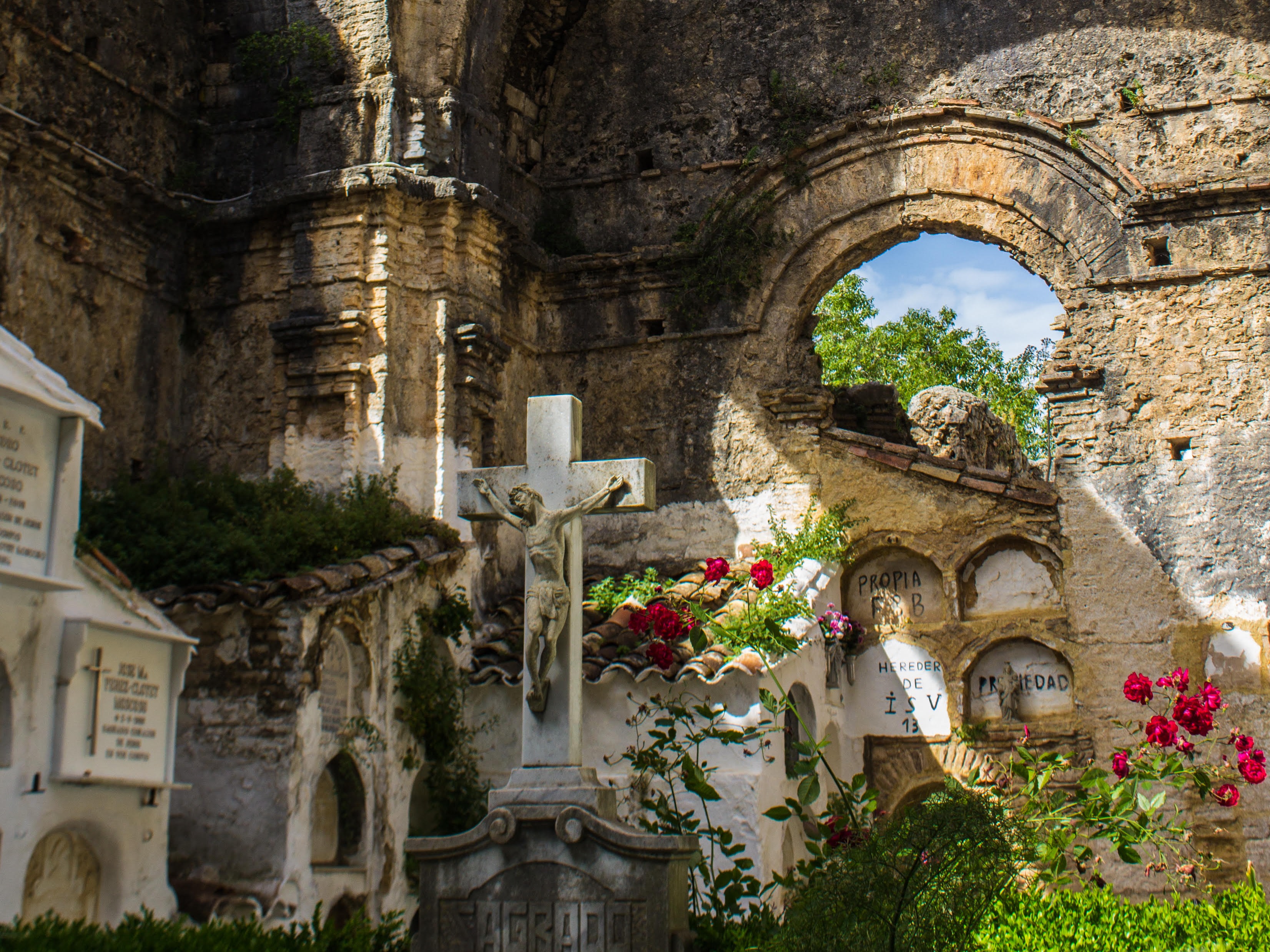
El Salvador Church and Cemetery is located in the upper part of Villaluenga del Rosario, the littlest village of the Province of Cádiz (Spain).

About the cemetery

El Salvador Cemetery is an ancient church of Villaluenga del Rosario that was burned by the Napoleonic army between 1809-1814. In Villaluenga there is even a proverb that says: “Villaluenga del Rosario no quiso capitular y llegaron los Franceses y quemaron el lugar.”

The people of Villaluenga were courageous and they refused to bow down to the Napoleonic army. They showed that there isn't an obstacle that can knock them down. So, they found another function for the church and converted it into a cemetery. They used every part of the church to build niches and now it can be seen in the irregular distribution of the walls. During their visit to the cemetery, people are still inside the ancient church, as its ancient tower, walls and the skeleton of the vault are still preserved.

The exact date in which El Salvador Church and Cemetery was built is still unknown. On the tower of the church, we can see some tiles engraved in 1722, the year of the restoration of this part of the church, so it would be built rather before.

In the cemetery, we can also find a mausoleum where the illustrious poet Pedro Pérez-Clotet was buried in 1966. Pérez-Clotet belongs to the Spanish 27th Generation which include poets such as Alberti, García Lorca, and Miguel Hernández, among others.

Address

Calle Torre 8
Villaluenga del Rosario 11611
Spain

Contacts

Email: ayuntamiento@villaluengadelrosario.es
Phone: (+34) 956460001
Website: www.villaluengadelrosario.es

Basic information

Year of first burial: 1830
Current area: 440 m2
Approximate number of graves: 1058