Showing posts with label location. Show all posts

St. Nicholas and St. Mary Cemetery (Berlin, Germany)

St. Nicholas and St. Mary Cemetery (Berlin, Germany)
St. Nicholas and St. Mary Cemetery is devided in the old and new part, named St. Nicholas and St. Mary Cemetery I and St. Nicholas and St. Mary Cemetery II.

About the cemetery

The St. Nicholas and St. Mary Cemetery I is located in Berlin's Prenzlauer Berg district of Pankow. It is right on the Prenzlauer Allee and is the final resting place for the parishioners of Mary and St. Nicholas' Church.

The opening of this cemetery dates back to the year 1802. At that time, however, the cemetery covered only a very small area, so that an extension was necessary already in 1814 and then again in 1847. This area is referred to as the Old Cemetery of St. Nicholas and St. Mary's church.

Another acquisition in 1858, covered the area of Prenzlauer Allee No. 7, which today is the St. Nicholas and St. Mary Cemetery II or the New Cemetery of St. Nicholas and St. Mary's church.

Together, the two cemeteries comprise an area of approximately 65,000 square meters.

Cemetery address

Prenzlauer Allee 1 / Prenzlauer Allee 7
10405 Berlin
Germany

Cemeteries at Hallesches Tor (Berlin, Germany)

Cemeteries at Hallesches Tor (Berlin, Germany)
This cemetery complex consists of six cemeteries that were established at the beginning of the 18th century, at that time still outside the city gates.

About the cemetery

The Cemeteries at Hallesches Tor can be traced back to 1735. In terms of its cultural history, it has become the most significant burial site in West Berlin.

Among the most beautiful works of art are the heads of two women by the “Art Nouveau” sculptor Ignatz Taschner. They decorate the gravestones of the landscape painter Karl Wilhelm Bennewitz von Loefen and his wife.

The area includes a total of twenty-two famous graves, among them the poets E.T.A. Hoffmann and Adelbert von Chamisso, the architects David Gilly and Georg Wenzeslaus von Knobelsdorff, the composer Jakob Ludwig Felix Mendelssohn Bartholdy, his sister Fanny Hensel, his parents and other family members and many others.

Cemetery address

Mehringdamm 21
10961 Berlin
Germany

Website

www.evfbs.de

Cemetery of the March Revolution (Berlin, Germany)

Cemetery of the March Revolution (Berlin, Germany)
The Cemetery of the March Revolution is a cemetery in the public park in the Berlin district of Friedrichshain.

About the cemetery

It was designed by the Berlin architect Ludwig Hoffmann in 1925 and it is the burial place and a memorial to the heroes and victims of the 1848 March Revolution and the November Revolution of 1918 in Berlin.

The Cemetery of the March Revolution was restored in 1948 when it acquired the name  Märzgefallenen, and again in 1957. Today in the cemetery you can find 18 grave plates, three iron grave crosses, a stele and two grave monuments made of cast iron.

Address

Friedhof der Märzgefallenen
Ernst-Zinna-Weg 1
10249 Berlin
Germany

Contacts

Memorial Site Friedhof der Märzgefallenen
Paul Singer e.V. (Office)
Strausberger Str. 39
10243 Berlin
Germany

Email: kontakt@paulsinger.de

Website: www.friedhof-der-maerzgefallenen.de

The Dorotheenstadt Cemetery (Berlin, Germany)

Dorotheenstadt Cemetery (Berlin, Germany)
The Dorotheenstadt Cemetery was established for the new Berlin parishes developing during the reign of Kaiser Friedrich the Great.

About the cemetery

The Dorotheenstadt Cemetery was founded in 1780 as the "Dorotheenstädtisch-Französischer Friedhof" (Dorotheenstadt French Cemetery) by the protestant French Huguenot community in Berlin.

It is certainly worth to visit because of the many illustrious personalities of German culture that lie buried here. On the tombstones are names such as Schinkel, Schadow, Fichte, Hegel, Dessau, Brecht and Weigel.

Furthermore, on the northern edge of the cemetery is located the house of German poet, playwrighter and theatre director Berthold Brecht (1898-1956) and his wife, actress Helene Weigel (1900-1972). They lived there from 1953 until their deaths. The house contains manuscripts, typescripts and collections of Brecht’s printed works.

Address

Chausseestraße 126
10115 Berlin

Contacts

Ev. Friedhofsverband Berlin Stadtmitte (Geschäftsstelle)
Südstern 8-10
10961 Berlin

Phone: (030) 612027-14
Email: info@evfbs.en

Website: www.evfbs.de

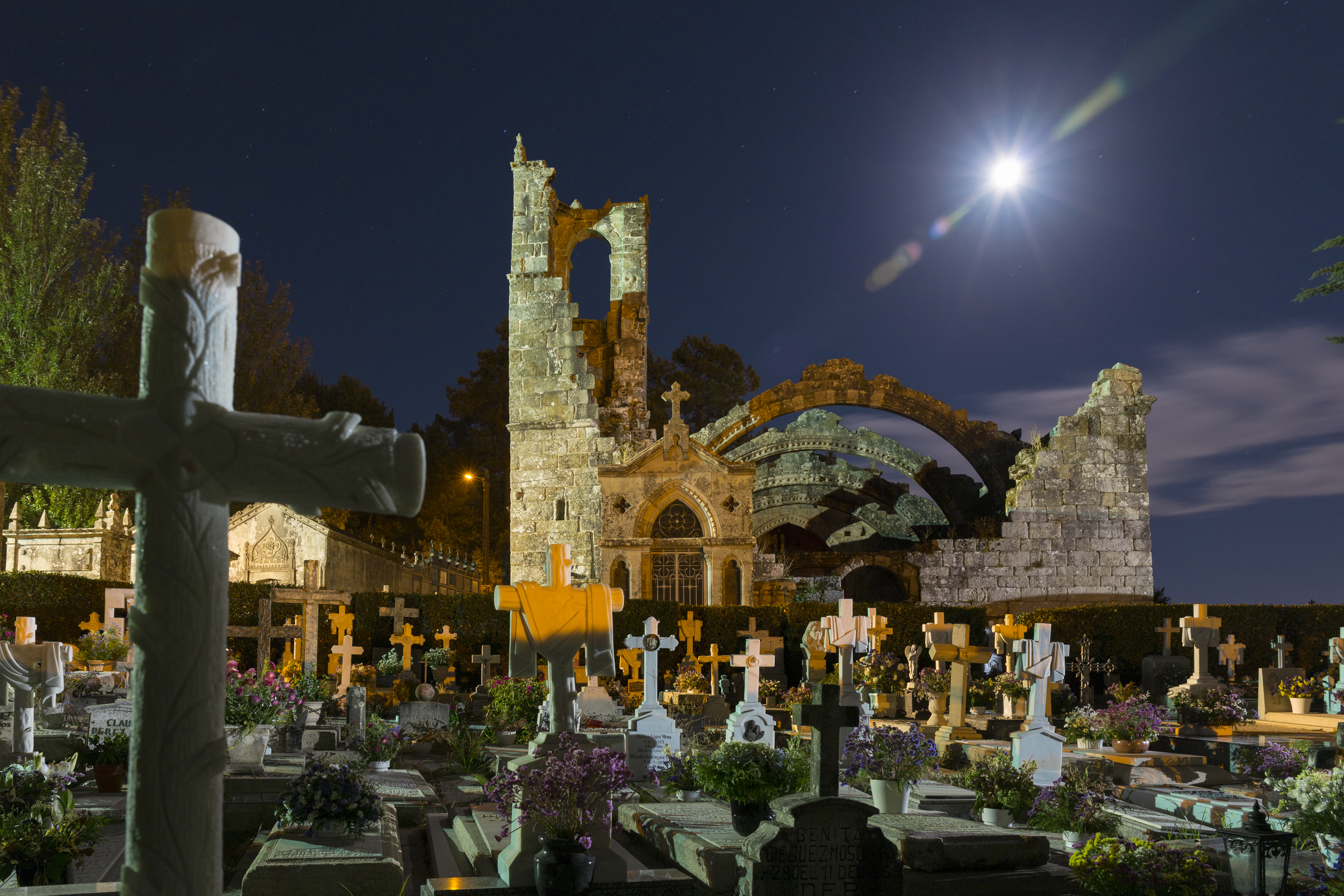
Santa Mariña Cemetery (Cambados, Spain)

Santa Mariña Cemetery (Cambados, Spain)
In 2014, the Ruins of Santa Mariña de Dozo were chosen as the third most important funerary monument in Spain.

About Cambados

The Ruins of Santa Mariña de Dozo are located in Cambados which is known for being a true outdoor museum carved in granite. It is one of the best preserved historic areas in Galicia due to the countless stately mansions, noble streets, monuments and sculptures.

Cambados was born from the merger of three historical villages, which maintained their authenticity: 

  • Fefiñáns, with a noble character;
  • Cambados, with its beautiful squares, streets and Saint Mariña Ruins;
  • and the sailor character of Saint Tomé.
This combination makes Cambados a unique place in Galicia.

The Ruins of Santa Mariña de Dozo

The Ruins of Santa Mariña de Dozo are located in the foothills of Mount a Pastora. In the environs of an old Castro, lie the remains of the old parish church of Saint Mariña, Cambados patroness. On a XII century Romanesque chapel, feudal lord Lope Sánchez de Ulloa built the church of Saint Mariña Dozo, restored and enlarged by his daughter María de Ulloa in the late XV century.

Sailor Gothic style and Renaissance features are also presented. The church comprises a single nave divided by four transverse Romanesque arches, five side chapels, sacristy and chapel. Inside, it should be noted, the decoration with balls on the arches and chapels. In one of these arces is represented one of the seven deadly sins, "laziness". In the chapels highlights embossed iconographies with Biblical scenes, such as visitation, Christ and the apostles, the expulsion from paradise or the deadly sins.

The church of Saint Mariña Dozo was abandoned for political and religious reasons in the XIX century, moving the parish church to the church of the former convent of Saint Francisco. Finally, it was used as a parish cemetery. Its remains were declared a National Monument in 1943 and nowadays home to "the world's most melancholic cemetery" in the words of Galician writer Alvaro Cunqueiro, big fan of the town.

Address

36630 Cambados,
Pontevedra,
Spain

Contacts

Phone: (+34) 986 520 786
Web: www.cambados.es
E-mail: turismo@cambados.es